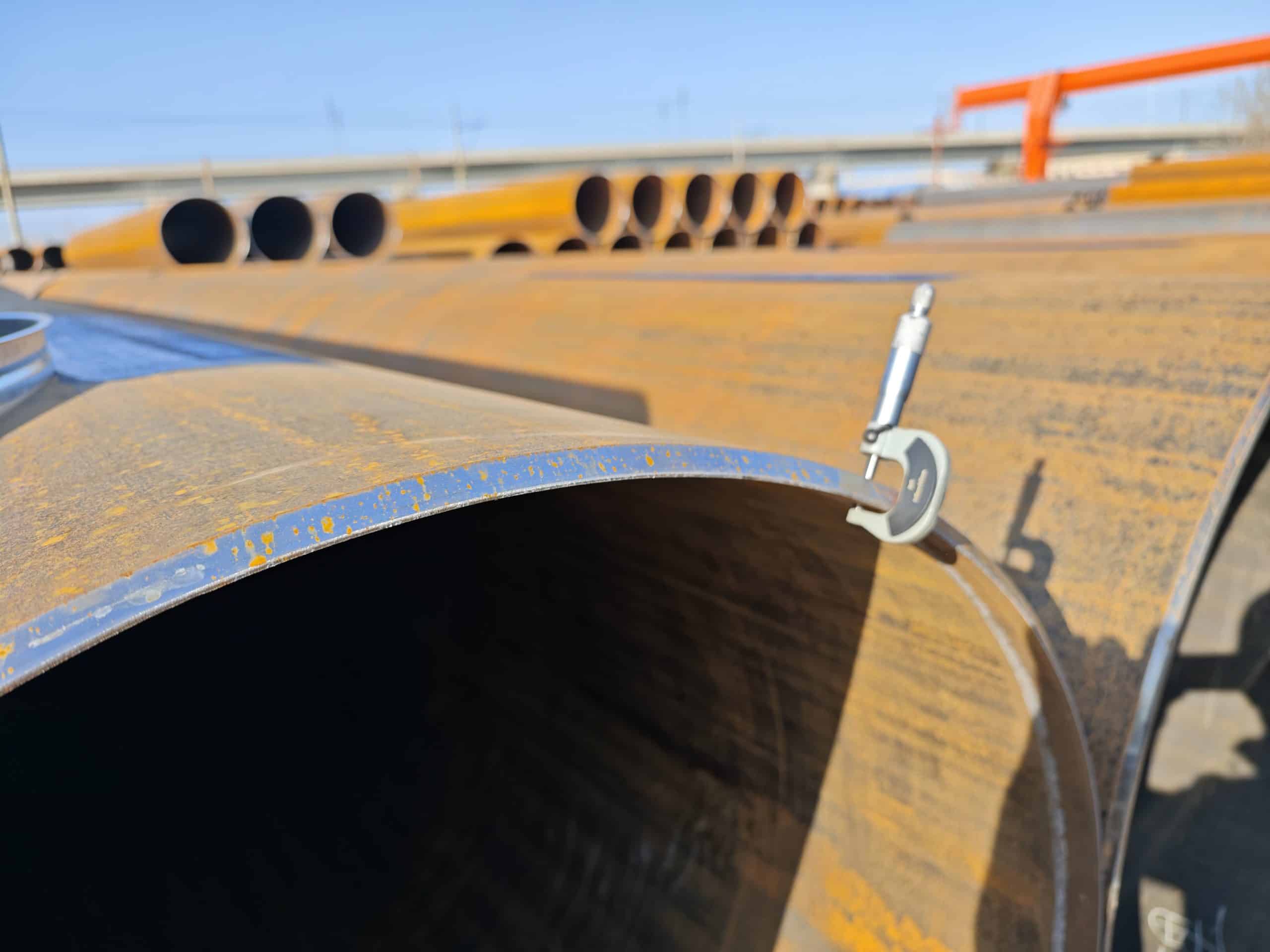
- 1. Overview of the ASTM A691 Inspection Standard System
- 2. Chemical Composition and Mechanical Property Testing
- 3. Detailed Explanation of Non-Destructive Testing (NDT) Methods
- 4. Heat Treatment and Process Verification (ASTM A691)
- 5. Procurement Risks and Quality Control Pain Points
- 6. LONGMA’s Quality Assurance System
- 7. Conclusion: Testing Determines Quality, Quality Ensures Safety
In the petroleum, natural gas, power, and chemical industries, high-temperature and high-pressure environments impose extremely stringent safety requirements on pipelines. As a critical standard for electric fusion welded (EFW) alloy steel pipes, ASTM A691 products demand rigorous controls not only in materials and manufacturing processes but also in their inspection systems. For purchasers, understanding the inspection standards and non-destructive testing (NDT) methods of ASTM A691 pipe is key to mitigating quality risks and ensuring project safety.
This article systematically analyzes the testing requirements for ASTM A691 steel pipes from the perspectives of the standard system, testing methods, implementation procedures, and quality control, while demonstrating LONGMA’s professional expertise in quality assurance.
Overview of the ASTM A691 Inspection Standard System
ASTM A691 applies to electric fusion welded (EFW) alloy steel pipes for high-temperature and high-pressure service. Its inspection requirements cover the following aspects:
- Chemical composition analysis
- Mechanical property testing
- Non-destructive testing (NDT)
- Heat treatment verification
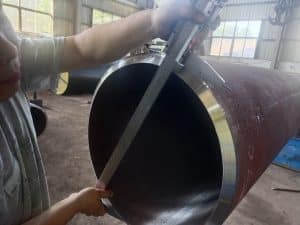
- Visual and dimensional inspection
Notably, high-grade products such as ASTM A691 CL32 are subject to stricter standard requirements, typically mandating 100% non-destructive testing.
Chemical Composition and Mechanical Property Testing
1.Chemical Composition Analysis (ASTM A751)
Purpose: To ensure materials meet specified compositional requirements
Applicable Grades: e.g., ASTM A691 Grade 2.1 4Cr Gr 32
Implementation Steps:
- Sampling from steel pipes or base metal
- Element content analysis using optical emission spectrometry (OES)
- Comparison against standard limits
For ASTM A691 Grade 2.1 4Cr, key elements such as Cr and Mo must be tightly controlled to guarantee high-temperature performance.
2. Mechanical Property Testing (ASTM A370)
| Test Item | Purpose | Key Indicators |
| Tensile Test | Determine strength | Tensile strength, yield strength |
| Elongation Test | Verify ductility | ≥18% |
| Impact Test | Verify toughness | Per project specifications |
All ASTM A691 pipes must meet minimum mechanical property requirements, particularly for high-temperature applications.
Detailed Explanation of Non-Destructive Testing (NDT) Methods
Non-destructive testing is one of the most critical quality control steps in the ASTM A691 standard, with even stricter requirements for the ASTM A691 CL32 grade.
1. Ultrasonic Testing (UT) — ASTM A435 / A578
Purpose: Detect internal flaws (e.g., inclusions, laminations)
Implementation Steps:
- Scan the pipe body with a probe
- Receive reflected wave signals
- Determine flaw location and size
👉 Advantage: Large testing depth, suitable for thick-walled ASTM A691 pipes
2.Radiographic Testing (RT) — ASTM E94 / E1032
Purpose: Detect internal weld flaws (porosity, incomplete penetration)
Implementation Process:
- Irradiate welds with X-rays or γ-rays
- Record flaws via imaging
- Evaluate flaw grades per standards
👉 For export projects (e.g., ASTM A691 pipes & tubes in Spain), 100% RT testing of welds is usually required.
3.Magnetic Particle Testing (MT) — ASTM E709
Purpose: Detect surface and near-surface cracks
Steps:
- Magnetize the workpiece
- Apply magnetic particles
- Observe magnetic particle indications
4. Penetrant Testing (PT) — ASTM E165
Applicable Scope: Non-magnetic materials or precision surface inspection
NDT Method Comparison Tabl
| Method | Testing Type | Applicable Parts | Advantages |
| UT | Internal flaws | Pipe body | Large testing depth |
| RT | Internal weld flaws | Welds | Intuitive imaging |
| MT | Surface cracks | Welds / Base metal | High sensitivity |
| PT | Surface flaws | Finished surfaces | Wide applicability |
Heat Treatment and Process Verification (ASTM A691)
The ASTM A691 standard mandates post-weld heat treatment:
- Normalizing
- Tempering
Testing Purposes:
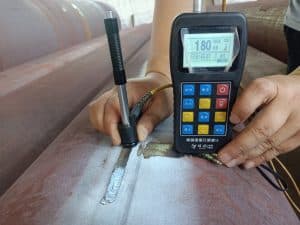
- Relieve welding residual stress
- Improve metallurgical structure
- Enhance high-temperature performance
For ASTM A691 Grade 2.1 4Cr Gr 32, heat treatment quality directly affects creep resistance.
Procurement Risks and Quality Control Pain Points
In practical procurement, customers often encounter the following issues:
❗ Incomplete Non-Destructive Testing
Failure to comply with CL32 standards, leading to potential weld defects.
❗ Unreliable Testing Reports
Lack of laboratory data support and non-traceability.
❗ Unstable Material Properties
Non-compliance with strict ASTM A691 standard requirements.
LONGMA’s Quality Assurance System
With over 20 years of experience in steel pipe manufacturing, LONGMA holds a leading edge in the production and testing of ASTM A691 pipes:
1.In-House Internal Laboratory
LONGMA is equipped with a full set of testing equipment:
- Optical emission spectrometer (ASTM A751)
- Universal tensile testing machine (ASTM A370)
- Impact testing machine
- Complete UT / RT / MT NDT equipment
👉 All ASTM A691 CL32 products undergo full-process testing with traceable data.
2. Strict Adherence to International Standards
Strict implementation in accordance with ASTM A691 and related standards ensures every ASTM A691 pipe meets project requirements.
3.Extensive Export Experience
Supplied ASTM A691 pipes & tubes for multiple European projects (e.g., Spain), complying with strict third-party inspection standards (SGS / BV).
4. Full-Process Quality Control
Rigorous control from raw materials → forming → welding → heat treatment → testing.
Conclusion: Testing Determines Quality, Quality Ensures Safety
For high-temperature and high-pressure systems, testing is not only a quality control measure but also the core of safety assurance. Strict compliance with all testing requirements in the ASTM A691 standard effectively prevents material failure and engineering risks.
In particular, high-end materials such as ASTM A691 Grade 2.1 4Cr rely heavily on testing and process control for their performance.
📩 Contact LONGMA for Professional Support
We can provide you with:
- Complete ASTM A691 inspection reports (MTC)
- Non-destructive testing scheme recommendations
- Customized project technical support
- Latest quotations (supporting the European market)
Choose LONGMA for safer and more reliable ASTM A691 pipe procurement!