- 1. Why Is Uniform Wall Thickness of Steel Pipes So Important?
- 2. How Do High-Speed Production Lines Affect Wall Thickness Stability?
- 3. Key Factors Affecting the Uniformity of Steel Pipe Wall Thickness
- 4. How Does the On-Line Inspection System Control Wall Thickness in Real Time?
- 5. How Does LONGMA’s In-House Laboratory Verify Steel Pipe Quality?
- 6. Ultrasonic Testing (UT)
- 7. X-Ray Testing (RT)
- 8. How Does Hydrostatic Testing Verify Wall Thickness Stability?
- 9. Why Do More and More International Customers Choose LONGMA?
- 10. Conclusion
In oil and gas transportation, offshore engineering, high-pressure boilers, and large-scale structural projects, the uniform wall thickness of steel pipes directly affects pressure resistance, welding stability, and long-term operational safety. For international buyers, excessive wall thickness deviation not only means unstable product quality but may also lead to on-site installation difficulties, pressure test failures, and even pipeline leakage risks in later stages.
Especially in projects involving API 5L steel pipes, LSAW steel pipes, and high-pressure steel pipes, many engineering accidents are not caused by insufficient material strength, but by local stress concentration resulting from uneven wall thickness of steel pipes.
Therefore, an increasing number of overseas EPC clients, when selecting a steel pipe manufacturer, are no longer only concerned about price, but pay more attention to:
- Stability of high-speed production lines
- Automated dimensional control capability
- On-line inspection systems
- In-house laboratory systems
- International standard implementation capabilities
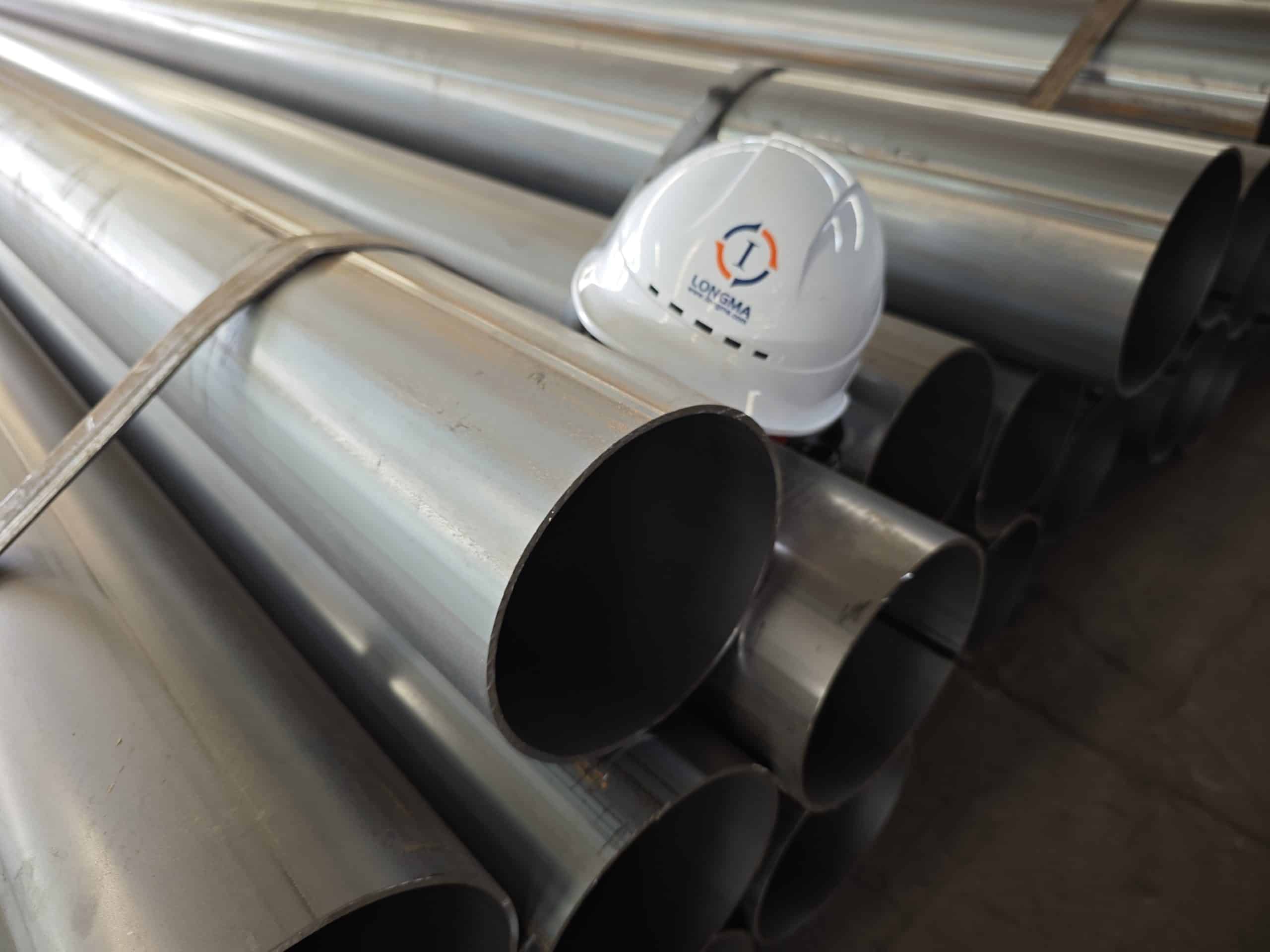
As a professional steel pipe supplier with over 20 years of industry experience, LONGMA provides global customers with more stable and reliable welded steel pipes and pipeline steel pipes through automated high-speed production lines, intelligent on-line inspection equipment, and a complete quality traceability system.
Why Is Uniform Wall Thickness of Steel Pipes So Important?
During the steel pipe manufacturing process, even if the average wall thickness of the steel pipe meets the standard, excessive local thickness fluctuations may still affect engineering safety.
Particularly in oil and gas pipeline projects, uneven wall thickness can easily lead to:
- Reduced local pressure resistance
- Stress concentration at welds
- Uneven stress on anti-corrosion coatings
- Fatigue crack propagation
- Hydrostatic test failures
For API 5L PSL2 projects, the control of steel pipe wall thickness even directly affects the results of third-party inspections.
Thus, the core of high-quality welded steel pipes is not only “meeting the wall thickness requirement” but more importantly “maintaining uniform wall thickness”.
How Do High-Speed Production Lines Affect Wall Thickness Stability?
Many buyers assume that:
The faster the production speed, the more prone to quality fluctuations.
In fact, modern automated high-speed production lines can precisely improve the consistency of steel pipe production through digital control.
LONGMA’s high-speed production lines achieve dynamic adjustment of steel pipe wall thickness through:
- Automatic roll pressing control
- Real-time dimensional feedback
- On-line laser thickness measurement
- Intelligent deviation correction systems
Compared with the traditional manual adjustment method, the automated system can more stably control:
- Outer diameter deviation
- Wall thickness fluctuation
- Ovality
- Weld gap
This is also an important reason why modern LSAW steel pipes are widely used in large-scale transportation projects.
Key Factors Affecting the Uniformity of Steel Pipe Wall Thickness
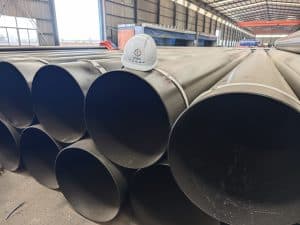
The stability of steel pipe wall thickness depends not only on a single piece of equipment, but on the collaborative control of the entire steel pipe manufacturing process.
- Stability of Raw Material Thickness
The first step in high-quality steel pipe production is stable steel plate quality.
LONGMA conducts the following inspections on steel coils and plates:
- Automatic thickness measurement
- Surface defect inspection
- Chemical composition analysis
- Width detection
If the thickness of raw materials fluctuates greatly, it is difficult to ensure the uniformity of the final pipeline steel pipes even with advanced subsequent equipment.
- Forming Process Control
In the production of welded steel pipes, the forming stage directly determines the wall thickness distribution.
Unstable roll pressing pressure can easily lead to:
- Local thinning
- Pipe body ovality
- Weld misalignment
LONGMA’s automatic forming system can adjust in real time:
- Roll gap pressure
- Forming angle
- Conveying speed
to improve the dimensional stability of API 5L steel pipes.
- Welding Heat Input Control
During the manufacturing of submerged arc welded pipes, welding heat input affects the local deformation of steel pipes.
Uneven heat input may result in:
- Thickening of the weld area
- Deformation of the heat-affected zone
- Out-of-round pipe body
Therefore, LONGMA adopts an automatic submerged arc welding (SAW) system to automatically control:
- Current
- Voltage
- Welding speed
- Wire feed rate
In accordance with ASME BPVC Section IX standards, welding process parameters must be strictly evaluated to ensure the long-term operational stability of welded steel pipes.
How Does the On-Line Inspection System Control Wall Thickness in Real Time?
One of the greatest advantages of modern high-speed steel pipe production is real-time on-line inspection.
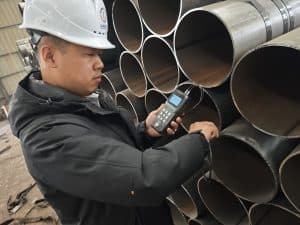
LONGMA’s on-line inspection system can continuously monitor:
| Inspection Item | Purpose |
| Wall Thickness Inspection | Control thickness deviation |
| Outer Diameter Inspection | Ensure dimensional consistency |
| Ovality Inspection | Reduce installation risks |
| Weld Tracking | Improve welding stability |
Compared with the traditional sampling inspection method, automated on-line inspection can detect problems in advance and automatically adjust equipment parameters.
For large-scale oil and gas pipeline projects, this real-time control capability can significantly reduce batch quality fluctuations.
How Does LONGMA’s In-House Laboratory Verify Steel Pipe Quality?
The real concerns of many international buyers are not:
“Whether the production line looks advanced”.
But:
- Are the inspection data authentic?
- Can the products pass third-party inspections?
- Is the wall thickness uniformity stable in the long term?
Therefore, LONGMA has established a complete in-house laboratory system to conduct full-process quality verification on welded steel pipes and API 5L steel pipes.
Ultrasonic Testing (UT)
UT testing is mainly used to detect:
- Laminations
- Cracks
- Lack of penetration
- Internal inclusions
In accordance with API 5L PSL2 and ISO 3183 requirements:
Welds are usually subject to 100% ultrasonic testing.
LONGMA’s automatic UT system can perform continuous scanning, improving inspection stability and reducing the risk of manual missed detection.
X-Ray Testing (RT)
RT testing is particularly critical in ASTM A671 and high-pressure steel pipe projects.
It is mainly used to inspect:
- Porosity
- Lack of fusion
- Weld cracks
LONGMA’s digital RT system can improve defect identification efficiency and establish complete quality traceability records.
How Does Hydrostatic Testing Verify Wall Thickness Stability?
Even if dimensional inspection is qualified, steel pipes still need to pass hydrostatic testing to verify actual pressure resistance.
In accordance with API 5L and ASTM A53 standards:
Export pipeline steel pipes usually require a Hydrostatic Test.
LONGMA’s automated hydrostatic system can record in real time:
- Test pressure
- Pressure holding time
- Leakage data
The more stable the wall thickness uniformity, the more reliable the performance of steel pipes in high-pressure tests usually is.
Why Do More and More International Customers Choose LONGMA?
In the global steel pipe supplier market, a truly reliable supplier needs not only production capacity but also:
- Automated high-speed production lines
- On-line dimensional inspection systems
- Complete in-house laboratories
- API 5L standard implementation capabilities
- Third-party inspection support
LONGMA supports:
- SGS inspection
- BV inspection
- TUV inspection
- Full-process quality traceability
helping overseas EPC clients reduce procurement risks and engineering rework costs.
Conclusion
The uniform wall thickness of steel pipes is not only a dimensional issue, but also directly related to the pressure resistance, welding stability, and long-term operational safety of pipeline steel pipes.
With the development of automated high-speed production lines and intelligent inspection technology, modern welded steel pipes have achieved a higher level of dimensional consistency and quality stability.
With over 20 years of steel pipe manufacturing experience, advanced automated production equipment, and a complete in-house laboratory system, LONGMA continues to provide global customers with high-quality solutions for API 5L steel pipes, LSAW steel pipes, and submerged arc welded pipes, helping customers reduce procurement risks and enhance engineering safety.