- 1. Step 1: Steel Material Selection – The Foundation of Pipe Quality
- 2. Step 2: Steel Plate Preparation and Cutting
- 3. Step 3: Steel Pipe Forming Process
- 4. Step 4: Automatic Welding Process
- 5. Step 5: Pipe Expansion and Straightening
- 6. Step 6: Heat Treatment Process
- 7. Step 7: Dimensional Inspection and Quality Control
- 8. Step 8: Non-Destructive Testing (NDT)
- 9. How Does LONGMA’s In-House Laboratory Ensure Product Reliability?
- 10. Why Do Global Customers Choose LONGMA?
- 11. Conclusion
In industries such as oil and gas transportation, offshore engineering, power generation, structural construction, and chemical processing, the quality of steel pipes directly impacts project safety and service life. However, many buyers only see the finished product and may not fully understand the rigorous manufacturing process behind a high-quality steel pipe.
In reality, every stage—from raw material selection to final delivery—affects the pipe’s strength, dimensional accuracy, weldability, and long-term performance. Therefore, choosing a steel pipe manufacturer with a comprehensive production system and robust quality control capabilities is critical.
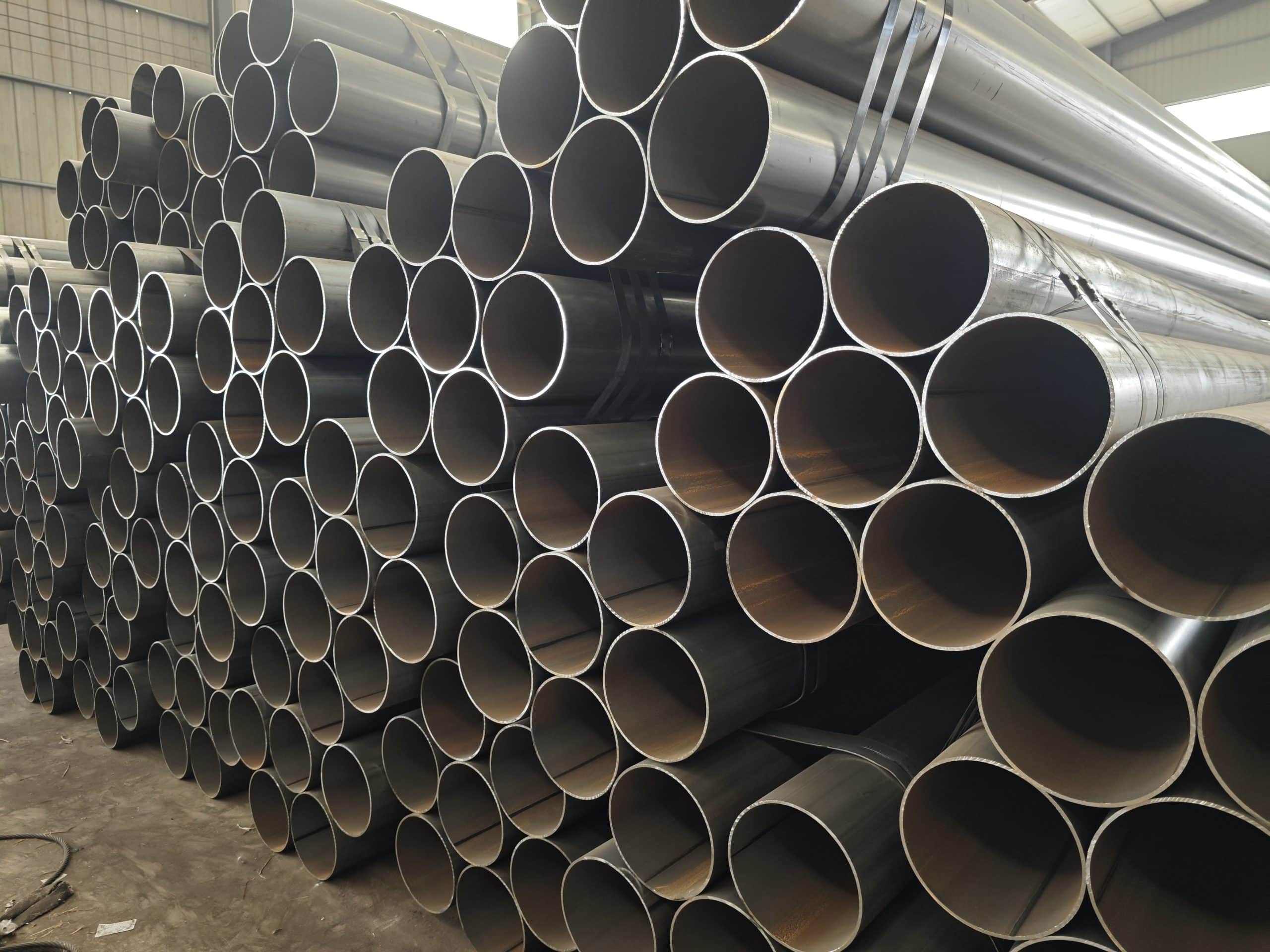
With more than 20 years of industry experience, LONGMA adheres to international manufacturing standards and provides high-quality API 5L steel pipes, LSAW steel pipes, and customized steel pipe solutions through advanced equipment, strict inspection procedures, and a comprehensive in-house laboratory system. This article provides a complete overview of the steel pipe manufacturing process and explains how LONGMA ensures consistent product quality.
Step 1: Steel Material Selection – The Foundation of Pipe Quality
The quality of a steel pipe begins with the quality of its raw materials.
For API 5L steel pipes and LSAW steel pipes, commonly used steel grades include:
| Steel Grade | Typical Application |
| X42 | Standard transmission pipelines |
| X52 | Medium-pressure transportation systems |
| X60 | Long-distance pipeline projects |
| X70 | High-pressure oil and gas transmission |
| X80 | Large-scale energy infrastructure projects |
LONGMA carefully selects steel plates from reputable domestic and international steel mills and performs rigorous incoming material inspections.
Inspection Items
- Chemical composition analysis
- Tensile testing
- Impact testing
- Ultrasonic examination
Applicable Standards
- API 5L Section 9
- ISO 3183
- ASTM A370
For buyers, unstable raw material quality is often the root cause of weld cracking, performance inconsistency, and reduced service life.
Step 2: Steel Plate Preparation and Cutting
Before entering the production line, steel plates undergo a series of preparation processes.
Main Operations
- Plate leveling
- Surface cleaning
- Edge milling
- Precision cutting
Objectives
To ensure:
- Proper plate flatness
- Accurate weld bevel dimensions
- Stable downstream forming quality
For large-diameter LSAW steel pipes, edge preparation accuracy directly affects weld quality.
LONGMA utilizes CNC edge-milling equipment to achieve high-precision bevel preparation and improved welding consistency.
Step 3: Steel Pipe Forming Process
Pipe forming is a critical stage that determines dimensional accuracy.
LONGMA primarily employs the internationally recognized JCOE forming process.
JCOE Process Flow
- J-forming
- C-forming
- O-forming
- Mechanical expansion
Compared with conventional forming methods, JCOE offers significant advantages:
| Item | JCOE Advantage |
| Roundness control | Higher precision |
| Stress distribution | More uniform |
| Weld stability | Improved |
| Large-diameter production | Better suitability |
As a result, JCOE technology has become a key standard in the production of premium LSAW steel pipes.
Step 4: Automatic Welding Process
Welding quality directly determines whether a steel pipe can meet high-pressure service requirements.
LONGMA utilizes Double Submerged Arc Welding (DSAW) technology.
Welding Characteristics
- Deep weld penetration
- Uniform weld profile
- Stable mechanical strength
- High automation level
Key Welding Parameters
| Parameter | Control Objective |
| Current | Stable output |
| Voltage | Precise control |
| Welding speed | Automatic adjustment |
| Heat input | Standardized management |
Applicable standards include:
- API 5L
- AWS D1.1
- ISO 17635
Through a digital welding management system, LONGMA achieves full traceability of weld quality throughout the production process.
Step 5: Pipe Expansion and Straightening
After welding, steel pipes undergo expansion and straightening processes.
Purpose of Expansion
- Improve roundness
- Reduce residual stress
- Enhance dimensional consistency
Purpose of Straightening
- Control straightness
- Improve installation performance
- Increase welding efficiency
For long-distance oil and gas pipeline projects, dimensional accuracy directly affects field construction efficiency.
Therefore, LONGMA utilizes automated expansion systems and multi-roll straightening equipment to ensure compliance with international standards.
Step 6: Heat Treatment Process
Heat treatment is essential for improving the overall performance of steel pipes.
Depending on product requirements, the following processes may be applied:
- Normalizing
- Quenching
- Tempering
Benefits of Heat Treatment
- Increased strength
- Improved toughness
- Relief of residual stress
- Enhanced low-temperature performance
For high-grade API 5L X70 and X80 steel pipes, heat treatment quality directly determines final mechanical properties.
Step 7: Dimensional Inspection and Quality Control
At LONGMA, dimensional inspection is integrated throughout the manufacturing process.
Inspection Items
| Inspection Type | Purpose |
| Outside Diameter (OD) Inspection | OD dimensional control |
| Wall Thickness Inspection | WT tolerance control |
| Length Inspection | Cut-to-length accuracy |
| Roundness Inspection | Ovality control |
| Straightness Inspection | Installation compatibility |
Inspection Equipment
- Laser diameter measurement systems
- Ultrasonic thickness gauges
- Automated dimensional scanning systems
These tools ensure that every steel pipe meets customer specifications.
Step 8: Non-Destructive Testing (NDT)
Non-destructive testing is a crucial component of LONGMA’s quality assurance system.
- Ultrasonic Testing (UT)
Standards
- ASTM E213
- ISO 10893-10
Detectable Defects
- Laminations
- Cracks
- Lack of fusion
- Radiographic Testing (RT)
Standards
- ASTM E94
- ISO 10893-7
Detectable Defects
- Porosity
- Slag inclusions
- Incomplete penetration
- Magnetic Particle Testing (MT)
Used to detect:
- Surface cracks
- Weld defects
Standard
- ASTM E709
Through 100% NDT inspection, LONGMA ensures that both internal and external pipe quality meet international project requirements.
How Does LONGMA’s In-House Laboratory Ensure Product Reliability?
For international buyers, production equipment alone is not enough. True manufacturing capability is demonstrated through laboratory expertise.
LONGMA has established a comprehensive in-house laboratory system.
1.Chemical Analysis Laboratory
Testing includes:
- Carbon (C)
- Manganese (Mn)
- Phosphorus (P)
- Sulfur (S)
- Alloying elements
2.Mechanical Testing Laboratory
Tests include:
- Yield strength
- Tensile strength
- Elongation
3.Metallurgical Laboratory
Analysis includes:
- Grain structure
- Heat-affected zones (HAZ)
- Weld microstructure
4.Non-Destructive Testing Center
Inspection methods include:
- UT
- RT
- MT
- PT
By integrating laboratory verification with production data, LONGMA achieves complete quality traceability throughout the manufacturing process.
Why Do Global Customers Choose LONGMA?
When sourcing steel pipes, buyers are typically concerned about:
- Product performance consistency
- Compliance with international standards
- Availability of complete inspection reports
- Long-term supply capability
After more than two decades of development, LONGMA has established a mature steel pipe manufacturing system featuring:
- API 5L compliant production
- Automated JCOE production lines
- Full-process quality control
- Comprehensive in-house laboratories
- Extensive international project experience
From steel selection to final delivery, every steel pipe undergoes rigorous inspection and validation.
Conclusion
A high-quality steel pipe is not the result of a single process. Rather, it is the outcome of carefully controlled raw materials, advanced forming technology, precision welding, optimized heat treatment, and a comprehensive quality management system.
As a professional steel pipe manufacturer with over 20 years of experience, LONGMA remains committed to international standards and delivers reliable API 5L steel pipes, LSAW steel pipes, and customized steel pipe solutions through advanced production equipment, strict inspection procedures, and a robust laboratory infrastructure.
If you are looking for a trusted steel pipe supplier, contact LONGMA today to obtain product catalogs, third-party inspection reports, project references, and the latest quotations. Together, we can build safer, more efficient, and more reliable engineering projects.