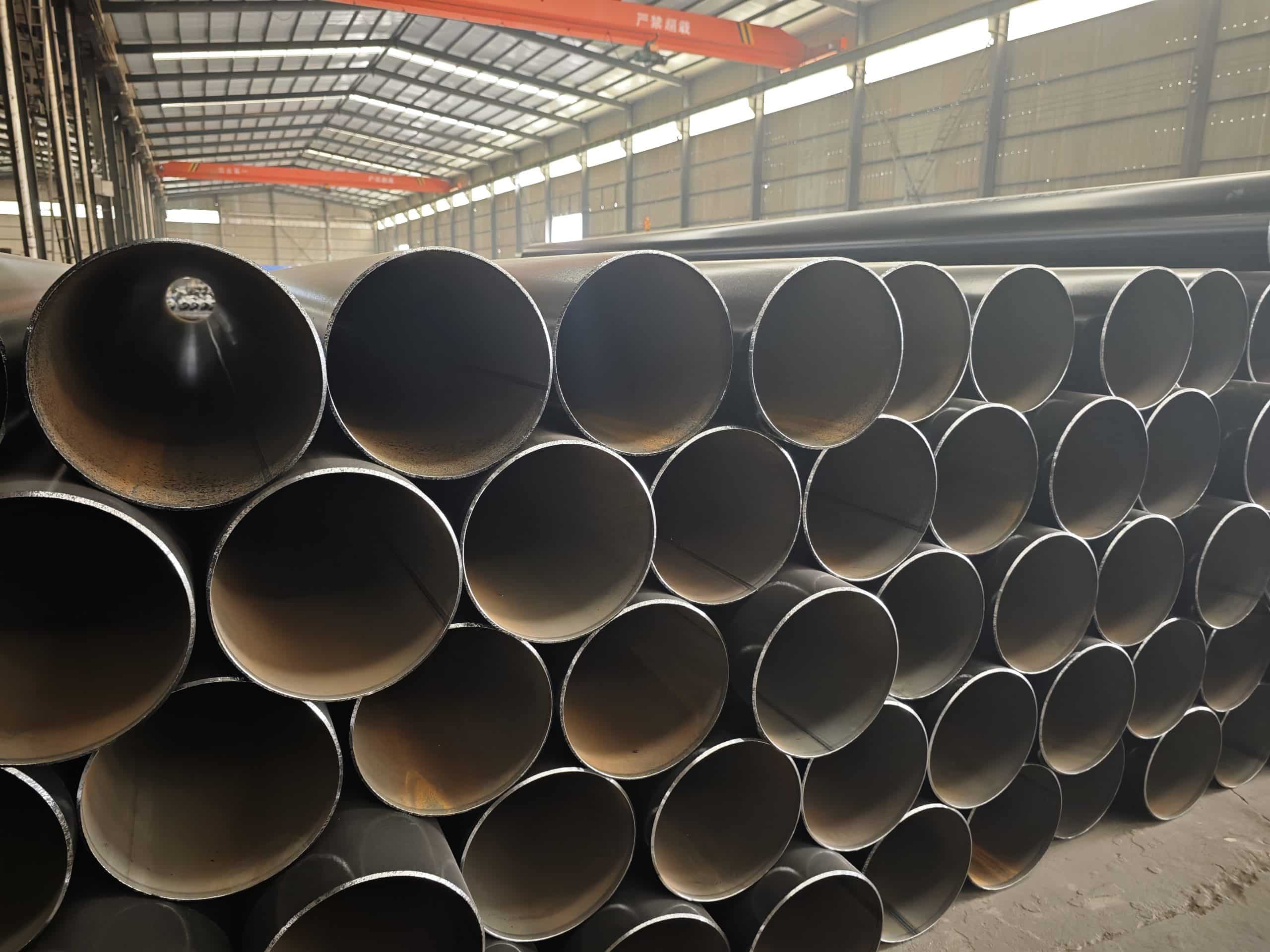
- 1. Why Does Heat Treatment Affect Steel Pipe Mechanical Properties?
- 2. Specific Effects of Heat Treatment on Mechanical Properties
- 3. Impact of the Straightening Process on Mechanical Properties
- 4. How Does LONGMA Verify Mechanical Performance?
- 5. How Does LONGMA’s Laboratory Reduce Procurement Risks?
- 6. Conclusion
In industries such as oil and gas transmission, offshore engineering, power generation, and large-scale infrastructure construction, the mechanical properties of steel pipes directly affect project safety and service life. For API 5L pipes, LSAW steel pipes, and large-diameter steel pipes, meeting dimensional requirements alone is far from sufficient. Yield strength, tensile strength, impact toughness, and residual stress levels are equally critical performance indicators.
In modern steel pipe manufacturing, heat treatment and straightening are two key processes that significantly influence mechanical properties. As a professional steel pipe manufacturer with more than 20 years of industry experience, LONGMA utilizes advanced heat treatment facilities, intelligent straightening systems, and a comprehensive quality control program to ensure every pipe meets international standards. This article explores how these processes affect steel pipe performance and how LONGMA minimizes procurement risks through strict process control.
Why Does Heat Treatment Affect Steel Pipe Mechanical Properties?
Heat treatment is a process that alters the internal microstructure of steel through controlled heating, soaking, and cooling.
For steel pipe manufacturing, common heat treatment methods include:
- Normalizing
- Tempering
- Quenching and Tempering (Q&T)
- Stress Relieving
The primary objective of heat treatment is to improve mechanical performance and microstructural uniformity.
Key Improvements Achieved Through Heat Treatment
| Property | Before Heat Treatment | After Heat Treatment |
| Yield Strength | Large variation | More stable |
| Tensile Strength | Inconsistent | Uniformly improved |
| Impact Toughness | Lower | Significantly enhanced |
| Residual Stress | High | Substantially reduced |
| Structural Uniformity | Moderate | Improved |
For high-grade pipeline steels such as API 5L X65, X70, and X80, proper heat treatment is essential for achieving required performance specifications.
Specific Effects of Heat Treatment on Mechanical Properties
- Improving Strength Performance
During welding and forming operations, microstructural inconsistencies can develop within the steel.
Normalizing treatment helps:
- Refine grain size
- Improve microstructural uniformity
- Stabilize yield strength
According to API 5L PSL2 requirements, high-grade pipeline steels must meet strict strength control ranges. A stable heat treatment process effectively reduces performance variation between production batches.
- Enhancing Low-Temperature Impact Toughness
For oil and gas transportation projects operating in cold regions such as:
- Canada
- Russia
- High-altitude areas of the Middle East
Steel pipes must maintain excellent low-temperature toughness.
Heat treatment optimizes the microstructure by:
- Reducing brittle phases
- Increasing crack propagation resistance
- Improving impact energy absorption
This is one reason why impact test results receive significant attention during international project inspections.
- Reducing Welding Residual Stress
The welding process generates substantial thermal stresses.
If these stresses remain within the pipe for extended periods, they may:
- Cause dimensional distortion
- Reduce fatigue life
- Increase cracking risks
Stress-relieving heat treatment can:
- Release internal stresses
- Improve dimensional stability
- Enhance long-term service reliability
Impact of the Straightening Process on Mechanical Properties
Many buyers assume that straightening only affects appearance and dimensional accuracy.
In reality, straightening also influences mechanical performance.
Primary Functions of Straightening
- Eliminating pipe curvature
- Improving straightness
- Adjusting residual stress distribution
- Enhancing dimensional consistency
- Residual Stress Redistribution
During straightening, steel pipes undergo slight plastic deformation.
Proper straightening helps:
- Balance internal stress fields
- Improve dimensional stability
- Reduce springback during transportation and installation
This is particularly important for large-diameter steel pipes.
- Risks of Excessive Straightening
Improper straightening parameters can introduce new defects.
| Issue | Potential Consequence |
| Excessive Pressure | Localized hardening |
| Excessive Deformation | Reduced toughness |
| Surface Indentation | Stress concentration |
| Dimensional Variation | Installation difficulties |
For this reason, advanced steel pipe production lines typically utilize automated CNC straightening systems.
LONGMA employs multi-roll CNC straightening equipment to achieve precise pressure control and consistent product quality.
How Does LONGMA Verify Mechanical Performance?
Advanced manufacturing processes must be validated through rigorous testing.
LONGMA has established a comprehensive in-house laboratory quality control system.
- Tensile Testing
Purpose
To verify:
- Yield strength
- Tensile strength
- Elongation
Testing Procedure
- Prepare standardized specimens
- Install specimens on a tensile testing machine
- Apply load according to applicable standards
- Record fracture data
Reference Standards
- ASTM A370
- ISO 6892-1
- API 5L PSL2
- Charpy Impact Testing
Purpose
To verify low-temperature toughness.
Testing Procedure
- Prepare V-notch specimens
- Control test temperature
- Conduct pendulum impact testing
- Record absorbed energy
Reference Standards
- ASTM A370
- ISO 148-1
- API 5L PSL2
This test is a critical acceptance requirement for many international oil and gas projects.
- Hardness Testing
Purpose
To evaluate heat treatment effectiveness.
Common Methods
- Rockwell Hardness
- Brinell Hardness
- Vickers Hardness
Reference Standards
- ASTM E10
- ASTM E18
- ISO 6506
Hardness analysis can identify:
- Insufficient heat treatment
- Localized hardening
- Abnormal microstructures
- Metallographic Analysis
Purpose
To examine the microstructure after heat treatment.
LONGMA Laboratory Equipment
Includes:
- Metallurgical microscopes
- Image analysis systems
- Automatic grading software
Inspection Items
- Grain size
- Pearlite content
- Weld microstructure
- Heat-affected zone (HAZ) microstructure
This ensures compliance with design and specification requirements.
- Non-Destructive Testing (NDT)
Mechanical performance can only be guaranteed when internal defects are absent.
Ultrasonic Testing (UT)
Reference Standards:
- API 5L Annex E
- ISO 10893-10
Detects:
- Lamination
- Cracks
- Inclusions
Radiographic Testing (RT)
Reference Standard:
- ISO 10893-7
Detects:
- Weld defects
- Lack of fusion
- Porosity
All inspection results are digitally archived and fully traceable throughout the production process.
How Does LONGMA’s Laboratory Reduce Procurement Risks?
For international buyers, the greatest risk is often not price but inconsistent product quality.
LONGMA maintains a complete laboratory testing system:
| Laboratory Equipment | Primary Function |
| Spectrometer | Chemical composition analysis |
| Tensile Testing Machine | Strength verification |
| Impact Testing Machine | Toughness verification |
| Metallurgical Microscope | Microstructure analysis |
| Ultrasonic Testing Equipment | Internal defect inspection |
| X-Ray Equipment | Weld quality verification |
This comprehensive quality control system, covering everything from raw materials to finished products, significantly improves product consistency and reliability.
Conclusion
Heat treatment and straightening are two critical processes that determine the final mechanical performance of steel pipes. Proper heat treatment improves strength and toughness while reducing residual stresses. Scientific straightening processes enhance dimensional stability and long-term service reliability. Together, these processes define the overall quality of the finished steel pipe.
For buyers, selecting a supplier equipped with advanced heat treatment facilities, intelligent straightening systems, and comprehensive laboratory verification capabilities is an effective way to minimize project risks. With more than 20 years of industry experience and strict quality management standards, LONGMA continues to provide reliable, high-quality steel pipe solutions for global energy, infrastructure, and industrial projects.