- 1. Why Is PWHT a Mandatory Step for High-Pressure Steel Pipe?
- 2. Five PWHT Process Types: Principles, Mechanical Effects, and Applicable Products
- 3. PWHT Effects on Four Key Mechanical Properties
- 4. Post-PWHT Quality Verification: Mechanical Testing System
- 5. NDT: Verifying Internal Weld Quality After PWHT
- 6. LONGMA In-House Laboratory: Full-Process PWHT Quality Assurance
- 7. PWHT-Capable Steel Pipe Supplier Evaluation Checklist
- 8. FAQ: Steel Pipe Post Weld Heat Treatment — Common Procurement Questions
- 9. About LONGMA: Welded Steel Pipe Supplier with Full PWHT Capability
Applications: Oil & Gas Pipelines · Pressure Vessels · Power Plant Boilers · Offshore Engineering · Large-Diameter Transmission Pipe
Post Weld Heat Treatment (PWHT) is one of the most critical process steps governing welded steel pipe joint quality and service life. In high-pressure, high-temperature, or cryogenic service environments, weld joints that have not received adequate heat treatment may suffer from excessive residual stress, out-of-spec hardness, or insufficient toughness — leading to stress corrosion cracking, delayed cracking, or fatigue failure that directly threatens pipeline safety.
This guide covers PWHT process principles, a comparison of five heat treatment methods, the effects on four key mechanical properties, NDT verification methods, and a supplier evaluation checklist — providing a complete technical reference to help EPC buyers and engineers identify and mitigate heat treatment risks at the procurement stage.
Why Is PWHT a Mandatory Step for High-Pressure Steel Pipe?
During welding, the weld zone undergoes rapid heating and cooling — generating the following problems that, if left unresolved, lead to serious consequences in service:
| Welding Problem | Root Cause | In-Service Consequence | Applicable Standard |
| Welding residual stress | Non-uniform cooling shrinkage of the weld | Stress corrosion cracking (SCC) | ASME BPVC / API 5L |
| Martensitic hardening | Excessive cooling rate | Hydrogen-induced cracking (HIC) / delayed cracking | NACE MR0175 |
| HAZ embrittlement | Grain coarsening; toughness reduction | Low-temperature brittle fracture; fatigue failure | API 5L PSL2 Charpy impact test |
| Weld distortion | Non-uniform heat input | Dimensional non-conformance; installation difficulties | API 5L Section 10 |
| Excess HAZ hardness | Quench hardening of the heat-affected zone | Sulfide stress corrosion (SSC) | NACE MR0175 (≤ 22 HRC) |
ASME, API, and ASTM standards all specify heat treatment requirements for certain categories of welded steel pipe, depending on steel grade, wall thickness, and service conditions. Failing to confirm PWHT requirements at the procurement stage is one of the most common risk oversights in high-pressure pipeline projects.
Five PWHT Process Types: Principles, Mechanical Effects, and Applicable Products
Different heat treatment methods address different performance deficiencies. Selection must be based on steel grade, wall thickness, and project specification:
| Heat Treatment Type | Primary Purpose | Effect on Mechanical Properties | Typical Applicable Products |
| Stress Relieving (SR) | Reduce welding residual stress | Improves dimensional stability; prevents SCC | LSAW pipe; medium-to-heavy-wall welded pipe |
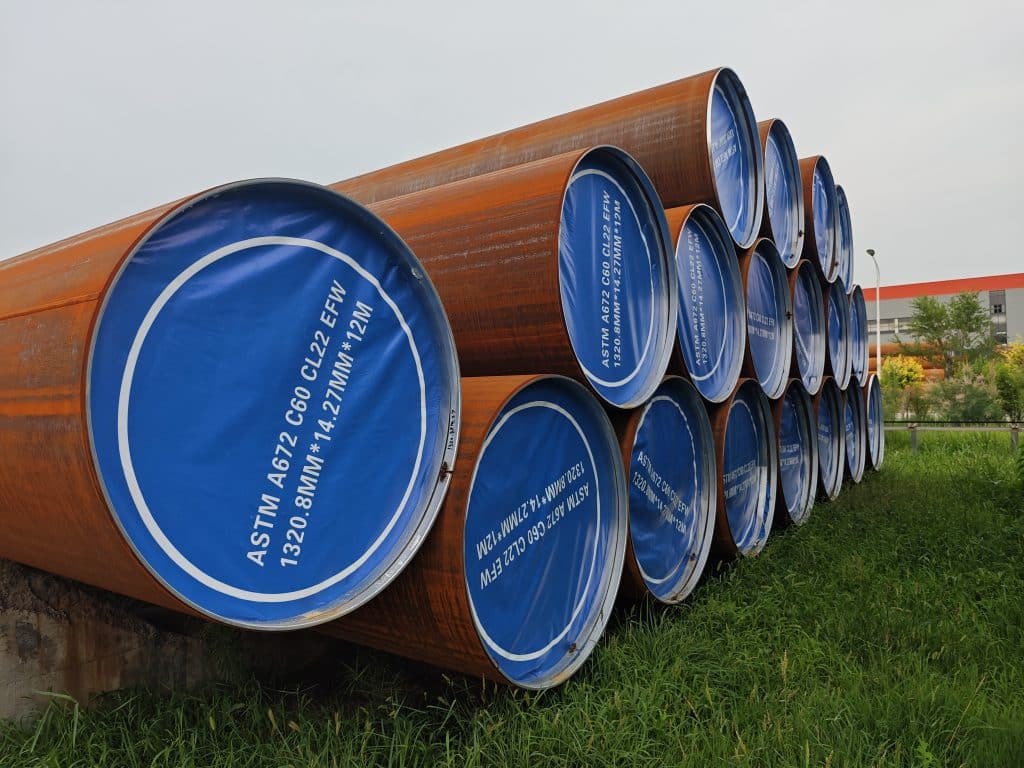
| Normalizing (N) | Refine grain structure; homogenize microstructure | Improves strength and low-temperature impact toughness | ASTM A672 / medium-to-high grade line pipe |
| Tempering (T) | Reduce HAZ hardness; improve ductility | Enhances toughness; prevents SSC | High-pressure pipe; H₂S-service pipe |
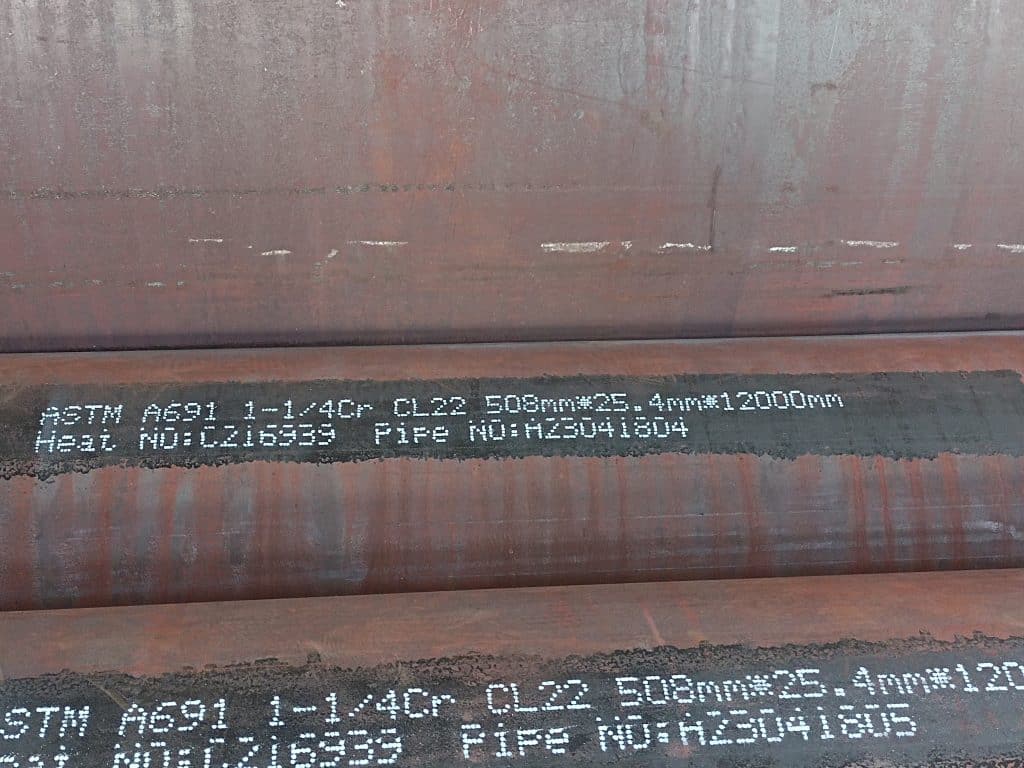
| Normalizing + Tempering (N+T) | Optimize strength-toughness balance | Achieves best combination of strength and toughness | ASTM A691 / X70 high-grade pipe |
| Solution Annealing | Dissolve carbide precipitates; restore corrosion resistance | Significantly improves corrosion resistance | Austenitic stainless steel pipe; duplex steel pipe |
💡 Properly executed PWHT can not only restore weld zone properties — it can bring welded joint performance to a level approaching or matching the base material. Heat treatment type must be explicitly written into the PO at the procurement stage via the applicable Class designation or project specification. It cannot be added retroactively after production.
PWHT Effects on Four Key Mechanical Properties
3.1 Yield Strength
After proper normalizing treatment, grain structure becomes more uniform, yield strength stabilizes, and material anisotropy is reduced. This is particularly important for high-grade line pipe such as API 5L X65 and X70 — these materials have tight heat treatment temperature windows, and deviations in either direction will affect whether the final yield strength meets the API 5L minimum requirement.
| Heat Treatment Type | Effect on Yield Strength | Key Risk |
| Normalizing | Stabilizes and homogenizes yield strength | Excessively high temperature may reduce strength below minimum |
| Stress Relieving | Slight reduction (typically < 5%) | Must still satisfy standard minimum yield requirement |
| Normalizing + Tempering | Slightly lower than normalized-only; toughness superior | Must verify compliance with API 5L specified minimum values |
3.2 Charpy Impact Toughness
Impact toughness is the mechanical property result that buyers pay the most attention to after PWHT — it directly determines whether the pipe can operate safely in low-temperature service conditions.
| Condition | Impact Energy Level | Low-Temperature Risk |
| As-welded (no PWHT) | Coarse grain structure; impact toughness significantly reduced | Highly susceptible to brittle fracture at low temperature |
| After stress relieving | Moderate improvement in toughness | Suitable only for ambient to moderate temperature service |
| After normalizing | Grain refinement; absorbed energy significantly increased | Can meet PSL2 low-temperature impact requirements |
| After normalizing + tempering | Best toughness; approaches base material level | Suited for LNG, arctic, and other demanding cryogenic service |
ASTM A672 requires that products of different grades undergo impact testing per the purchase agreement. The test temperature and minimum absorbed energy requirement must be explicitly stated in the purchase document.
3.3 HAZ Hardness
The heat-affected zone (HAZ) is typically the highest-hardness location in the entire pipe. Excessive hardness not only affects machinability but introduces hydrogen-induced cracking and sulfide stress corrosion (SSC) risk:
| Hardness Condition | Risk | Applicable Standard / Limit |
| HAZ hardness excessive (> 22 HRC) | High risk of HIC and SSC | NACE MR0175 / ISO 15156: ≤ 22 HRC |
| After tempering | Hardness reduced; SSC risk significantly lower | Suited for H₂S-containing or acidic media service |
| After normalizing + tempering | Uniform hardness; HAZ approaches base material | Meets demanding corrosive service requirements |
3.4 Tensile Strength and Ductility
PWHT eliminates microstructural defects and reduces stress concentration — improving both the overall load-carrying capacity and bending adaptability of the weld joint:
| Property Dimension | Before PWHT | After PWHT | Verification Standard |
| Tensile Strength | Potential localized low-strength zones in weld | Approaches base material; uniform and stable | ASTM A370 tensile test |
| Elongation | Reduced ductility in weld zone | Improved plastic deformation capability in weld zone | ASTM A370 elongation requirement |
| Bend Performance | Prone to cracking at the weld zone | Bend acceptance rate significantly improved | ASTM A370 guided bend test |
Post-PWHT Quality Verification: Mechanical Testing System
After PWHT is completed, systematic testing is mandatory to verify that heat treatment has achieved its intended effect. The following tests are required by international standards:
| Test Item | Purpose | Reference Standard | Key Focus |
| Tensile Test | Verify yield strength, tensile strength, elongation | ASTM A370 | Does it meet the minimum requirements for the steel grade? |
| Charpy Impact Test | Verify low-temperature toughness | ASTM A370 / ISO 148-1 | Test temperature and minimum absorbed energy value |
| Hardness Test (Brinell / Rockwell) | Prevent HAZ over-hardness causing SSC/HIC | ASTM E10 / ASTM E384 | Typically must not exceed 22 HRC |
| Metallographic Examination | Observe grain morphology and microstructural changes | ASTM E3 / ASTM E407 | Grain size rating and microstructural uniformity |
| Guided Bend Test | Verify weld plastic deformation capability | ASTM A370 | Bend angle and crack evaluation criteria |
| PWHT Record | Demonstrate that process parameters complied with specification | Project WPS / heat treatment procedure card | Full temperature–time curve automatically recorded |
⚠️ PWHT records (temperature–time curves) are the most commonly overlooked document in procurement acceptance. A supplier who cannot provide heat treatment records cannot demonstrate that PWHT was executed per specification. Always require this document explicitly in the PO.
NDT: Verifying Internal Weld Quality After PWHT
Once PWHT is complete, visual inspection alone cannot assess internal weld condition. The following four NDT methods must be applied in combination:
| NDT Method | Purpose | Defects Detectable | Key Standards |
| Ultrasonic Testing (UT) | Detect internal weld and pipe body defects | Incomplete penetration, cracks, laminations, slag inclusions | ASTM E164 / ISO 17640 |
| Radiographic Testing (RT) | Obtain image record of weld interior | Porosity, lack of fusion, cracking | ASTM E1032 / ISO 17636-1 |
| Magnetic Particle Testing (MT) | Detect surface and near-surface defects | Surface cracks, undercut | ASTM E709 / ISO 17638 |
| Liquid Penetrant Testing (PT) | Detect open surface defects | Micro-cracks, pinholes (non-magnetic materials) | ASTM E1417 / ISO 3452 |
💡 For high-pressure pipelines and H₂S-corrosive service environments, it is strongly recommended to perform 100% UT + RT on all weld seams after PWHT completion — to confirm that the heat treatment process itself has not introduced new internal defects such as heat treatment cracks.
LONGMA In-House Laboratory: Full-Process PWHT Quality Assurance
A manufacturer with a comprehensive in-house laboratory delivers better batch-to-batch consistency and quality traceability than one relying solely on third-party testing. LONGMA’s laboratory covers all critical inspection points before and after PWHT:
| Inspection Stage | Items Inspected | Purpose |
| Incoming Raw Material | Chemical composition (OES) / PMI / mechanical properties | Confirm carbon equivalent and weldability; determine preheat or PWHT requirements |
| During Welding | Welding parameter records / preheat temperature / interpass temperature | Prevent HAZ hardening and cold cracking |
| During PWHT | Automatic temperature–time curve recording (PLC) | Demonstrate that heat treatment parameters fully comply with WPS and project specification |
| After PWHT | Tensile / impact / hardness / metallographic / bend / UT / RT | Comprehensive verification of heat treatment effectiveness and weld integrity |
| Document Archiving | EN 10204 3.1 MTC / NDT reports / PWHT records | Supports third-party acceptance, project audit, and export customs clearance |
LONGMA supports on-site witnessing by SGS, BV, TÜV, DNV, and other third-party inspection agencies, and can provide EN 10204 3.1 / 3.2 Mill Test Certificates. PWHT process records are fully cross-referenced to pipe heat numbers and MTC documents.
PWHT-Capable Steel Pipe Supplier Evaluation Checklist
The evaluation dimensions below can be used directly for RFQ drafting and supplier qualification assessment:
| Evaluation Item | Recommended Requirement | How to Verify |
| Heat treatment equipment | Automatic temperature control with PLC full-process temperature recording | Request equipment list and sample historical temperature records |
| PWHT procedure execution | Executed per ASME / API / ASTM standards; supported by qualified WPS | Request WPS/PQR documents |
| Mechanical testing capability | Full coverage: tensile / impact / hardness / metallographic / bend | Request historical test reports |
| NDT capability | UT + RT + MT + PT — all four methods available | Review equipment list and sample NDT reports |
| In-house laboratory | Independent laboratory covering full PWHT pre/post inspection scope | Factory audit or third-party assessment |
| MTC documentation | EN 10204 3.1; includes heat treatment records | Request sample MTC and temperature–time curves |
| Third-party inspection | SGS / BV / TÜV / DNV available for witnessing | Name inspection body and hold points in PO |
| Project track record | Oil & gas / power / offshore large-scale projects | Request reference project list |
FAQ: Steel Pipe Post Weld Heat Treatment — Common Procurement Questions
Q1: Is PWHT mandatory for all welded steel pipe?
No — not all welded pipe requires PWHT. Whether it is needed depends on steel grade, wall thickness, carbon equivalent (CE), and service conditions. PWHT is typically required in the following situations: wall thickness exceeds the threshold specified by the applicable code (e.g. ASME B31.3); high-temperature or low-temperature service; H₂S-containing corrosive media; high-grade requirements such as API 5L PSL2 or ASTM A672. PWHT requirements must be clearly stated in the purchase specification at the procurement stage to avoid disputes after production.
Q2: Will PWHT reduce the strength of the steel pipe?
Properly executed PWHT will not cause the product to fall below standard minimum strength requirements. Stress relieving may cause a slight reduction in yield strength (typically < 5%), but normalizing or normalizing + tempering generally improves both strength and toughness simultaneously. The critical requirement is that the heat treatment procedure must be qualified through WPS/PQR and executed strictly within the specified temperature–time window.
Q3: What documents should I require when purchasing PWHT steel pipe?
A complete PWHT pipe procurement document set should include: ① EN 10204 3.1 MTC with chemical composition and mechanical properties; ② PWHT temperature–time curve records; ③ WPS/PQR welding procedure qualification documents; ④ tensile / impact / hardness / metallographic test reports; ⑤ NDT reports (UT / RT); ⑥ dimensional inspection report. If any of these six documents is missing, the quality traceability system is incomplete.
Q4: What is the relationship between carbon equivalent (CE) and preheat / PWHT requirements?
Carbon equivalent is the primary index for assessing steel weldability and determining whether preheat is required. The higher the CE value, the greater the cold cracking risk during welding — typically requiring higher preheat temperatures and more stringent PWHT requirements. API 5L PSL2 specifies explicit CE upper limits for each steel grade; these must be verified on the MTC. Pipe with a CE value above the limit may appear acceptable on external inspection but carries a latent weldability risk.
Q5: How can I verify that a supplier genuinely has PWHT capability?
Verify from the following angles: ① Request the heat treatment furnace equipment specification and PLC temperature control system description; ② Request sample historical PWHT temperature–time curve records; ③ Confirm that WPS/PQR documents include heat treatment process parameters; ④ Request post-PWHT Charpy impact test reports including the test temperature and energy values; ⑤ Arrange a factory audit or on-site witnessing of the PWHT process by SGS, BV, or TÜV — this is the most direct and reliable verification method.
About LONGMA: Welded Steel Pipe Supplier with Full PWHT Capability
LONGMA has over 20 years of experience manufacturing ERW and LSAW steel pipe. Our PWHT capability covers the full range of heat treatment processes — stress relieving, normalizing, tempering, and normalizing + tempering:
▸ Multi-standard certification: API 5L (PSL1/PSL2) / ASTM A672 / ASTM A691 / ISO 3183 — PWHT executed per qualified WPS/PQR
▸ Automated heat treatment furnaces with PLC full-process temperature recording; temperature–time curves supplied alongside MTC
▸ In-house laboratory: tensile / low-temperature impact / hardness / metallographic / bend / UT / RT — complete coverage
▸ EN 10204 3.1 Mill Test Certificates; PWHT records fully cross-referenced to pipe heat numbers throughout the supply chain
▸ Third-party inspection support: SGS / BV / TÜV / DNV — on-site PWHT process witnessing and factory audit available
▸ Large-diameter LSAW heavy-wall pipe PWHT capability, covering API 5L X52 through X70 steel grades
If you are sourcing steel pipe that requires PWHT, or have technical questions about post weld heat treatment, contact LONGMA for: PWHT process plan · historical test reports · specification confirmation · project quotation.