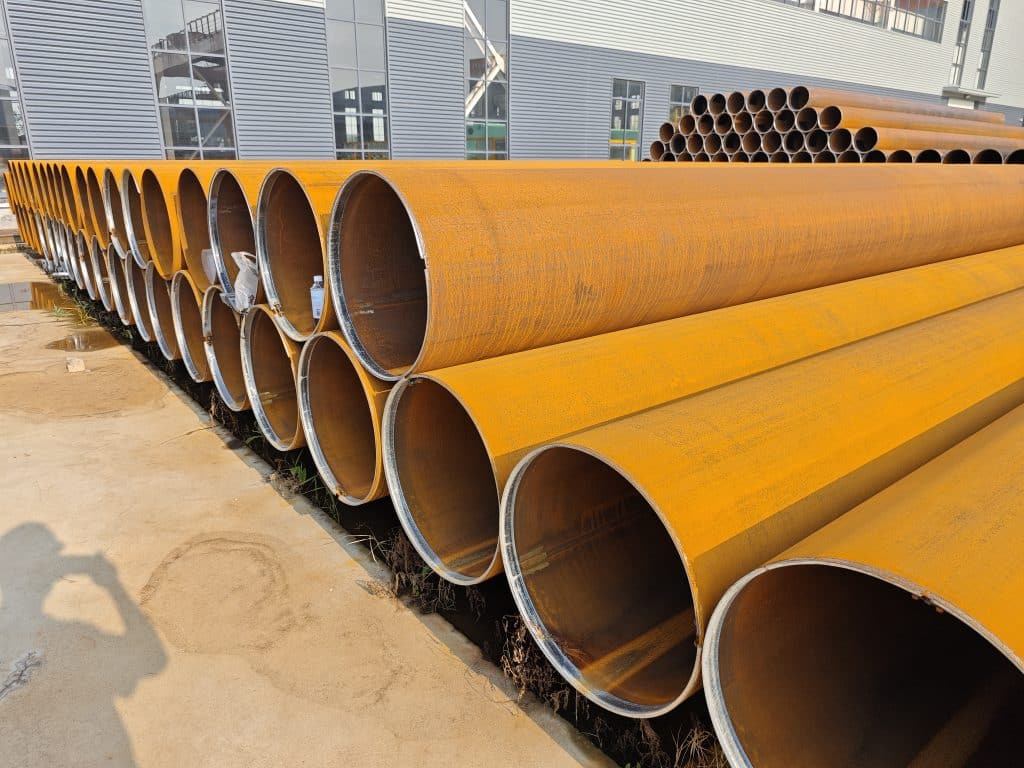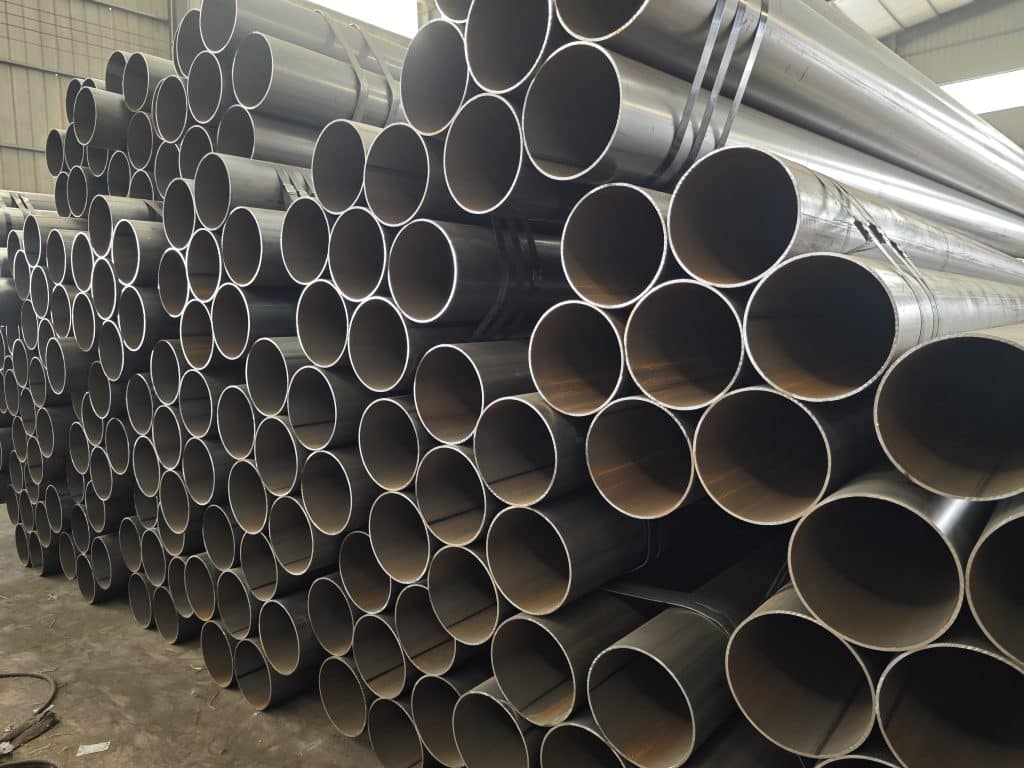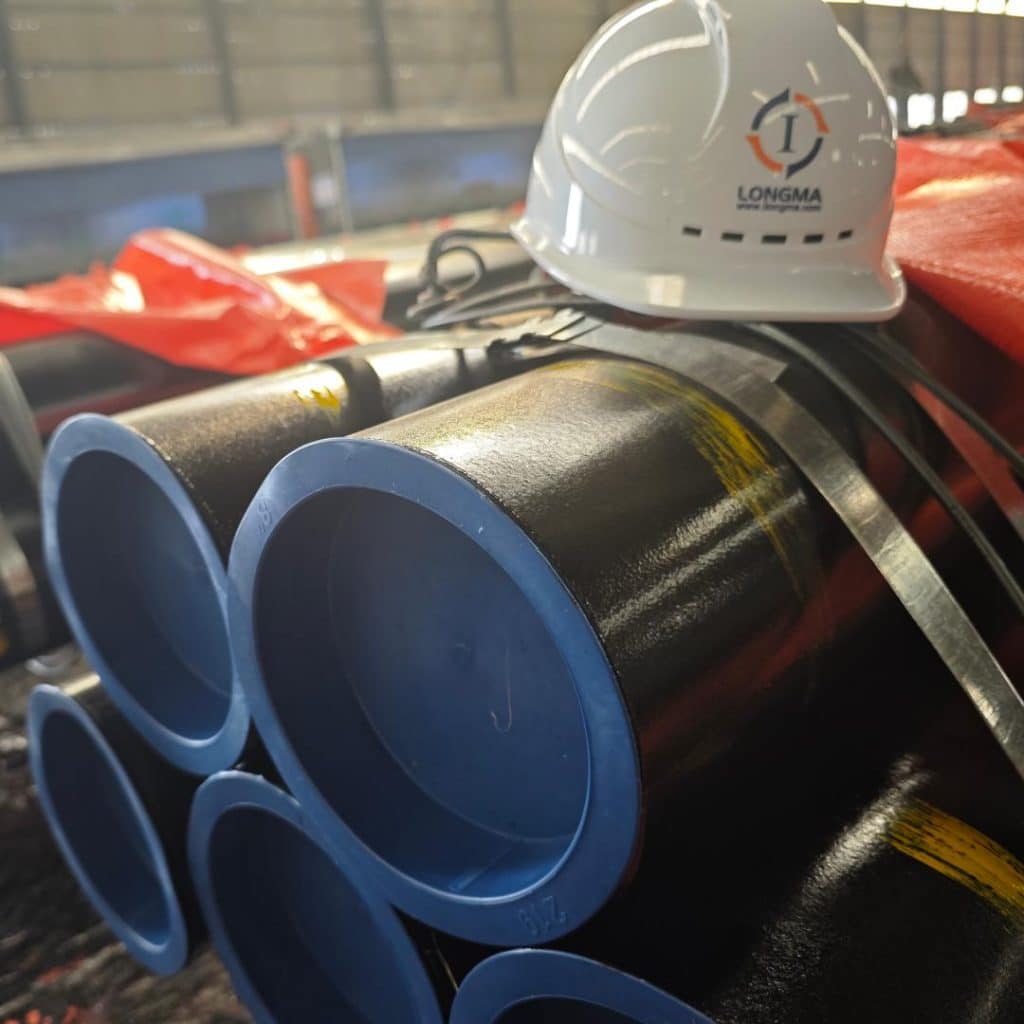
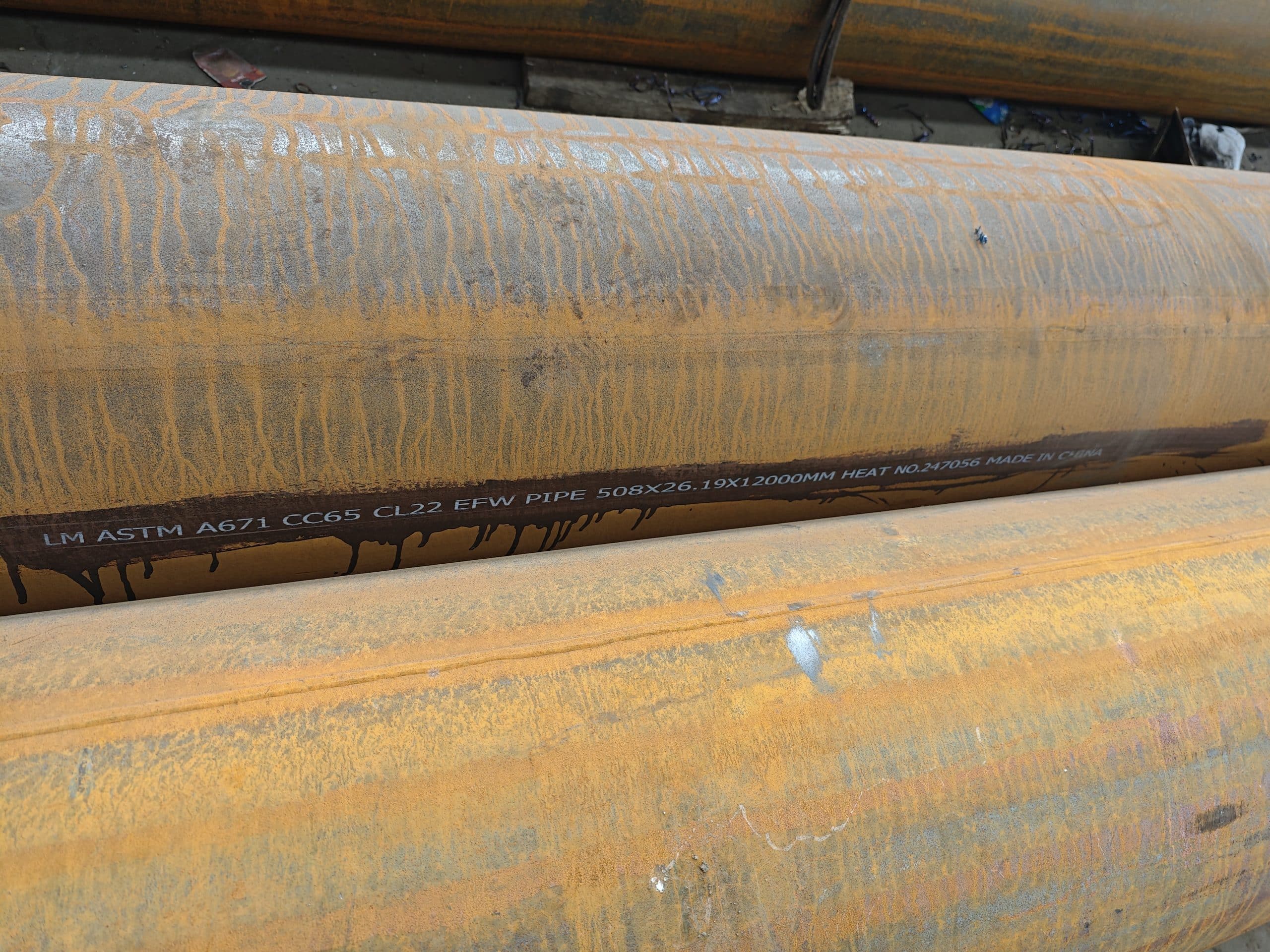
In pressure-sensitive applications such as petrochemical plants, LNG terminals, and power generating facilities, specifying the correct pipe standard can be the difference between a successful project and a costly failure. ASTM A671 pipe is an electric-fusion-welded (EFW) steel pipe manufactured from pressure-vessel-grade steel plate for atmospheric and low-temperature service. It is produced to ASTM A671/A671M with full-penetration welds, and is available in grades such as CC60, CC65, CC70, CD70, CFA65 and CFE70.
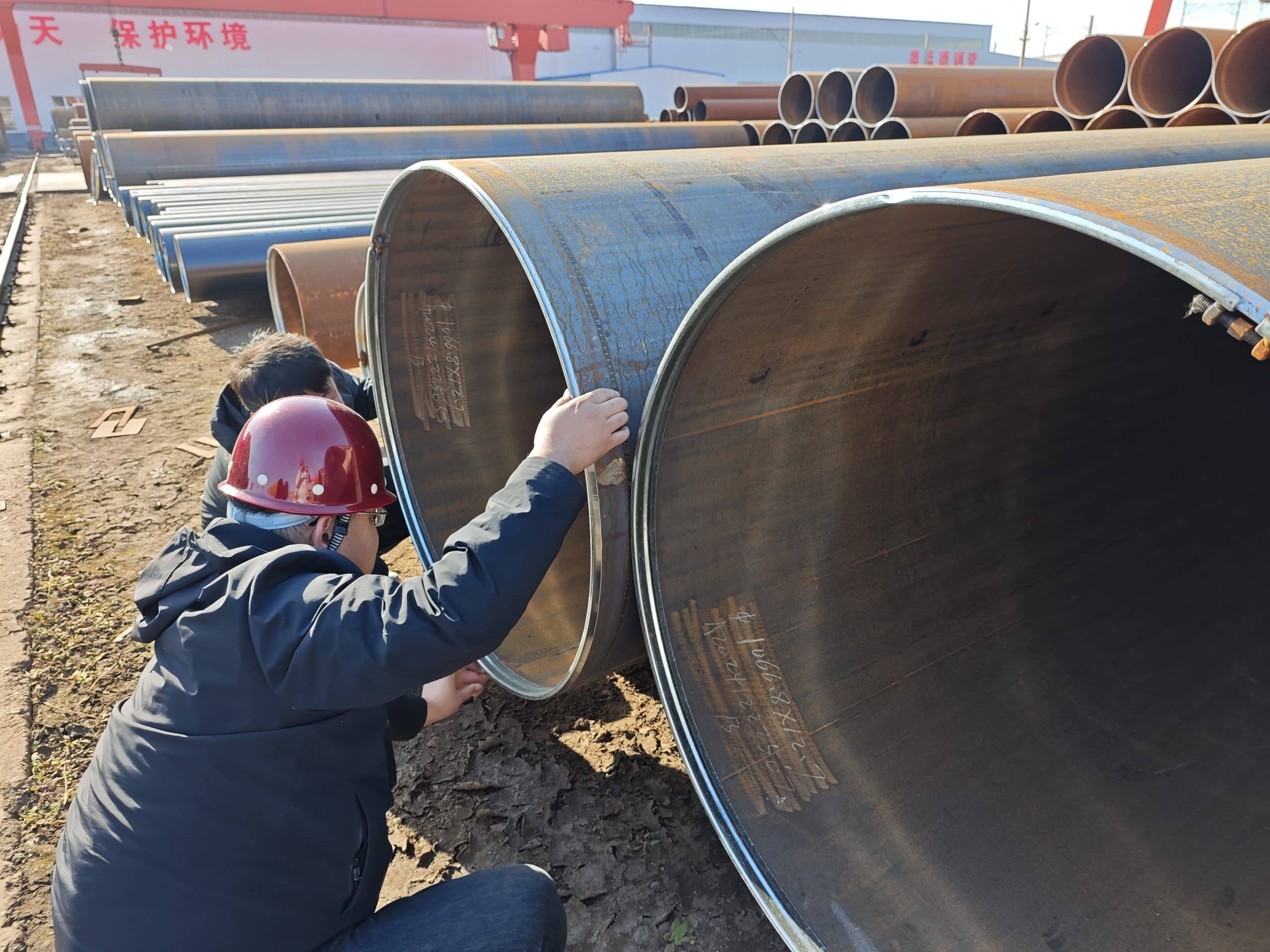
ASTM A671 Pipe: Specifications and Standards
Manufacturing Method and Common Grades
The ASTM A671 pipe standard covers electric-fusion-welded pipe made from pressure-vessel-grade steel plate. It differs from ASTM A106, which covers seamless pipe, and ASTM A53, which covers electric-resistance-welded pipe. A671 is intended for applications requiring large diameters and exceptional weld quality: the steel plate is rolled into a cylinder, and the longitudinal seam is joined by electric fusion welding so that the weld achieves complete penetration and can sustain high internal pressures.
A671 is commonly compared with ASTM A672. Both cover EFW pipe, but A671 is intended for service at room and lower temperatures, while A672 is intended for moderate temperatures and higher pressures. This distinction helps purchasing teams select the correct specification based on the temperature range and pressure rating in the project’s material requirements.
The grades are named after the pressure-vessel plate used in manufacture, with chemistry regulated within roughly the following ranges: carbon 0.27–0.31%, manganese 0.85–1.20%, phosphorus and sulfur below 0.035%, and silicon 0.15–0.40% for deoxidation and strength.
- Grade CC (based on A516 Grade 60/65/70): Offers good toughness at low temperature through carbon-manganese chemistry. CC60 has a minimum tensile strength of 60 ksi, and CC70 reaches 70 ksi.
- Grade CD (enhanced low-temperature A516 chemistry): Formulated for low-temperature and cryogenic applications. Controlled chemistry helps avoid brittle failure in LNG plants and cold-climate systems.
Mechanical Properties, Heat Treatment, and Dimensional Tolerances
The grade number (60, 65, 70) in an ASTM A671 pipe designation indicates the minimum tensile strength in ksi. Actual tensile and yield values are governed by the specified plate material — for example, ASTM A516 Grade 60/65/70 — with CC60 having a minimum yield strength of 220 MPa and CC70 a minimum yield strength of 260 MPa. These properties provide adequate safety margins for design-pressure calculations using the appropriate allowable stress values.
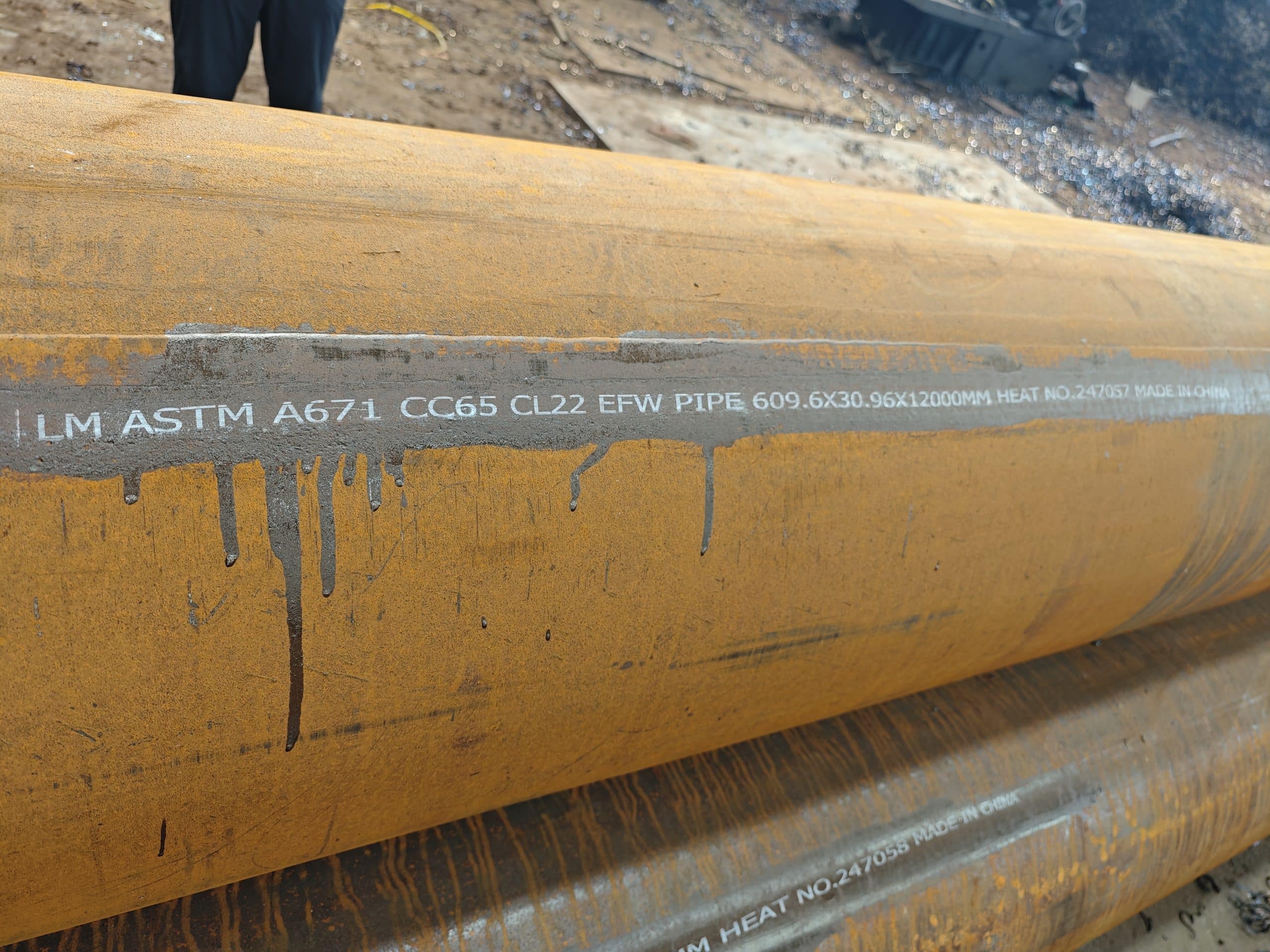
The required mechanical properties are achieved through heat treatment. Normalizing — heating the pipe above the upper critical temperature and air-cooling it — refines the grain structure and increases toughness. Stress relieving, a subcritical treatment, reduces residual stresses left by forming and welding, improving dimensional stability. The Class number determines the heat treatment and extent of testing applied: for example, Class 22 denotes stress-relieved pipe with 100% radiography of longitudinal welds, allowing a weld joint efficiency factor of 1.0 in pressure design calculations.
ASTM A671 covers large-diameter pipe: outside diameters of 406 mm (16 inches) and above, with wall thicknesses of 6 mm (1/4 inch) and above. These are minimum parameters defined by the standard, with no specified upper limit. Outer-diameter tolerance is ±1% for pipe under 508 mm and ±0.75% for larger pipe; wall-thickness under-tolerance is limited to 12.5%. Standard manufacturing lengths run up to 12 m, minimizing the need for field welds.
Manufacturing Process and Quality Assurance of ASTM A671 Pipe
Raw Material Qualification and Forming/Welding Technology
The first step is sourcing pressure-vessel-grade steel plate to ASTM A516 or comparable specifications from recognized mills. For every plate, mill test certificates (MTCs) detailing chemical composition, mechanical properties and heat-number tracking are reviewed so that each pipe can be traced back to its source steel batch. Suppliers also perform ultrasonic testing of plate surfaces to check for laminations, inclusions and grain-size uniformity, providing upstream controls that keep defects from reaching the finished pipe.
A multi-roll plate-bending machine forms the flat plate into a cylinder, with the process controlled to keep work hardening within limits and maintain dimensional accuracy. Edges are beveled by milling or plasma cutting to ensure complete weld fusion. Electric fusion welding uses submerged arc welding to achieve full-penetration longitudinal seams, and automated welding systems maintain consistent heat input, travel speed and electrode position, producing a uniform weld bead with minimal distortion. Post-weld conditioning smooths the reinforcement and removes the bead, leaving a surface suitable for radiography and ultrasonic examination. Together, these shaping, welding and inspection stages give ASTM A671 pipe its required mechanical properties and dimensional tolerances.
Testing Protocols, Certification, and Documentation
Quality assurance goes beyond the minimum specification requirements:
| Test | What It Verifies |
| Non-Destructive Testing (NDT) | Radiographic testing (RT) per class requirements detects internal flaws such as porosity, slag inclusions or partial fusion. Ultrasonic testing (UT) provides volumetric examination, particularly useful for thick walls. |
| Hydrostatic Pressure Testing | Each pipe is tested at the required pressure for a minimum holding time, with automated monitoring recording the parameters for customer and regulatory review. |
| Mechanical Testing | Tensile samples verify strength, Charpy V-notch impact tests confirm low-temperature toughness, and guided bend tests check weld ductility. |
| Dimensional Inspection | Statistical process control monitors outside diameter, wall thickness, length and ovality throughout production. |
Documentation is a significant deliverable for multinational EPC projects. Suppliers should provide certified material test certificates signed by authorized inspectors, covering chemical analysis, mechanical test data, heat-treatment records and NDT reports, ideally co-signed by an independent body such as SGS, Bureau Veritas or TÜV for third-party verification. Each pipe should carry an identification number linked to its manufacturing history — plate heat number, welding process specification (WPS), welder ID, inspection reports and test certificates.
Comparing ASTM A671 Pipe with Other Pipe Standards
ASTM A53 is a general-purpose specification covering electric-resistance-welded and furnace-butt-welded pipe for moderate-temperature and pressure service. It is typically used for smaller diameters — generally under 508 mm — and its wall-thickness limits constrain its pressure capability. The EFW construction of ASTM A671 supports large diameters with heavy walls for high-pressure process systems, and pressure-vessel-grade plate offers better mechanical properties and toughness than typical carbon steel pipe. A53 costs less and suits utility pipelines; A671 offers a lower failure rate and low-temperature capability in conditions where standard carbon steel would become brittle.
The Class designation lets procurement teams select the appropriate heat-treatment level:
| Class | Heat Treatment and Examination | Typical Application |
| Class 10 | No post-weld thermal processing | Atmospheric tank connections where residual stresses are acceptable |
| Class 12 | Normalizing to improve toughness and refine grain structure | Moderate-pressure process lines |
| Class 22 | Stress relieving with full radiographic examination; residual stresses below 30% of yield strength | Critical pressure service with maximum allowable stress in design |
| Class 32 | Normalizing with radiographic testing | Cyclic loading or low-temperature service |
With appropriate coatings and linings for corrosion protection, carbon-steel A671 pipe performs effectively at a significantly lower material cost than stainless alloys. Applications with high chloride content or low pH typically call for stainless steel instead, but for large diameters, carbon steel remains considerably more economical — a 12 m ASTM A671 pipe with a 762 mm OD is roughly a third of the price of an equivalent stainless pipe. With suitable coatings and cathodic protection, carbon steel can achieve a comparable service life to stainless steel at a lower cost.
Procurement Guide: Buying ASTM A671 Pipe for Your Business
Supplier Selection, Pricing, and Lead Times
Key qualification criteria include ISO 9001 quality management certification, ASME U-stamp licensing for pressure-vessel work, production capability such as heavy plate-bending equipment, automated welding and calibrated NDT equipment, and a track record of reference projects in your industry.
Pricing depends on grade and class, diameter and wall thickness, order quantity and testing requirements. CC70 is a higher-strength grade than CC60 and costs more. Class 22 costs 8–12% more than Class 10, and Class 32 costs a further 15–20% more. Volume discounts typically apply at order quantities of 100, 500 and 1,000 tons. Standard RT adds roughly 5–8% to the base price, and a full EPC testing program requires a contingency budget of 10–15%. Lead times typically break down as 4–6 weeks for plate procurement, 2–4 weeks for manufacturing, 1–2 weeks for testing, and 2–8 weeks for shipping — for a total delivery time of roughly 8 weeks for stock materials to 14 weeks for made-to-order materials.
Customization, Logistics, and Documentation
Value-added customization includes custom lengths up to 12 meters to eliminate field welds, factory-applied bevels to the applicable welding standard, coating and lining systems such as epoxy, FBE or 3LPE, and special testing such as hardness surveys or impact testing at temperatures below the specification minimums. Cross-border procurement requires clear Incoterms (FOB or CIF), correct HS code classification (7305.11 for line pipe, 7305.19 for other welded pipe), export license verification, and a complete documentation package covering mill test certificates, inspection reports, welding logs and traceability records.
Conclusion
Choosing the correct pipe material affects project safety, performance and cost. ASTM A671 pipe has a strong track record in pressure-critical applications across the petrochemical, power generation, LNG and broader industrial sectors. Manufactured from pressure-vessel-grade plate with electric fusion welding, it meets demanding mechanical and toughness requirements. Class and grade selection lets engineers match specifications to service conditions ranging from room-temperature water transfer to cryogenic LNG handling. Successful procurement depends on carefully evaluating a manufacturer’s capabilities, specification details and quality-assurance methods — reliable suppliers back their pipe with thorough testing, record-keeping and certification systems that confirm materials meet regulatory requirements.
FAQ
1. What is the main difference between ASTM A671 and ASTM A53 pipe?
The main difference lies in manufacturing method and intended service. ASTM A671 pipe is electric-fusion-welded from pressure-vessel-quality steel plate for atmospheric and low-temperature service, in large diameters per the standard’s requirements. ASTM A53 covers welded and seamless pipe for mechanical and pressure applications at moderate temperatures, usually in smaller diameters with standard carbon-steel properties. Because A671 grades offer greater toughness and strength than A53 grades, A671 is typically specified for critical process piping in power plants, pipelines and petrochemical facilities.
2. What does the Class designation mean for ASTM A671 pipe?
The Class number defines the post-weld heat treatment and nondestructive examination level. Class 10 receives no post-weld heat treatment. Class 22 is stress-relieved with radiographic testing per class requirements, giving a weld joint efficiency of 1.0. Class 32 is normalized with radiographic and hydrostatic testing, providing strong toughness for low-temperature or cyclic service.
3. Can ASTM A671 pipe handle cryogenic temperatures?
Yes, within defined limits. Grade CD and CF pipe is impact-tested per Supplementary Requirement S2 at purchaser-specified temperatures, providing a safety margin for LNG service down to -162°C. Selection depends on the minimum design metal temperature and the governing project codes; Charpy V-notch impact tests verify toughness at the required service temperature.
4. How do I verify the quality and traceability of supplied pipe?
Request the mill test report and confirm the heat number, chemical analysis, and tensile and impact test data against ASTM limits. Check that RT and UT records show the correct examination methods and acceptance standards. Ask for certified material test certificates, or 3.2 certificates co-signed by a third-party inspector, and verify that each pipe’s marking traces back to its steel-plate heat number.
Partner with LONGMA for ASTM A671 Pipe Solutions
LONGMA has supplied electric-fusion-welded pipe to oil and gas, petrochemical, and power generation projects worldwide since 2003, with clients including SINOPEC, CNPC, PEMEX, and PTTEP. Manufacturing takes place at a 230,000-square-meter factory with annual output exceeding 500,000 tons of ASTM A671 pipe, covering grades CC60 through CFE70 in large diameters and wall thicknesses from 6 mm upward. Every pipe undergoes radiographic and ultrasonic testing per class and supplementary requirements, hydrostatic pressure testing per class requirements, and full material traceability from heat number to steel-mill certification. Certified material test certificates and 3.2 mill test results are available, along with custom lengths, bevel ends, and third-party inspection by SGS, Bureau Veritas, or TÜV. Stock pipe ships within seven days; custom orders deliver in 45 days. Contact our team at info@ilongma.com to discuss your piping requirements or request technical data sheets.