- 1. API 5L Pipe Grades X42 vs X52
- 2. Production and Quality Parameters Affecting X42 and X52 Pipes
- 3. Application Areas and Performance Suitability
- 4. Comparative Analysis X42 vs X52 and Other Related Grades
- 5. Procurement Requirements for X42 and X52 Pipe
- 6. Conclusion
- 7. FAQ
- 8. Partner with LONGMA for API 5L X42 and X52 Pipe
API 5L X52 has a higher minimum strength than X42. In the API 5L 46th-edition SI tables, X42 has minimum yield and tensile strengths of 290 MPa and 415 MPa, while X52 has 360 MPa and 460 MPa, subject to applicable notes. The choice affects pressure-design calculations and potential wall economy, but grade alone does not determine pressure rating, weldability or sour-service suitability.
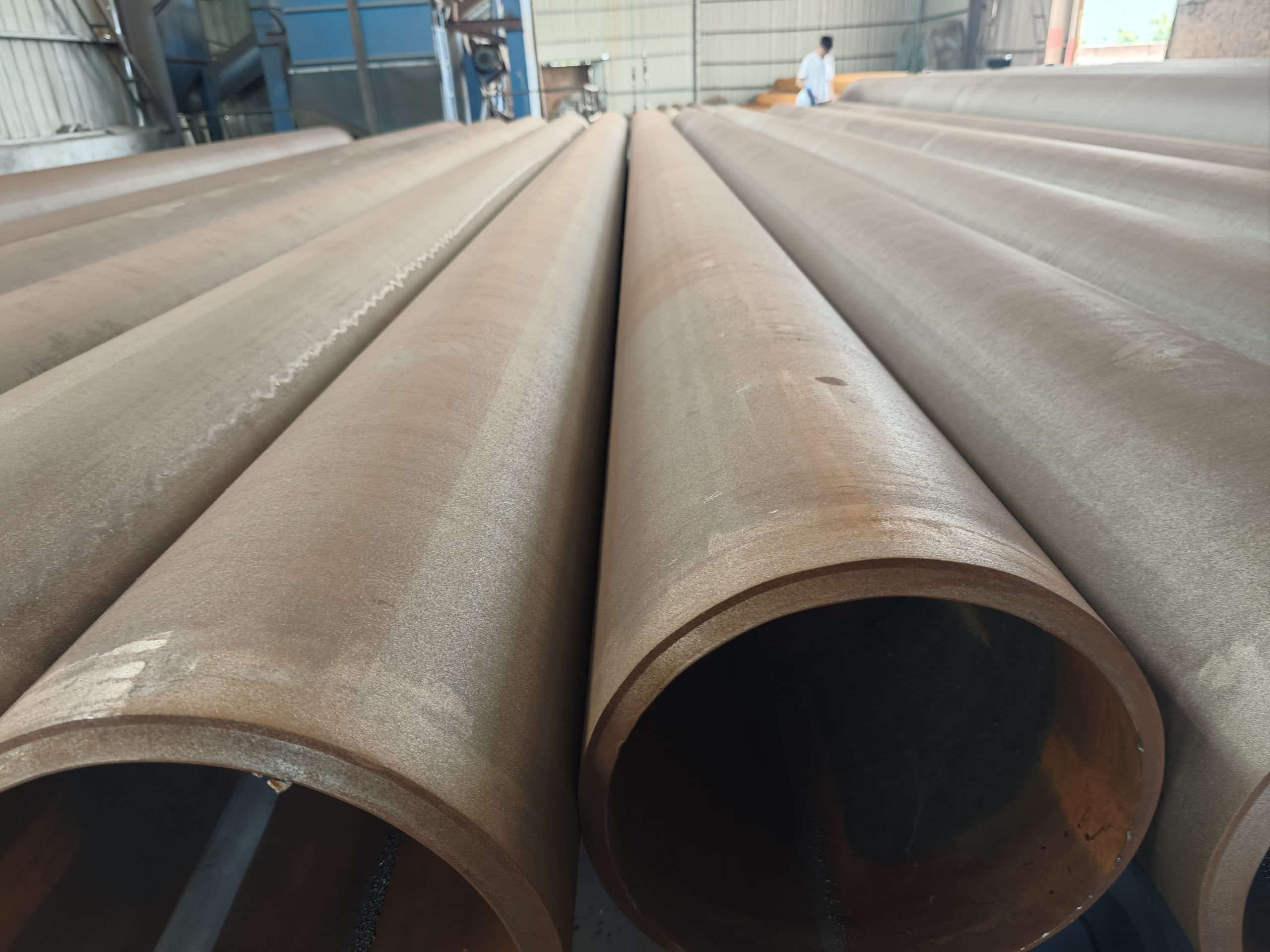
API 5L Pipe Grades X42 vs X52
The number following X identifies a nominal yield-strength class in thousands of psi. Use the standard’s SI or USC tables consistently rather than replace tabulated values with direct conversions. Both grades are available in PSL 1 and PSL 2. API published the 47th edition in June 2026; the order must identify the governing edition and amendments. The numerical comparison here uses the 46th-edition SI baseline.
Chemical Composition Where the Grades Begin to Diverge
Chemical requirements depend on PSL, manufacturing route, delivery condition and wall thickness. For ERW or LSAW procurement, use the applicable welded-pipe requirements and table notes instead of copying limits for another product condition. Higher permitted manganese does not guarantee an unchanged carbon equivalent. Compare actual chemistry and the applicable CE formula when assessing field weldability. Ordinary PSL 2 sulfur and phosphorus limits do not establish resistance to HIC or qualify a pipe for sour service.
Mechanical Properties at a Glance
| Property | X42 (PSL2) | X52 (PSL2) | Standard Reference |
| Min. Yield Strength | 290 MPa | 360 MPa | API 5L, 2018, Table 7 |
| Min. Tensile Strength | 415 MPa | 460 MPa | API 5L, 2018, Table 7 |
| Max. Yield/Tensile Ratio | 0.93 | 0.93 | Applicable table notes |
| CVN Impact Toughness | Required where applicable | Required where applicable | Applicable CVN provisions |
Higher specified yield strength can reduce calculated pressure-design thickness under the same assumptions. The increase from 290 MPa to 360 MPa is about 24%, but this does not imply a 24% reduction in the final ordered wall. Corrosion allowance, minimum handling thickness, external pressure, buckling and installation loads can govern. Compare both grades using the same design code and load cases.
Production and Quality Parameters Affecting X42 and X52 Pipes
ERW pipe is typically formed from hot-rolled coil and joined by high-frequency welding. LSAW pipe is formed from plate, often by JCOE or UOE, and joined by longitudinal submerged arc welding. Available dimensions depend on the mill. Both routes can produce compliant X42 or X52 where permitted by the specification; neither process name alone defines a low- or high-pressure application.
Quality Assurance From Raw Material to Final Inspection
For either grade, quality control must link the starting material, production test unit and supplied pipe. Agree an inspection and test plan covering the specified edition, PSL and project supplements before manufacture.
The principal checks for X42 and X52 include:
- Chemical analysis: Review the required heat and product analyses against the applicable limits and table notes. Specify CE reporting and any additional composition controls in the order.
- Mechanical tests: Verify tensile strength, yield strength and elongation using the required sampling frequency and orientation. Transverse and longitudinal tests are not universally both required for every size and route.
- Impact tests: Check required CVN sampling locations, specimen dimensions, orientation, temperature and acceptance criteria. The test temperature must follow the governing toughness requirements and is not automatically identical to the design temperature.
- NDE: Confirm weld examination methods, coverage and acceptance criteria for the manufacturing route. Pipe-body lamination examination and additional pipe-end inspections should be identified separately where applicable.
- Hydrostatic testing: Verify the required test conditions and traceable records for the supplied pipe. Hydrostatic testing does not replace weld NDE.
- Dimensions: Verify OD, wall thickness, ovality, straightness and pipe-end geometry against the applicable standard tables and agreed purchase requirements.
Specify the EN 10204 inspection document type separately. Type 3.1 and Type 3.2 have different validation arrangements; a third-party visit alone does not automatically create a Type 3.2 certificate. Product identification must remain linked to the reported test results.
Application Areas and Performance Suitability
Where X42 Line Pipe Excels
X42 can be suitable where its strength satisfies the approved design and the available wall sizes provide an economical solution. It is not restricted to a universal pressure limit such as 7 MPa. Assess field welding using actual chemistry, dimensions and the qualified WPS. For wet H2S exposure, agree the applicable material qualification and additional controls; ordinary X42 PSL 2 compliance alone is insufficient.
Where X52 Adds Decisive Value
X52 may offer a lower calculated pressure-design wall or additional strength margin where the governing design allows it. This can reduce weight and joint welding volume, but the final thickness remains subject to all relevant loads and allowances. Offshore risers need a separate assessment of fatigue, fracture and installation conditions. External coating options can be similar for both grades, while the selected coating system must still suit the service and installation.
Comparative Analysis X42 vs X52 and Other Related Grades
X46 lies between X42 and X52 in the strength sequence, with the corresponding SI designation L320. X56 corresponds to L390 and lies between X52 and X60. These are valid grade options where accepted by the design and available from a qualified mill. Do not treat a grade as obsolete or suitable only for replacement work because it is less common in a particular stock range.
X52 may carry a purchase-price premium of around 5–10%, depending on purchasing conditions. Compare quotations for the same dimensions, process, PSL and testing scope. Any potential wall reduction must be approved before it is used to calculate tonnage, freight and welding savings.
Procurement Requirements for X42 and X52 Pipe
Verify the manufacturing source and, where Monogram-marked product is required, the current API licence and authorized scope. Review quality-system certification, traceability and representative documentation. State the required source inspection, witness points and document type in the purchase order rather than assume that every operator uses identical requirements.
Stock X42 sizes may be available for dispatch within seven days, while custom LSAW orders may require 30–45 days, subject to order confirmation. Confirm the actual manufacturing, inspection and coating schedule for either grade. Dispatch from the mill is separate from arrival at the project site.
Conclusion
The main strength difference is 290 MPa versus 360 MPa minimum yield in the stated SI baseline. Choose X42 or X52 by comparing the approved wall thickness, service requirements, fabrication and total installed cost. Neither grade automatically provides better weldability, low-temperature performance or sour-service resistance. State the required PSL and supplements explicitly.
FAQ
Is X42 or X52 more weldable in field conditions
Neither grade is automatically easier to weld. Actual chemistry, carbon equivalent, wall thickness, restraint and hydrogen control determine the welding procedure. Select electrodes or wires and preheat through an approved WPS under the governing qualification standard, such as API 1104 or ASME Section IX where applicable.
Can X42 PSL2 be used in sour gas service
Yes, where the supplied material is qualified for the specified environment and ordered to the applicable sour-service requirements. Agree chemistry, hardness controls and any required HIC or SSC qualification and testing. These tests evaluate different mechanisms and cannot replace one another.
What is the typical price difference between X42 and X52
Prices vary with steel cost, dimensions, manufacturing process, PSL, inspection and order size. A 5–10% premium may be used as an indicative commercial comparison, but obtain quotations on the same technical basis. Any saving from a reduced X52 wall depends on approval of that thickness by the designer.
How do I verify a supplier’s API 5L certification
Use the API Composite List to verify the manufacturing organization’s current licence and authorized scope when Monogram-marked product is specified. Confirm that the actual source and ordered manufacturing route are covered, and separately review the material and inspection documentation.
Partner with LONGMA for API 5L X42 and X52 Pipe
Since 2003, LONGMA has manufactured round ERW and LSAW line pipe for EPC contractors and oil companies in the Middle East, Southeast Asia and Latin America. Our facility covers 230,000 square metres and annual output exceeds 500,000 tonnes. For X42 or X52 enquiries, send the OD, wall thickness, PSL, quantity and service requirements to info@ilongma.com. Inspection documentation, coatings and any sour-service requirements will be confirmed during technical review.