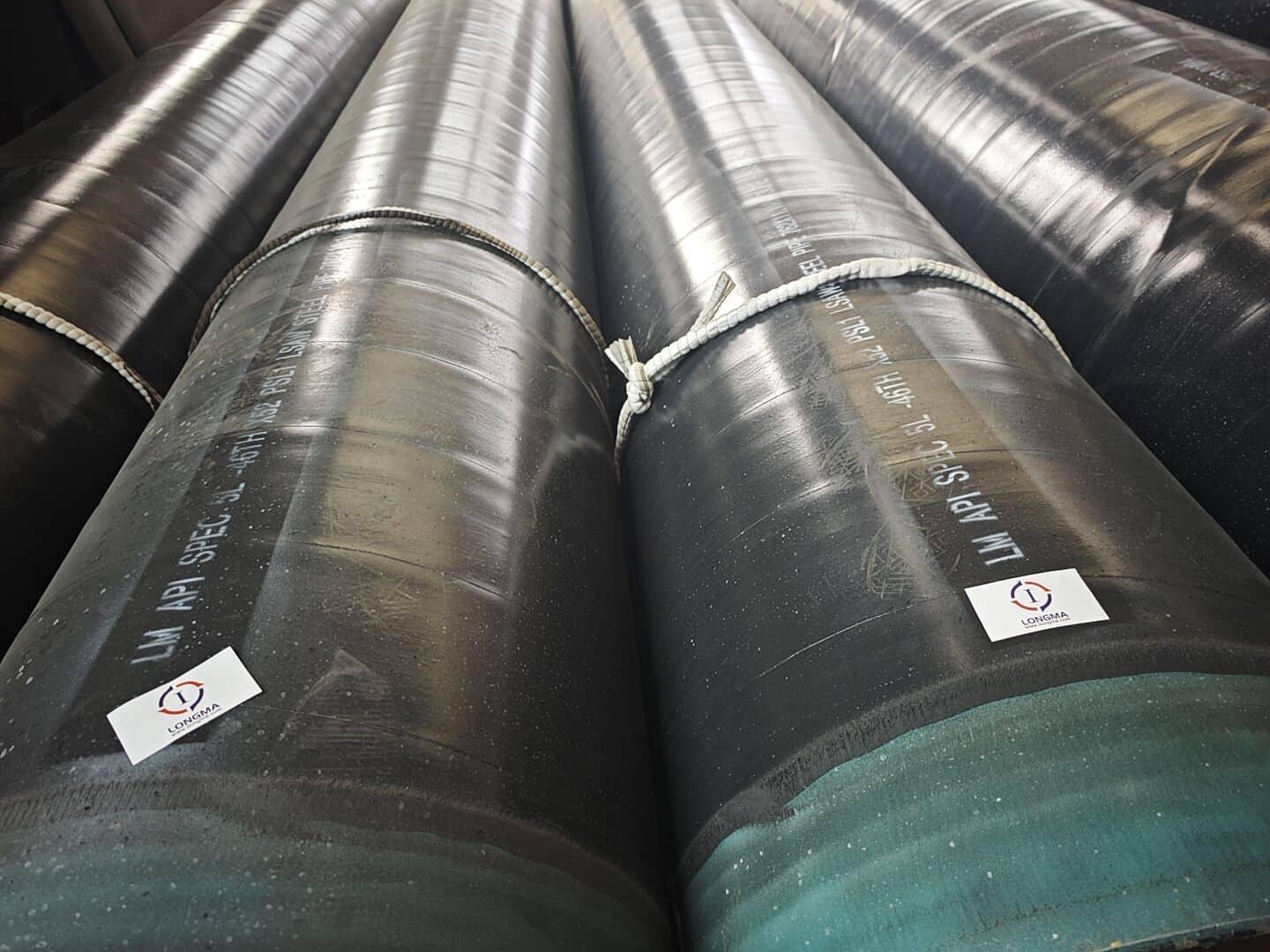
- 1. Why Manufacturing Processes Matter in Seamless Steel Pipe Production
- 2. The Seamless Steel Pipe Manufacturing Process
- 3. What Is the Rotary Piercing Process?
- 4. Key Factors Affecting Seamless Steel Pipe Quality
- 5. How Is Seamless Steel Pipe Quality Inspected?
- 6. How LONGMA’s In-House Laboratory Ensures Product Reliability
- 7. Why More Global Customers Choose LONGMA
In industries such as oil and gas transportation, power generation, mechanical engineering, pressure vessels, and offshore construction, seamless steel pipe remains one of the most critical industrial materials. Compared with welded pipes, seamless pipes have no weld seams, offering superior reliability under high-pressure, high-temperature, and demanding service conditions.
However, when international buyers source seamless steel pipes, their concerns go far beyond price. Key questions often include:
- How are seamless steel pipes manufactured?
- Is the rotary piercing process mature and reliable?
- How is wall thickness consistency ensured?
- What quality inspection systems are in place?
- Can the products meet API, ASTM, and EN standards?
In reality, every stage—from billet preparation to finished product—affects pipe performance. Among all manufacturing processes, rotary piercing is one of the most important technologies in modern seamless pipe manufacturing.
With over 20 years of industry experience, LONGMA utilizes advanced rotary piercing production lines, automated quality control systems, and comprehensive in-house laboratory facilities to deliver premium-quality seamless steel pipe solutions to customers worldwide.
Why Manufacturing Processes Matter in Seamless Steel Pipe Production
For buyers, many quality issues do not become apparent during delivery but emerge during installation or long-term operation.
Common problems include:
- Hydrostatic test failures
- Localized cracking
- Dimensional inaccuracies
- Reduced pressure-bearing capacity
- Shortened service life
In many cases, these issues originate from deficiencies in the manufacturing process.
Therefore, a reliable seamless steel pipe supplier must provide not only advanced equipment but also proven manufacturing expertise and strict quality management systems.
The Seamless Steel Pipe Manufacturing Process
Modern steel pipe production typically consists of the following stages:
| Process Stage | Purpose |
| Billet Inspection | Verify raw material quality |
| Heating | Improve plasticity for piercing |
| Rotary Piercing | Form hollow shell |
| Elongation Rolling | Control diameter and wall thickness |
| Sizing & Straightening | Improve dimensional accuracy |
| Heat Treatment | Optimize microstructure and properties |
| Non-Destructive Testing | Detect internal defects |
| Hydrostatic Testing | Verify pressure integrity |
Among these steps, rotary piercing is one of the most critical operations in seamless pipe manufacturing.
What Is the Rotary Piercing Process?
Rotary piercing is the foundation of modern seamless steel pipe production.The process works by feeding a heated round billet between two angled rotating rolls. Under compressive and rotational forces, a cavity forms in the billet center. A piercing plug then enlarges the cavity, creating a hollow shell.
Originally developed from the Mannesmann process in Germany, rotary piercing has become the industry standard for manufacturing seamless steel pipes worldwide.
Advantages of Rotary Piercing:
1.Higher Production Efficiency
Continuous production enables manufacturers to meet large-scale project requirements efficiently.
2.Improved Metal Flow Structure
The process enhances grain flow orientation, improving fatigue resistance and mechanical strength.
3.Better Wall Thickness Uniformity
Consistent wall thickness reduces the risk of localized stress concentration and pressure failures.
4.Suitable for Large-Diameter Pipes
Rotary piercing is widely used in the production of oil and gas pipe, boiler tubes, and mechanical tubing.
For international buyers, advanced rotary piercing equipment is often a strong indicator of manufacturing reliability.
Key Factors Affecting Seamless Steel Pipe Quality
Many buyers assume that modern equipment alone guarantees quality. In reality, process control is equally important.
- Raw Material Quality Control
The quality of the billet directly determines the quality of the finished pipe.
LONGMA conducts:
- Chemical composition analysis
- Ultrasonic testing of billets
- Surface defect inspection
- Dimensional verification
This ensures compliance with ASTM, API, and EN standards before production begins.
- Heating Temperature Control
Before piercing, billets are typically heated to temperatures exceeding 1100°C.
If the temperature is too low:
- Material plasticity decreases
- Cracking becomes more likely
If the temperature is too high:
- Grain coarsening may occur
- Mechanical properties can deteriorate
LONGMA employs automated temperature control systems to monitor and regulate the heating process in real time.
- Wall Thickness Consistency Control
Wall thickness uniformity is one of the most important quality indicators for buyers.
For precision seamless tube applications and high-pressure systems, even minor variations can affect performance and safety.
LONGMA utilizes:
- Automated rolling control systems
- Online laser wall thickness measurement
- Intelligent feedback adjustment technology
These technologies ensure excellent dimensional consistency throughout the production process.
How Is Seamless Steel Pipe Quality Inspected?
Even the most advanced production equipment cannot guarantee quality without a comprehensive inspection system.
To ensure product reliability, LONGMA has established a complete pipe inspection process.
1.Ultrasonic Testing (UT)
UT is one of the most important non-destructive testing methods used in the seamless steel pipe industry.
Inspection Purpose
UT is used to detect:
- Laminations
- Internal cracks
- Non-metallic inclusions
- Porosity and discontinuities
Applicable Standards
Testing is performed in accordance with:
- ASTM A999/A999M
- API 5L PSL2
- ISO 10893-10
LONGMA’s automated UT systems provide 100% full-length inspection coverage.
2.Eddy Current Testing (ET)
ET is widely used for small- and medium-diameter ASTM seamless pipe products.
Key Advantages
- High-speed inspection capability
- Non-contact testing
- Effective detection of surface and near-surface defects
Testing is conducted according to:
- ISO 10893-2
- ASTM E309
ET plays a critical role in ensuring consistent product quality.
3.Hydrostatic Testing
For oil and gas applications, hydrostatic testing is essential for verifying pressure integrity.
Testing Procedure
- Fill the pipe with water.
- Increase pressure to the specified level.
- Maintain pressure for the required duration.
- Inspect for leaks or failures.
Hydrostatic testing is conducted according to:
Only pipes that successfully pass hydrostatic testing proceed to final shipment.
How LONGMA’s In-House Laboratory Ensures Product Reliability
For international buyers, the greatest concern is often not the specification itself, but whether the reported data is accurate and trustworthy.
To address this concern, LONGMA has established a comprehensive in-house laboratory equipped with:
- Ultrasonic Testing Systems (UT)
- Eddy Current Testing Equipment (ET)
- Metallographic Analysis Instruments
- Optical Emission Spectrometers
- Tensile Testing Machines
- Impact Testing Equipment
Every batch of seamless steel pipe is fully traceable through documented quality records.
In addition, LONGMA supports:
- SGS inspections
- BV inspections
- TÜV inspections
- Third-party on-site audits
This transparency helps customers minimize procurement risks and maintain confidence in product quality.
Why More Global Customers Choose LONGMA
In today’s highly competitive steel pipe market, customers need more than a product supplier—they need a dependable manufacturing partner.
LONGMA stands out through:
- Over 20 years of manufacturing experience
- Advanced seamless pipe manufacturing technology
- Automated rotary piercing production lines
- Complete quality traceability systems
- Compliance with international standards
These strengths enable LONGMA to consistently supply high-quality seamless steel pipe products for energy, industrial, and infrastructure projects worldwide.
Conclusion
From billet preparation to finished product delivery, every stage influences the final quality of a seamless steel pipe. Among these stages, rotary piercing remains the core process that determines dimensional accuracy, mechanical performance, and long-term reliability.
By combining advanced production equipment, rigorous quality control procedures, and a fully equipped in-house laboratory, LONGMA delivers internationally compliant seamless steel pipe, ASTM seamless pipe, precision seamless tube, and oil and gas pipe products.
For global buyers seeking a stable and dependable supply chain, choosing a manufacturer with proven production expertise and comprehensive inspection capabilities offers far greater value than simply pursuing the lowest price.