- 1. Understand the Corrosion Environment First
- 2. Select the Pipe Material According to Service Conditions
- 3. Control Steel and Welding Quality
- 4. Use External Coatings as the Primary Barrier
- 5. Surface Preparation Is Critical
- 6. Consider Internal Corrosion Separately
- 7. Cathodic Protection for Buried and Submerged Pipelines
- 8. Seamless vs. Welded Large Diameter Steel Pipe
- 9. Procurement Checklist for Corrosion-Resistant Large Diameter Steel Pipe
- 10. Protect the Pipe During Transportation and Installation
- 11. Inspection and Maintenance During Service
- 12. FAQ
- 13. Conclusion
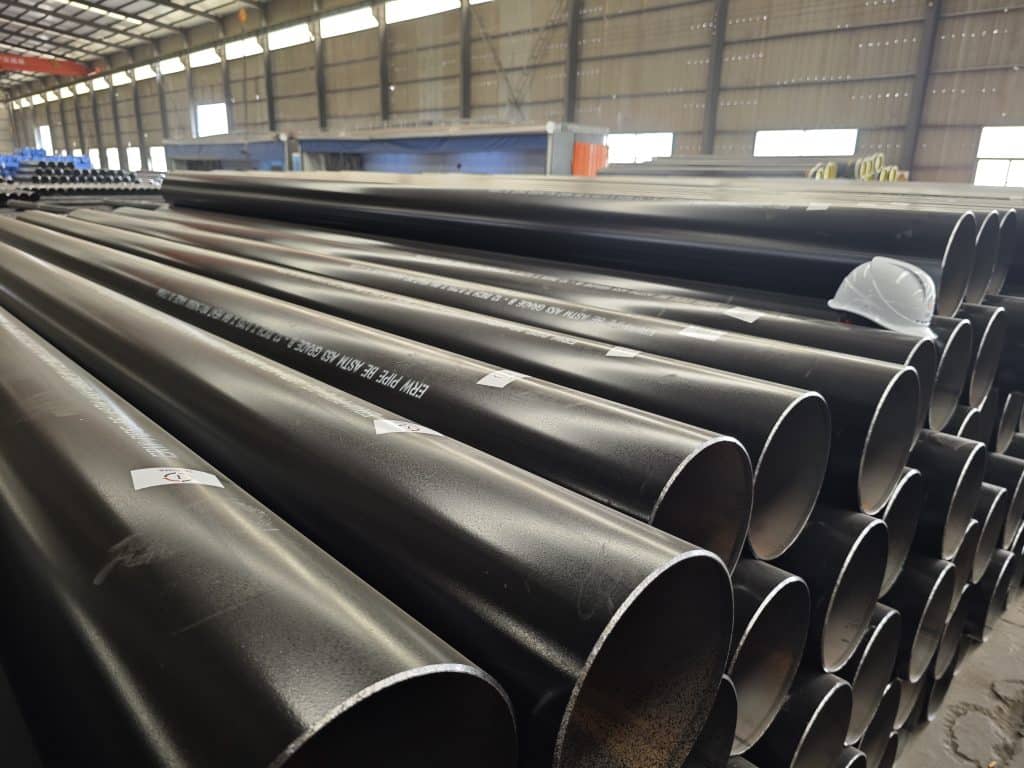
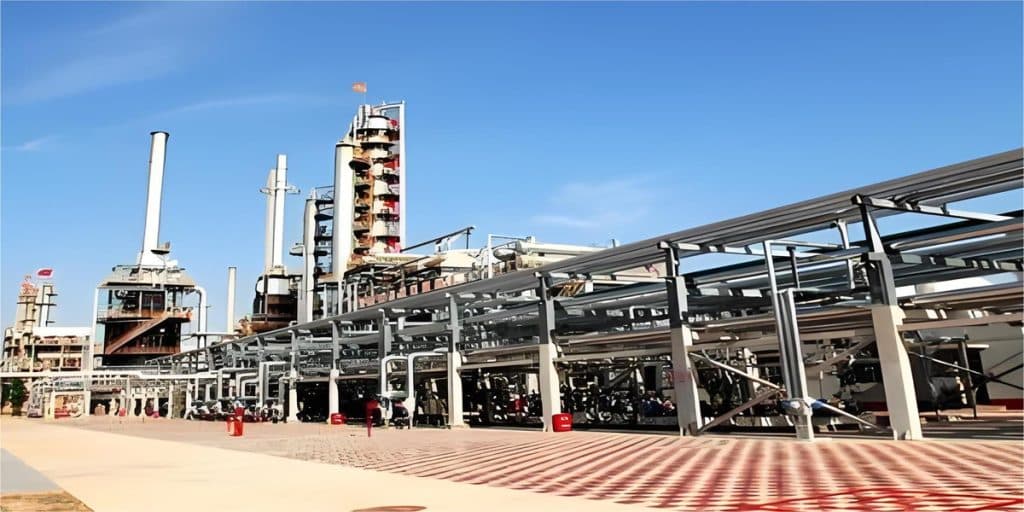
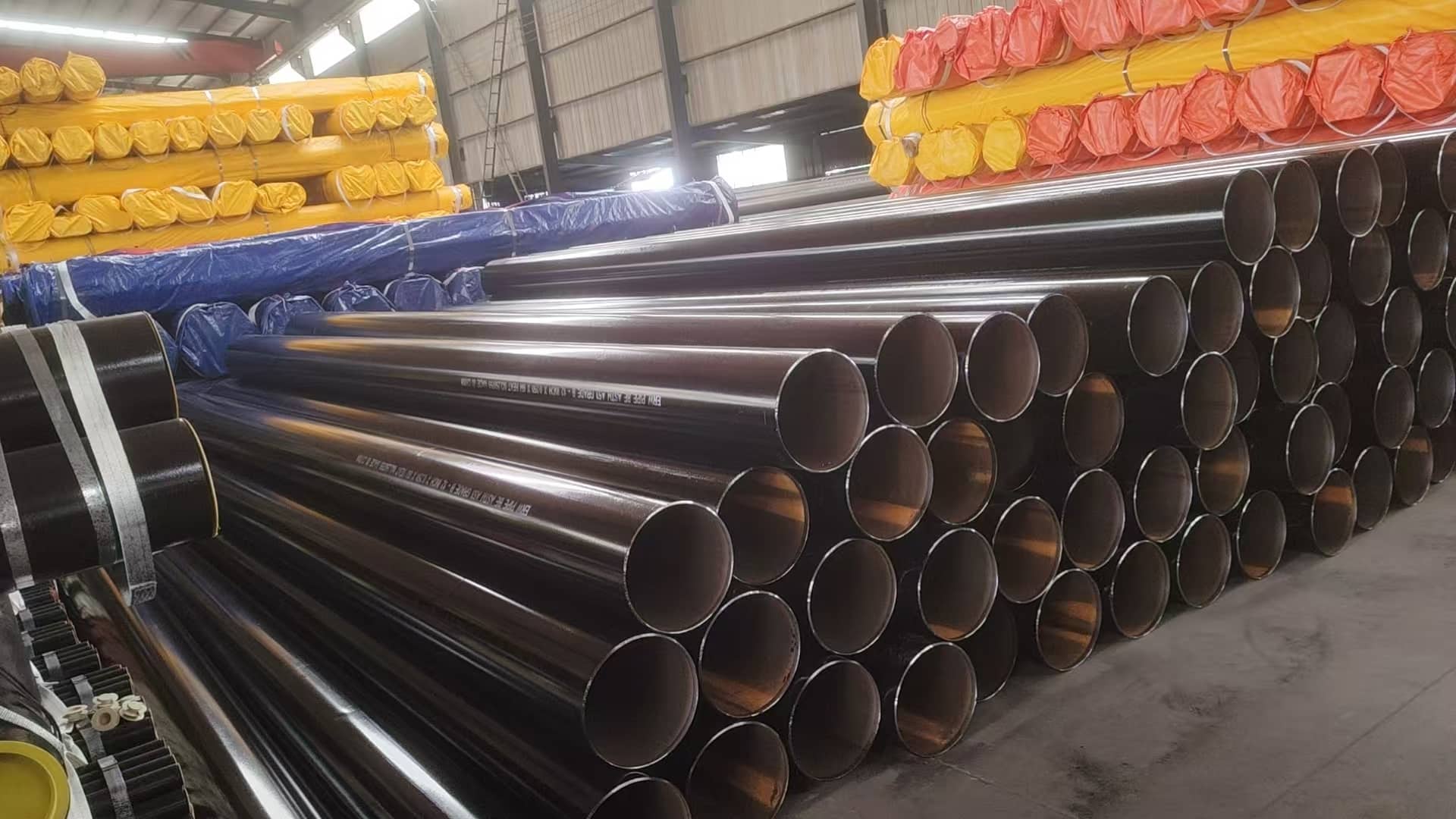
Large diameter steel pipe is widely used in water transmission, energy infrastructure, petrochemical facilities, industrial piping, and other applications where reliability and long service life are important. Because large-diameter pipe can represent a significant portion of project cost, corrosion protection should be considered from material selection through manufacturing, coating, installation, and operation.
However, corrosion resistance does not come from the pipe specification alone. For carbon steel pipe, long-term corrosion control normally requires an integrated approach that considers the service environment, steel material, weld quality, coating system, cathodic protection where applicable, and inspection strategy.
This article explains the main methods for improving the corrosion resistance of large diameter steel pipe.
Understand the Corrosion Environment First
The first step is to identify how the pipe will be exposed to corrosion.
Different applications create very different corrosion mechanisms.
Underground pipelines
External corrosion can be influenced by:
- Soil moisture
- Soil resistivity
- pH
- Coating condition
- Cathodic protection
- Microbiological activity
Offshore and marine environments
Marine exposure can involve:
- Chloride-containing water
- Sea spray
- Wet-dry cycling
- Marine deposits
- Mechanical damage to coatings
Process and petrochemical systems
Internal corrosion may be associated with:
- Water
- Carbon dioxide
- Hydrogen sulfide
- Acids
- Contaminants in the process fluid
- Elevated temperature
Therefore, there is no single coating or steel grade that is automatically the best solution for every large diameter steel pipe application.
Select the Pipe Material According to Service Conditions
Material selection is the foundation of the corrosion-control strategy, but it should not be confused with corrosion protection itself.
For many large-diameter applications, carbon steel is selected because it combines strength, weldability, availability, and cost effectiveness. Its corrosion performance can then be enhanced through appropriate external and/or internal protection systems.
The selection should consider:
- Fluid composition
- Operating temperature
- Pressure
- External environment
- Corrosion mechanism
- Required service life
- Wall thickness
- Welding requirements
- Applicable product and design standards
For low-temperature applications, toughness requirements also need to be considered separately from corrosion resistance.
For example, ASTM A671 covers electric-fusion-welded steel pipe for atmospheric and lower-temperature service and is manufactured from pressure-vessel-quality plate of several analyses and strength levels. The specification itself should not be interpreted as a corrosion-resistant coating or corrosion-control standard.
Control Steel and Welding Quality
Manufacturing quality can influence the reliability of a corrosion protection system.
For large diameter welded pipe, particular attention should be paid to:
- Plate quality
- Edge preparation
- Welding procedure
- Weld penetration and fusion
- Heat input control
- Weld profile
- Weld inspection
- Dimensional accuracy
- Heat treatment where specified
A weld discontinuity can become a local stress concentration or provide a pathway for corrosive media. This is why appropriate non-destructive examination is an important part of quality control.
ASTM A671, for example, establishes different classes that define heat treatment and whether the weld is radiographically examined and whether the pipe is pressure tested.
Use External Coatings as the Primary Barrier
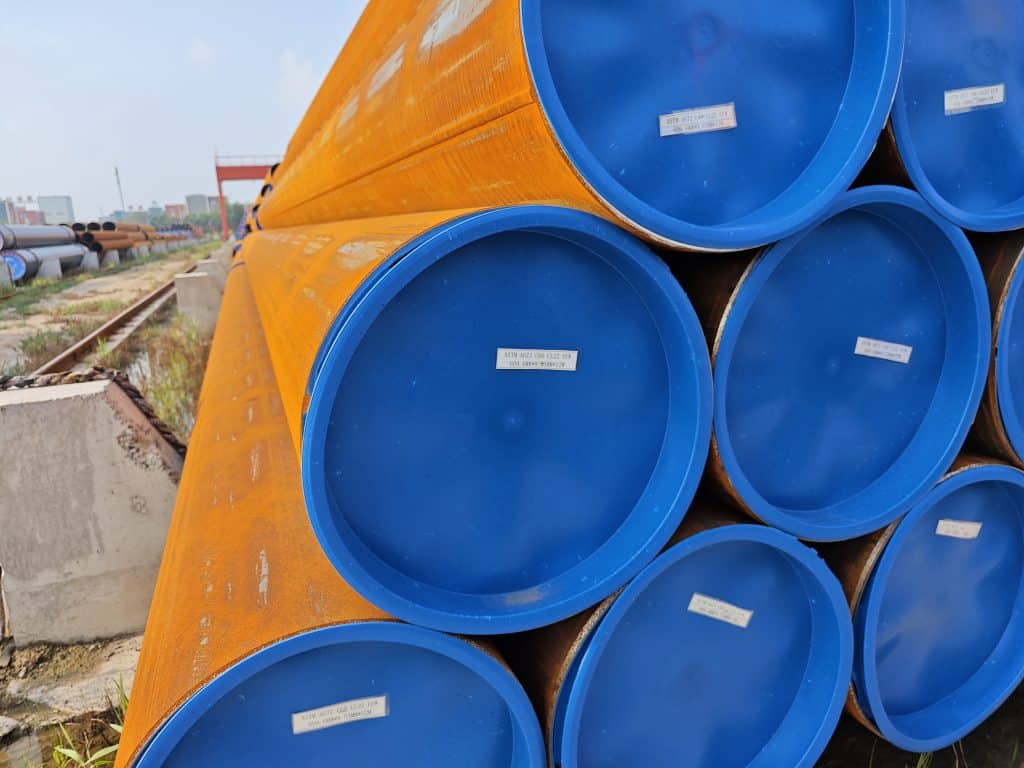
For underground or submerged large diameter carbon steel pipe, an external coating is often a major part of the corrosion protection system.
Common systems include:
Fusion-Bonded Epoxy (FBE)
FBE provides a continuous protective barrier and is widely used for steel pipeline applications. Its performance depends on appropriate surface preparation, application conditions, curing, coating thickness, and handling.
Three-Layer Polyethylene (3LPE)
3LPE systems combine an epoxy primer, adhesive layer, and polyethylene outer layer. They are designed to provide both corrosion protection and mechanical resistance.
Three-Layer Polypropylene (3LPP)
3LPP systems use polypropylene as the outer layer and may be selected where higher temperature or specific mechanical requirements make them appropriate.
The correct coating should be selected according to the actual environment and project specification rather than simply choosing the coating with the highest nominal performance.
Surface Preparation Is Critical
Even a high-performance coating can fail prematurely if the steel surface is not properly prepared.
Before coating, the project specification may require control of:
- Mill scale
- Rust
- Oil and grease
- Dust
- Surface profile
- Surface cleanliness
- Steel temperature
- Ambient temperature
- Relative humidity
- Dew point
The coating manufacturer’s application requirements and the project coating specification should be followed.
Coating inspection should also verify the finished coating for:
- Thickness
- Adhesion where specified
- Surface defects
- Holiday defects
- Damage caused during handling
Consider Internal Corrosion Separately
External and internal corrosion are different problems.
For pipelines transporting water, hydrocarbons, chemicals, or other corrosive fluids, the internal environment needs to be assessed separately.
Possible control measures can include:
- Internal coating or lining
- Corrosion inhibitors
- Fluid chemistry control
- Water management
- Material upgrades
- Corrosion monitoring
The appropriate solution depends on the fluid and operating conditions. An external coating cannot protect the inside surface of a pipe.
Cathodic Protection for Buried and Submerged Pipelines
Cathodic protection can be used together with an external coating for buried or submerged steel pipelines.
Two common approaches are:
Sacrificial Anode Systems
A more active metal acts as the anode and supplies protection to the steel structure.
Impressed Current Systems
An external power source is used to drive protective current to the pipeline through an anode system.
Cathodic protection design depends on factors such as:
- Coating condition
- Exposed steel area
- Soil or water environment
- Electrical characteristics
- Current demand
- Design life
- Monitoring requirements
Cathodic protection should therefore be engineered as part of the complete pipeline corrosion-control system rather than added as an isolated measure.
Seamless vs. Welded Large Diameter Steel Pipe
The presence of a longitudinal weld does not by itself mean that a large diameter welded pipe will have poor corrosion performance.
For large diameter applications, welded construction is widely used because it can provide dimensions and production efficiency that may not be practical with seamless manufacturing.
The important factors are:
- Proper welding procedure
- Adequate weld quality
- Appropriate NDT
- Surface treatment
- Coating integrity
- Correct installation
A pipe’s corrosion performance should therefore be evaluated based on the complete manufacturing and protection system rather than simply asking whether it is seamless or welded.
Procurement Checklist for Corrosion-Resistant Large Diameter Steel Pipe
Before placing an order, buyers should clearly define:
| Item | What to Specify |
| Pipe material | Applicable standard, grade and class |
| Dimensions | Outside diameter, wall thickness and length |
| Service | Fluid, pressure and temperature |
| Corrosion environment | Soil, seawater, process fluid or other exposure |
| External coating | Coating system and applicable specification |
| Internal protection | Lining/coating requirements where applicable |
| Welding | Welding procedure and acceptance requirements |
| NDT | RT, UT or other required examinations |
| Hydrostatic testing | Test requirements where applicable |
| Material documentation | MTC and heat-number traceability |
| Coating inspection | Thickness, holiday detection and other specified checks |
| Third-party inspection | Scope, hold points and witness requirements |
A detailed purchase specification helps prevent the common mistake of ordering a “corrosion-resistant pipe” without defining what corrosion protection actually means for the project.
Protect the Pipe During Transportation and Installation
Corrosion protection does not end when the pipe leaves the factory.
Coating damage can occur during:
- Loading
- Transportation
- Storage
- Lifting
- Stringing
- Welding
- Backfilling
Suitable lifting equipment and handling procedures should be used to avoid damaging the coating. Pipes should be stored in conditions appropriate to the coating and project requirements.
Any coating damage identified during inspection should be repaired according to the coating manufacturer’s repair procedure and project specification.
Inspection and Maintenance During Service
Long-term corrosion control requires monitoring.
Depending on the pipeline system, inspection programs may include:
- Visual inspection
- Coating condition assessment
- Ultrasonic wall-thickness measurements
- Cathodic protection monitoring
- Inline inspection where applicable
- Corrosion monitoring
- Risk-based inspection
The purpose is to identify metal loss or coating deterioration before the remaining wall thickness reaches an unacceptable level.
FAQ
What is the best way to improve the corrosion resistance of large diameter steel pipe?
There is no single best method. A reliable strategy normally combines appropriate material selection, high-quality manufacturing, surface preparation, an external coating where required, internal corrosion control where required, cathodic protection for applicable buried/submerged systems, and inspection.
Does ASTM A671 make steel pipe corrosion resistant?
No. ASTM A671 specifies requirements for electric-fusion-welded steel pipe for atmospheric and lower-temperature service. It should not be treated as a standalone corrosion-protection specification.
Is welded large diameter steel pipe more vulnerable to corrosion than seamless pipe?
Not automatically. Weld quality, surface condition, coating integrity, service environment and inspection have a major influence on corrosion performance. Large diameter welded pipe can be an appropriate solution when manufactured and protected according to the project requirements.
What coating is best for large diameter steel pipe?
The answer depends on the environment. FBE, 3LPE, 3LPP and other coating systems have different performance characteristics. The choice should be based on temperature, soil or water exposure, mechanical requirements, service life and the project coating specification.
How can buyers verify corrosion protection quality?
Buyers should review coating specifications, surface preparation records, coating inspection reports, holiday detection results where required, pipe material documentation, NDT reports and traceability records.
Conclusion
Improving the corrosion resistance of large diameter steel pipe is not a matter of selecting a single “corrosion-resistant” steel grade.
The most reliable approach is to manage corrosion throughout the pipe’s life cycle:
service environment → material selection → manufacturing quality → welding and NDT → surface preparation → coating → cathodic protection where applicable → transportation → installation → inspection and maintenance.
For large diameter carbon steel pipe, this integrated approach can provide a practical balance between structural performance, corrosion protection, service life, and project cost.
LONGMA can support large-diameter electric-fusion-welded steel pipe projects with manufacturing, inspection, material traceability and project-specific technical coordination. Product selection and inspection requirements should always be confirmed against the customer’s project specification before production.