- 1. Overview of S355 Steel: Why is Welding Performance So Critical?
- 2. Analysis of Core Factors Influencing S355 Welding Performance
- 3. Recommended Typical Welding Parameters for S355 Steel
- 4. Key Control Points of S355 Welding Process
- 5. Welding Performance Verification: Testing Methods and Standard Basis
- 6. Recommendations for Procurement and Engineering Risk Control
- 7. Why Choose LONGMA’s S355 Steel?
- 8. Conclusion
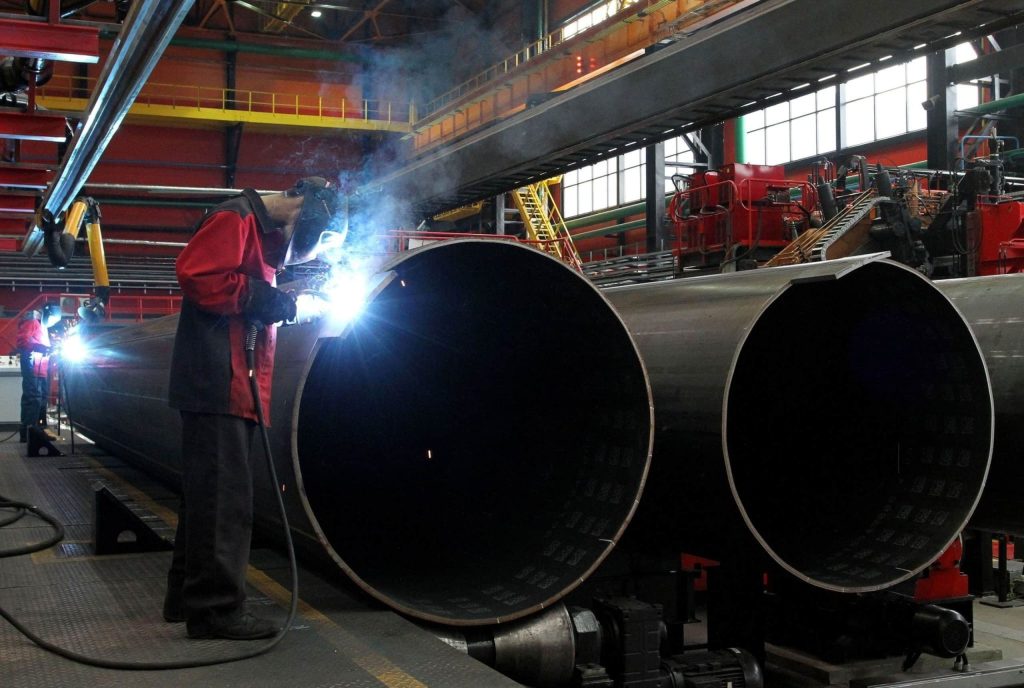
In large-scale steel structures, bridge engineering, pressure vessels, marine equipment, and other projects, welding performance is often more critical than nominal strength in determining the long-term safety of the structure. As a widely used high-strength structural steel in the European EN 10025 system, S355 steel is extensively employed in load-bearing welded structures due to its excellent strength-toughness balance.
However, in practical engineering, many quality issues stem not from the material itself but from insufficient understanding of S355’s welding performance, welding parameters, and welding processes. This article, written by LONGMA with over 20 years of experience in structural steel production and quality control, systematically analyzes the influencing factors of S355 steel’s welding performance, the selection of optimal welding parameters, and key points of inspection and quality control, helping engineers and purchasers effectively reduce welding risks.
Overview of S355 Steel: Why is Welding Performance So Critical?
S355 steel belongs to the high-strength structural steel category in the EN 10025 standard system, with a minimum yield strength of 355 MPa. It is widely used in the following fields:
- Steel structure workshops and high-rise buildings
- Bridges and heavy load-bearing structures
- Construction machinery and lifting equipment
- Offshore platforms and low-temperature service structures
In these applications, welds are often the weakest link. Even if the base metal has excellent performance, improper welding processes may lead to:
- Cold cracks
- Heat-Affected Zone (HAZ) embrittlement
- Decreased impact toughness
- Post-weld residual stress concentration
Therefore, a correct understanding of S355’s welding performance and reasonable control of welding parameters are prerequisites for ensuring the reliability of structural steel welding.
Analysis of Core Factors Influencing S355 Welding Performance
- Chemical Composition and Carbon Equivalent (CE)
S355 steel typically controls a low carbon content and improves strength through a small amount of microalloying elements such as Mn, Nb, and V. The core indicator of its welding performance is the carbon equivalent (CE).
- CE ≤ 0.45%: Good weldability
- CE > 0.45%: Preheating required and strict process control
LONGMA conducts chemical composition review for each heat of steel through OES spectral analysis in its internal laboratory to ensure that the welding performance of S355 steel is within the safe window.
- Influence of Delivery Condition on Welding Performance
The welding behavior of S355 steel varies significantly under different delivery conditions:
| Delivery Condition | Influence on Welding Performance |
| +AR (As-Rolled) | Large strength dispersion and higher sensitivity of the welding heat-affected zone |
| +N (Normalized/Normalized Rolled) | Uniform structure and the most stable welding performance |
| +M (Thermo-Mechanically Rolled) | Fine-grained structure and excellent low-temperature welding performance |
For welded structures, LONGMA usually recommends S355 steel in +N or +M condition to reduce the risk of welding cracks.
Recommended Typical Welding Parameters for S355 Steel
Reasonable welding parameters are crucial for exerting S355’s welding performance. The following parameters are common reference ranges for engineering applications:
| Item | Recommended Range |
| Preheating Temperature | 50–150°C (depending on CE and plate thickness) |
| Interpass Temperature | ≤250°C |
| Welding Heat Input | 1.0–2.5 kJ/mm |
| Welding Consumable Matching | E7018 / EN ISO 2560-A |
| Post-Weld Treatment | Determined by thickness and stress level |
Note: When the plate thickness >40 mm or CE is high, Welding Procedure Specification/Procedure Qualification Record (WPS/PQR) shall be conducted.
Reasonable control of welding parameters can significantly improve the welding performance of S355 steel and avoid the decrease in HAZ toughness.
Key Control Points of S355 Welding Process
- Pre-Weld Control
- Strictly clean oil, moisture, and rust from the groove
- Adequate preheating in low-temperature environments
- Drying of welding consumables (e.g., E7018: 350–400°C)
- Welding Process Control
- Adopt multi-layer multi-pass welding to avoid excessive heat input in a single pass
- Control the welding sequence to reduce residual stress
- Real-time monitoring of interpass temperature
- Post-Weld Control
- Post-Weld Heat Treatment (PWHT) if necessary
- Timely non-destructive testing to prevent crack propagation
A scientific welding process is the core of ensuring the safety of structural steel welding.
Welding Performance Verification: Testing Methods and Standard Basis
In its internal laboratory, LONGMA performs the following key tests for S355 welded structures, with reference to corresponding ASTM standards:
- Chemical Analysis (ASTM E415)
To ensure the stability of weldability indicators.
- Tensile Test (ASTM E8 / ASTM A370)
To verify whether the strength of the welded joint meets the design requirements.
- Impact Test (ASTM E23)
To focus on evaluating the low-temperature toughness of the weld and HAZ.
- Hardness Test (ASTM E384)
To check the risk of hardening or embrittlement in the welding heat-affected zone.
- Non-Destructive Testing (UT / MT / PT / RT)
Implemented in accordance with ASTM A578, ASTM E1444, etc.
Through systematic testing, LONGMA can minimize the engineering uncertainty of S355’s welding performance.
Recommendations for Procurement and Engineering Risk Control
For purchasers, simply specifying “S355 steel” is far from sufficient. It is recommended to clearly state the following in the contract:
- Specific grade and delivery condition
- Description of welding application
- Impact test temperature and minimum value
- Whether welding procedure qualification support is required
These clauses can effectively avoid rework and claim risks caused by mismatched welding performance.
Why Choose LONGMA’s S355 Steel?
As an enterprise specializing in structural steel and steel pipe manufacturing for over 20 years, LONGMA’s advantage lies not only in its supply capacity but also in its in-depth understanding of welding performance and engineering applications:
- Complete set of welding-related tests performed in the internal laboratory
- Provision of EN / ASTM dual-system Material Test Certificate (MTC)
- Support for welding procedure qualification and third-party witnessing
- Provision of project-level welding parameters and risk recommendations
This is the key reason why high-end engineering customers choose LONGMA.
Conclusion
The value of S355 steel is reflected not only in its strength parameters but also in its stable and controllable welding performance.
Through reasonable welding parameters, scientific welding processes, and strict testing systems, high-strength structural steel can serve reliably for a long time under complex working conditions.
If you are selecting suitable S355 steel for your project or optimizing the structural steel welding scheme, please feel free to contact LONGMA for welding parameter recommendations, sample test reports, and procurement technical support.