- 1. S355J0 Equivalents in International Standards (Core Comparison Table)
- 2. S355J0 Chemical & Mechanical Specifications (Hard Requirements for Equivalency)
- 3. Four Mandatory Tests for Material Equivalency Verification
- 4. Risks in Cross-Standard Procurement (Why Name Similarity ≠ Equivalence)
- 5. Why Choose LONGMA: We Build Trust with Test Data, Not Marketing Words
- 6. Conclusion: This Article Directly Answers Users’ Core Questions
In global steel engineering projects, S355J0 equivalent is one of the most frequently searched technical topics by procurement engineers and design institutes. As a steel pipe manufacturer with 20+ years of production experience, LONGMA fully understands the uncertainties of cross-standard material sourcing. This article provides a complete analysis based on authoritative data, standard clauses, and test evidence to help you accurately determine material equivalence, reduce project risks, and improve procurement efficiency.
S355J0 Equivalents in International Standards (Core Comparison Table)
The following table integrates the commonly used engineering equivalents of S355J0 from ASTM (USA), US engineering systems, Indian Standard, and the EN system, providing a fast comparison for project decision-making.
Table 1: S355J0 Equivalent International Comparison (Chemical + Mechanical Evaluation)
| Standard System | Equivalent or Corresponding Grade | Typical Yield Strength (MPa) | Typical Tensile Strength (MPa) | Low-Temperature Impact Requirement | Application Notes |
| EN 10025-2 | S355J0 | ≥355 | 470–630 | 0°C ≥ 27J | Base grade for European projects |
| ASTM (USA) | A572 Grade 50 | 345–350 | 450–620 | No mandatory 0°C requirement | Most common s355j0 equivalent astm |
| US Engineering System | HSLA 50 | ~350 | 450–620 | Project-specified | Often used as s355j0 us equivalent |
| Indian Standard | IS 2062 E350 / E350C | ≥350 | 490–610 | E350C includes impact requirement | Common s355j0 equivalent indian standard |
| British BS / Extended EN | S355JR / S355J0 | 335–355 | 470–630 | JR: +20°C | Compatible with EN system |
Note:
The table reflects common “engineering equivalence.”
True equivalence requires comparison of chemical composition, mechanical properties, impact toughness, and delivery condition (N/AR/TMCP).
S355J0 Chemical & Mechanical Specifications (Hard Requirements for Equivalency)
To confirm whether a material qualifies as s355j0 steel equivalent, the following chemical and mechanical parameters must be checked item by item.
Table 2: S355J0 Typical Chemical Composition Requirements (%)
| Element | C | Mn | Si | P | S | N | Cu (Optional) |
| Range | 0.20–0.23 | ≤1.60 | ≤0.55 | ≤0.030 | ≤0.025 | ≤0.012 | ≤0.55 |
Table 3: S355J0 Mechanical Property Requirements
| Thickness Range | Yield Strength (MPa) | Tensile Strength (MPa) | Elongation (%) | Impact Value (0°C) |
| ≤16 mm | ≥355 | 470–630 | ≥22 | ≥27 J |
| 16–40 mm | ≥345 | 470–630 | ≥22 | ≥27 J |
| 40–63 mm | ≥335 | 450–600 | ≥21 | ≥27 J |
These values are the core basis for determining whether ASTM, US, or Indian grades are truly equivalent.
Four Mandatory Tests for Material Equivalency Verification
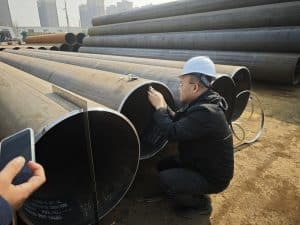
To ensure project safety, LONGMA recommends requiring suppliers to provide the following test reports (including heat number and batch tracing). Our internal laboratory performs tests according to ASTM / EN requirements.
- Tensile Test
- Purpose:Verify yield strength, tensile strength, elongation
- Standards:ASTM A370 (Ch. 7–14), EN ISO 6892-1
- Key Points:Test direction (L/T), yield type (Rp0.2 or ReH)
- Charpy V-Notch Impact Test
- Purpose:Confirm fracture toughness at 0°C
- Standards:ASTM E23, ISO 148-1
- Key Points:Average of three samples must ≥27J
- Chemical Composition Analysis (OES / Spectro)
Critical elements must meet S355J0 requirements: C, Mn, P, S, N.
(Notably, Indian Standards often allow wider P/S ranges.)
- Microstructure / Hardness Evaluation (for critical structural sections)
Used for pressure-bearing parts and high-risk welded joints, verifying controlled rolling or normalizing condition.
Risks in Cross-Standard Procurement (Why Name Similarity ≠ Equivalence)
Many suppliers judge s355j0 equivalent astm or s355j0 us equivalent based only on grade names.
However, real engineering risks are far deeper:
- Impact toughness requirements differ significantly
- S355J0: mandatory 0°C ≥ 27J
- A572 Gr.50: no mandatory impact requirement
➡Dangerous for cold regions, bridges, offshore structures.
- Chemical differences affect weldability
High Mn or high S can significantly increase cold crack risk.
- Delivery condition differences affect mechanical properties
N, AR, and TMCP conditions vary widely among suppliers.
- Thickness ranges affect yield strength
Yield strength decreases with increasing thickness—must compare actual dimensions.
Why Choose LONGMA: We Build Trust with Test Data, Not Marketing Words
LONGMA Provides:
- Complete internal laboratory (chemical, tensile, impact, metallography, hardness)
- Full heat-number traceability with source evidence
- EN / ASTM / IS cross-standard verification based on contract requirements
- Batch comparison reports, material conformity statements, production records
We firmly believe:
Real quality is not a promise — it is evidence you can verify.
Conclusion: This Article Directly Answers Users’ Core Questions
- What are the S355J0 equivalents?
- ASTM:A572 Grade 50
- US Engineering System:HSLA 50
- Indian Standard:IS 2062 E350 / E350C
- European Standard:S355 series (EN 10025-2)
- How to confirm true equivalence?
Check:
- Chemical composition
- Yield / tensile strength
- Impact toughness
- Thickness range
- Delivery condition
And verify through the four test categories above.
- Why choose LONGMA?
- 20+ years of manufacturing experience
- Full in-house laboratory
- Strong traceability
- Evidence-backed quality
- Lower procurement and engineering risk for customers
If you need, we can immediately provide:
- S355J0 Equivalent International Comparison Table (PDF)
- ASTM / EN / IS sample test reports
- Procurement technical specification (for EPC / contractors)
- Sample material certificates for pre-approval
Contact LONGMA for more technical information and samples.
Let every ton of steel be supported by evidence.