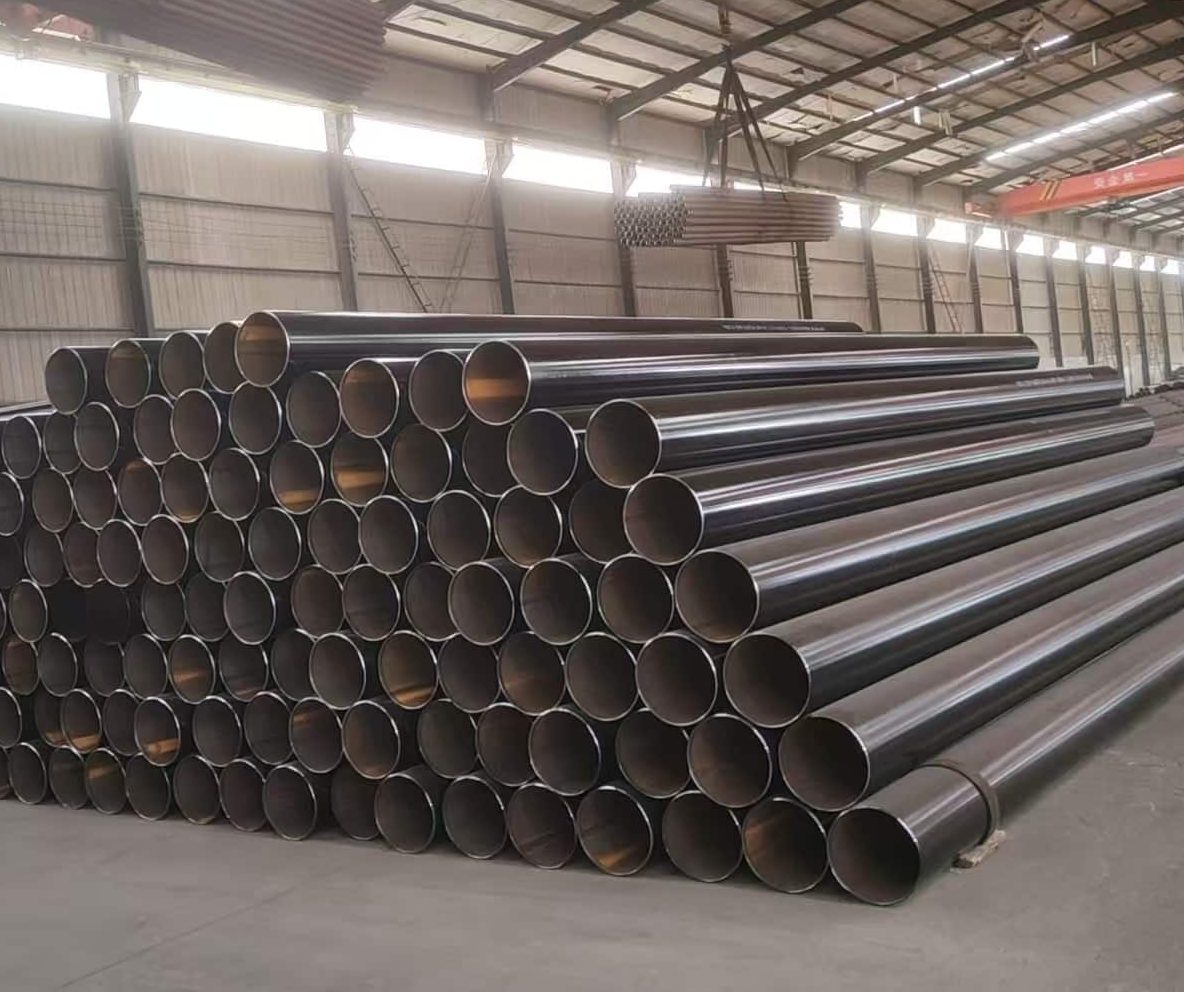
The primary distinction between a pipe pile and an H pile lies in their cross-sectional shapes and the methods they use to transfer load through the soil. A pipe pile is a circular steel section that is hollow and can either be open-ended or closed-ended, whereas an H pile is a solid steel section that is hot-rolled and H-shaped. Pipe piles provide options for varying diameter, wall thickness, and concrete fill, whereas H piles are typically effective for end-bearing applications and for driving into tough soil or rock.
Although both are elements of deep foundation, the correct option for a project should never be determined solely based on cross-section. The final decision is influenced by factors such as geotechnical conditions, design loads, available piling equipment, and the total installed cost. This guide contrasts the two types of piles, enabling engineers and buyers to make a choice based on data.
Quick Comparison: Pipe Pile vs H Pile
The table below outlines the key differences between a pipe pile and an H pile based on the factors that are most significant for procurement and foundation design.
| Factor | Pipe pile | H pile |
| Cross-section | Hollow circular steel section | Solid H-shaped rolled steel section |
| Pile end | Open-ended or closed-ended | Usually an open steel section around the flanges |
| Main load behavior | End bearing, skin friction, or combined action | Commonly end bearing, but also friction and tension applications |
| Concrete filling | Can be filled with concrete | Usually not filled in the same way |
| Diameter or section choice | Wide range of diameters and wall thicknesses | Selected by standard H-pile designation and weight |
| Hard soil or rock | May require a shoe, reinforcement, or predrilling | Often efficient for driving toward rock or a hard bearing layer |
| Splicing | Welded or mechanically connected extensions | Commonly welded splices |
| Typical uses | Bridges, marine structures, heavy foundations, caissons | Buildings, bridge piers, retaining systems, cofferdams |
| Key procurement concern | Diameter, wall thickness, end type, concrete and weld quality | Section size, steel grade, splice details and drivability |
What Is a Pipe Pile?
Pipe Pile Construction
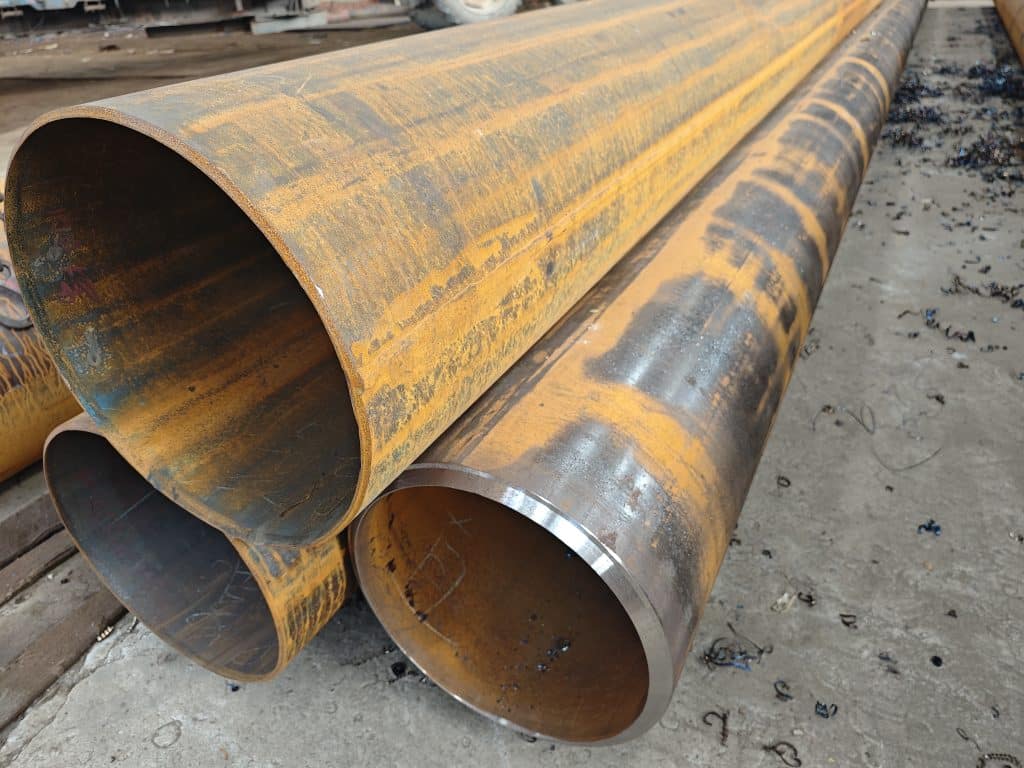
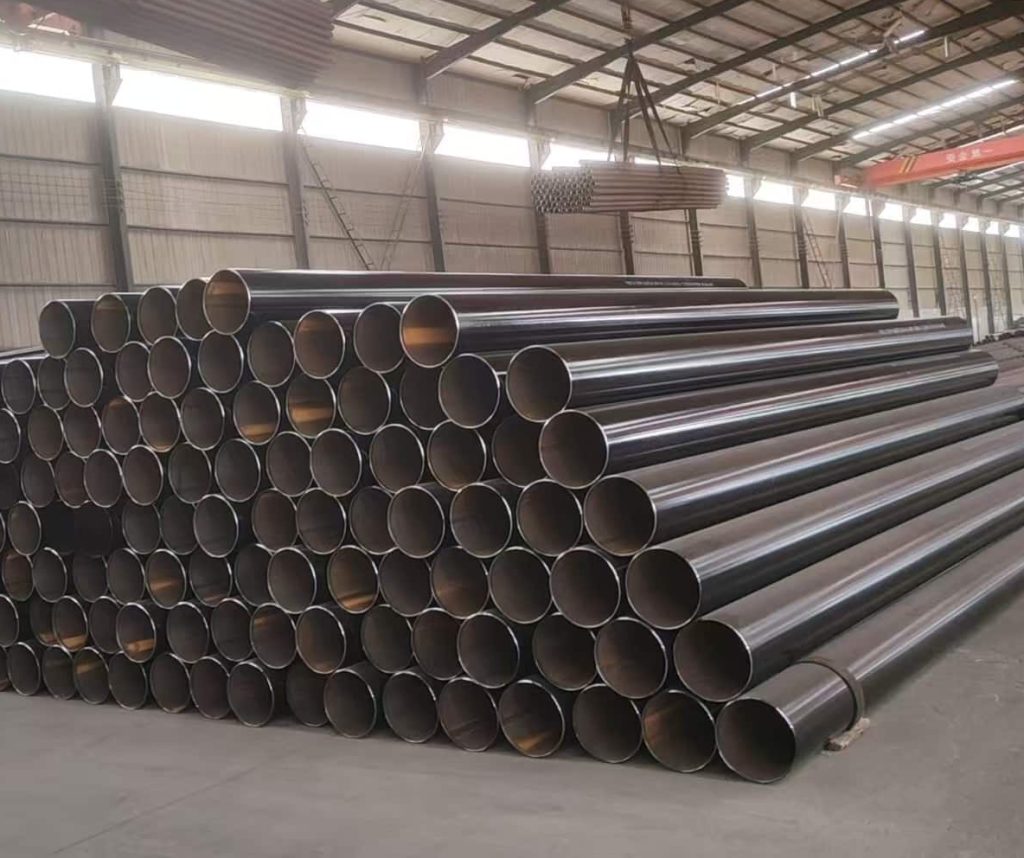
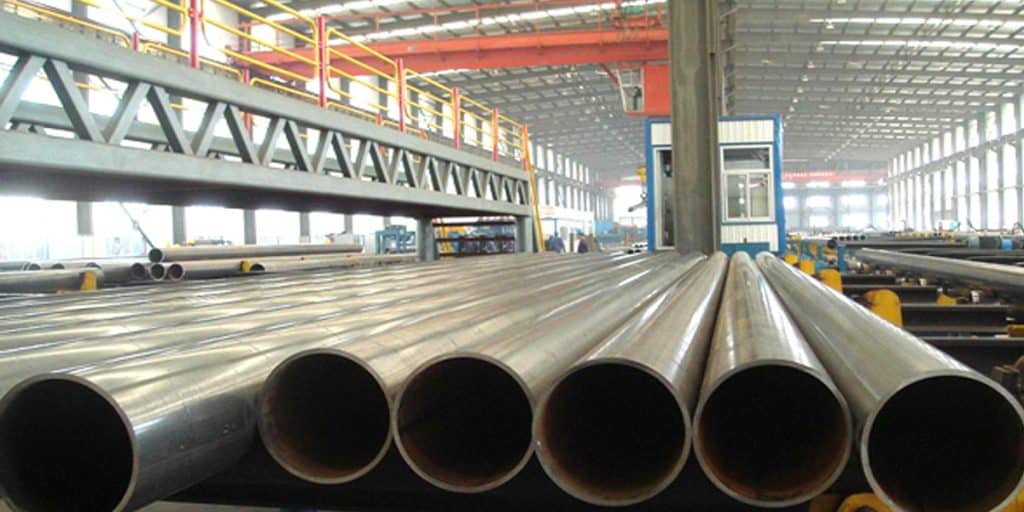
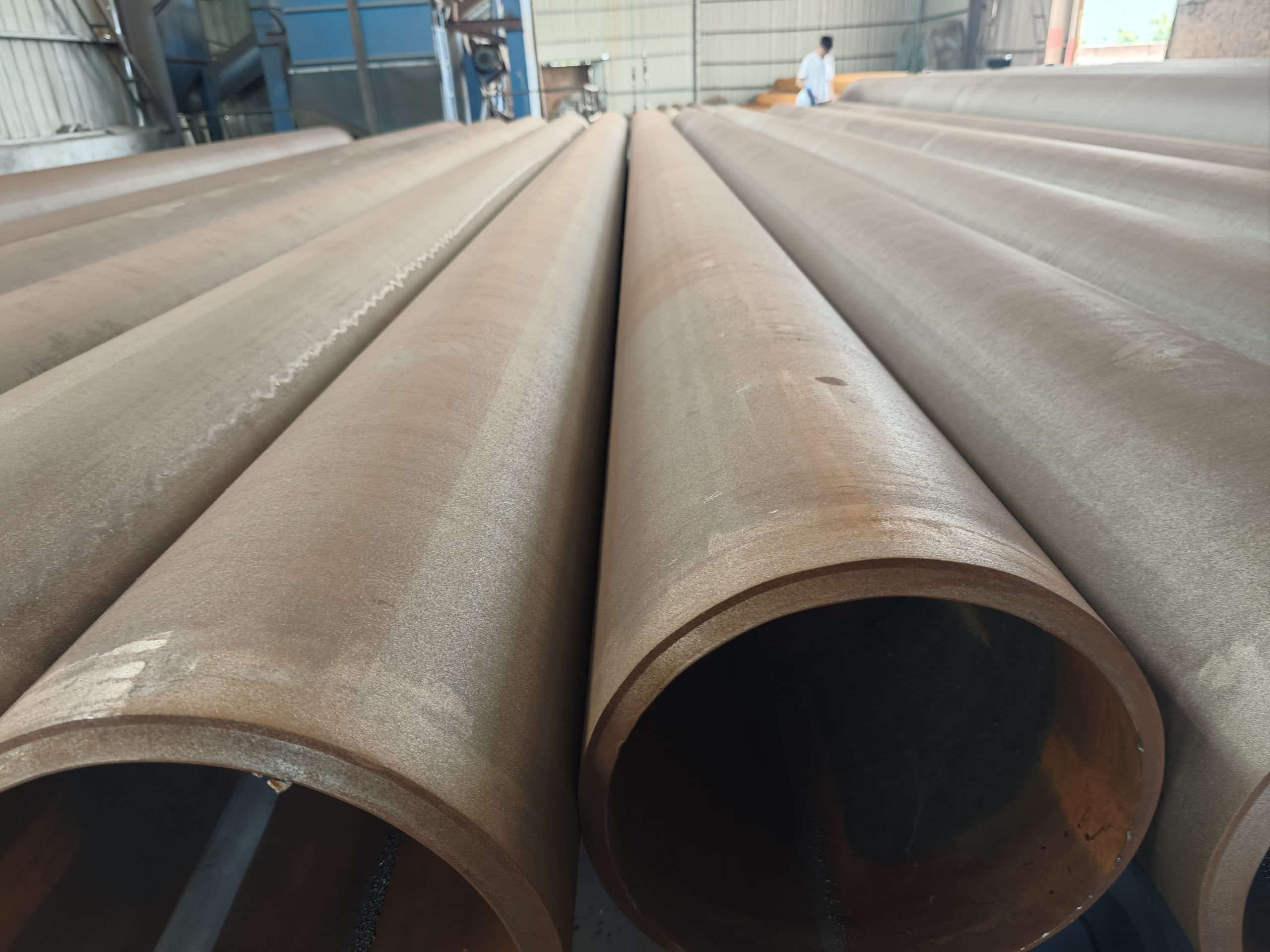
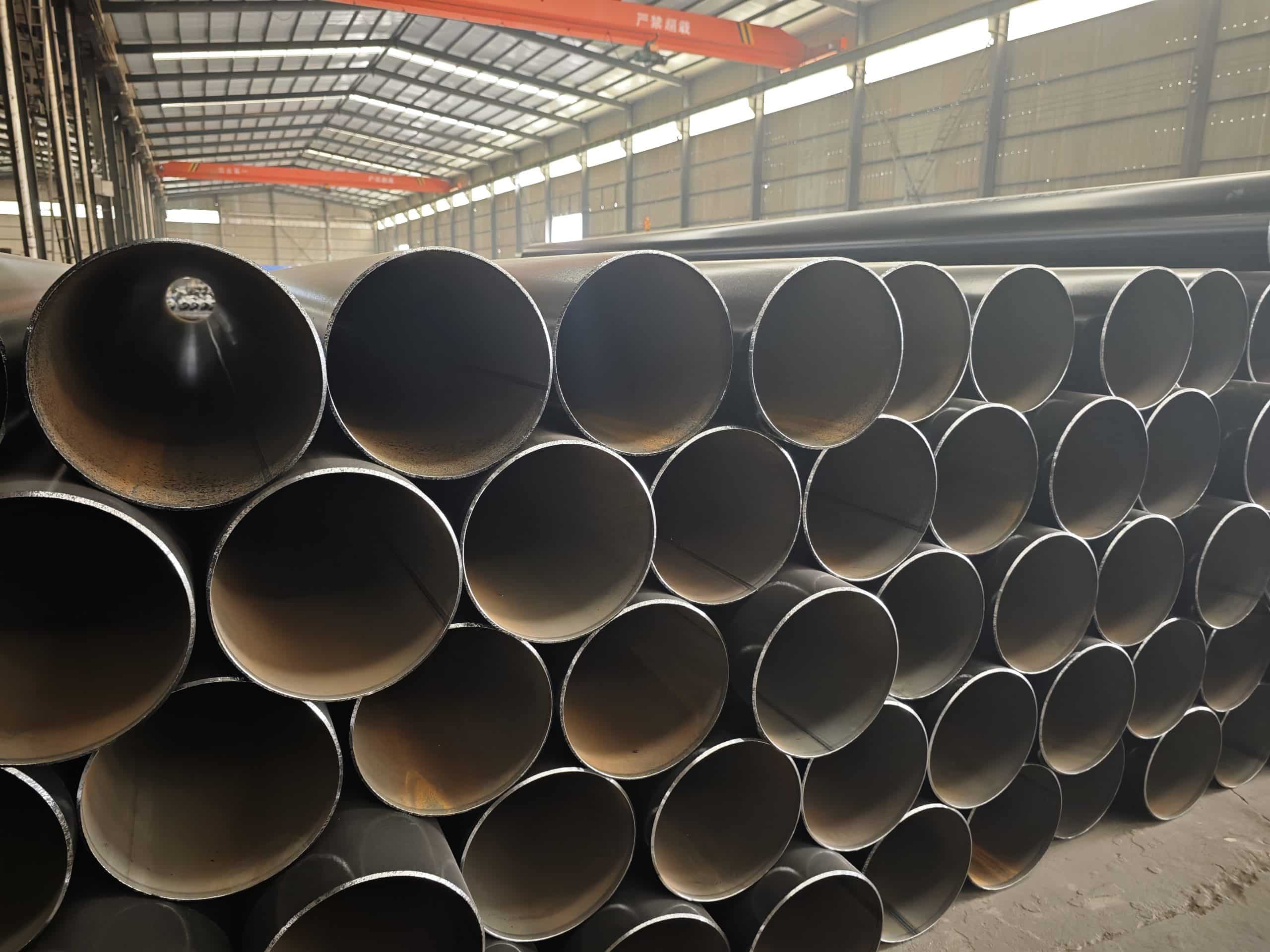
A pipe pile consists of a circular steel tube and serves as a deep foundation member. It is usually a hollow section, and can be produced as a welded steel pipe or a seamless pipe, depending on the diameter, wall thickness, and available manufacturing methods. Due to the hollow form, engineers have considerable leeway in determining dimensions, as the outside diameter and wall thickness can be adjusted to meet the necessary axial and lateral capacity without altering the manufacturing method. For a specified design, the pile diameter determines the base area and the side contact area, while the wall thickness regulates the steel area and, in conjunction with the grade, the structural strength of the section.
Due to the section being hollow, a pipe pile can be designed either as open-ended or closed-ended. An open-ended pipe is installed with its bottom left open, allowing soil to enter the tube while it is being driven, which typically decreases the driving resistance in comparison to a closed tip. A closed-ended pipe is equipped with a plate or shoe at its tip to displace soil during driving, which can enhance the end-bearing contribution but also increases the driving effort. After driving, a pipe pile can be filled with concrete to enhance its structural performance or to serve as a composite steel-concrete member. Additionally, if the design length surpasses transport limits, it can be extended on site by welding on extra sections.
The applicable specification defines the material grade of a pipe pile. The piling standard in North America is ASTM A252, which includes welded and seamless pipe piles in Grades 1, 2, and 3, with minimum yield strengths of 205 MPa, 240 MPa, and 310 MPa, respectively. In other regions, the pipe may be specified according to a pipe or line-pipe standard instead. Therefore, buyers should always verify which standard and grade are applicable to their project rather than assuming a single default.
Pipe Pile Load Transfer
There are three primary methods by which pipe piles support loads. With end bearing, the pile tip conveys the load down to a solid layer of soil or rock. Skin friction occurs when resistance builds up between the outer wall of the pile and the soil around it along the shaft. In combined bearing, the pile depends on both end bearing and skin friction simultaneously, which is typical for longer piles embedded in layered soils where neither mechanism alone is adequate.
Because the closed tip displaces soil as it is driven and mobilizes the full cross-sectional area at the base, a closed-ended pipe pile generally develops more pronounced end-bearing behavior. Inside an open-ended pipe pile, a soil plug may develop, and the real load-transfer behavior should be evaluated based on the soil profile and the driving process, rather than being inferred solely from the shape of the section. When the internal soil plug locks in and moves with the pile, the pile can start to behave more like a closed-ended section, making the plugging condition a crucial factor in the geotechnical calculation. These behavioral differences between a pipe pile and an H pile must be carefully considered in foundation design.
A pipe pile can be adjusted to support high axial loads, high lateral loads, or both, as it can be provided with different wall thicknesses while maintaining the same diameter. Pipe piles are selected for bridges, ports, and other heavy foundations where design loads differ across the site primarily due to this flexibility.
Pipe Pile Procurement Issues
When purchasing a pipe pile, it is important for buyers to verify several factors that influence both cost and structural performance. The outer diameter and wall thickness must comply with the design specifications, and the end condition must be specified as either open-ended or closed-ended. It is advisable for buyers to verify the necessity of a pile shoe, end plate, or reinforcing ring, ascertain if the pile will be filled with concrete, and determine if welds need ultrasonic or radiographic testing.
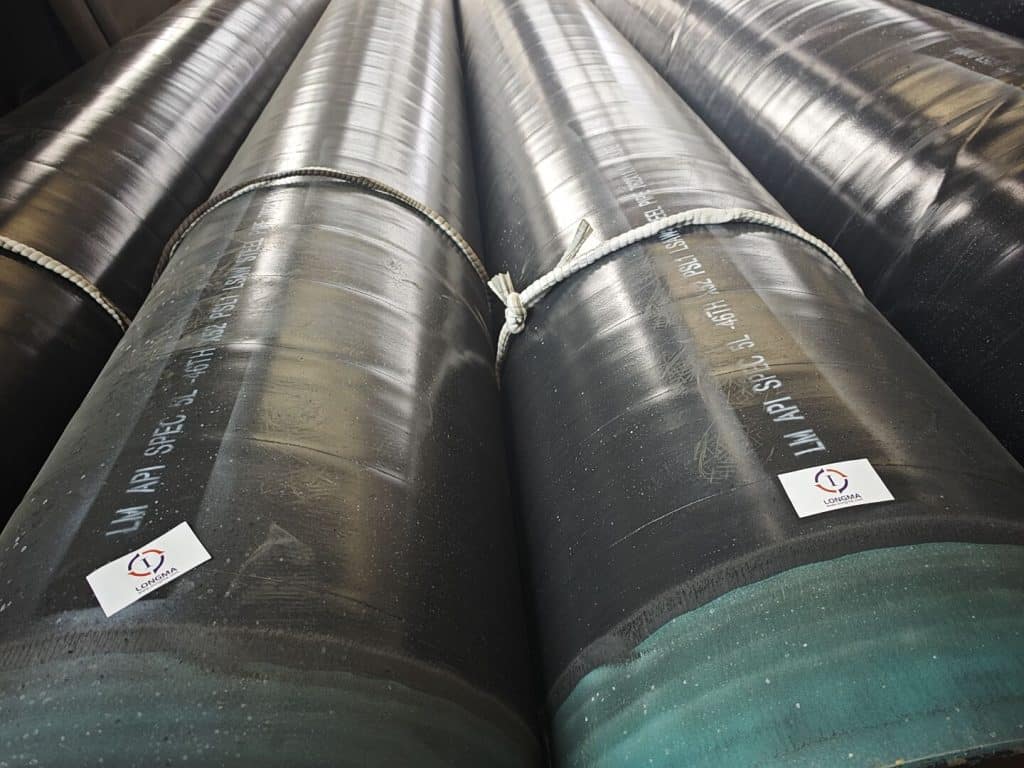
Another aspect that can be easily missed is corrosion protection. Due to the hollow nature of a pipe pile, its interior surface might need to be sealed or protected in damp conditions, while its exterior could necessitate a coating or a corrosion allowance to ensure it attains the intended service life. To ensure a clear transport and erection sequence prior to production, buyers should determine the length of each pile section and the field-splicing plan.
- If the outer diameter and wall thickness satisfy the design specifications.
- Configuration can be either open-ended or closed-ended.
- Whether it is necessary to use a pile shoe, end plate, or reinforcing ring.
- Whether the pile will be filled with concrete.
- Whether ultrasonic or radiographic testing is necessary for welds.
- Whether a corrosion coating or a corrosion allowance is necessary.
- The length of every pile segment and the plan for field splicing.
What Is an H Pile?
Comprising a hot-rolled H-shaped steel section, an H pile serves as a deep foundation member. It is made up of two flanges joined by a web and is typically a solid steel section instead of a hollow tube. Typically, sizing is indicated by the section dimensions and the weight per unit length. Therefore, an H pile is chosen from standard rolled sections rather than being tailored by diameter and wall thickness like a pipe pile.
H piles are typically produced in accordance with structural steel standards. High-strength low-alloy steel like ASTM A572 Grade 50 is a frequent selection; it has a specified minimum yield strength of 50 ksi (345 MPa) (ASTM A572, 2018). Welded joints can be used to extend the section on site, and it is usually installed with an impact hammer, a vibratory hammer, or hydraulic jacking to transfer the load to a deeper bearing layer. Since the section is rolled to a predetermined profile, its properties and availability are determined by the mill, not by the project.
Due to the compact cross-section of an H pile, it displaces relatively little soil when driven. This is one of its main advantages in hard ground and in situations where disturbance must be minimized. The identical form also facilitates handling, cutting, and splicing of the pile on location, which accounts for the common use of H piles in temporary constructions and end-bearing applications.
What Is the Main Structural Difference?
Pipe Pile Structural Behavior
Due to the circular cross-section of a pipe pile, it performs uniformly in all directions, which is beneficial when lateral loads may originate from any angle. It is appropriate for axial loads and a moderate amount of lateral load, and the addition of a closed end or concrete fill can enhance the tip and section capacity. The section can be adjusted to meet design requirements, ranging from small-diameter, thin-wall piles for light loads to large-diameter, thick-wall piles for heavy foundations, due to the flexible combination of diameter and wall thickness.
The empty interior, however, can lead to worries about internal corrosion, water ingress, and the quality control of the concrete fill. In marine or damp environments, the internal surface may require protection or sealing, and the concrete-fill process must be managed to prevent voids. These are practical issues that need to be addressed during design and inspection, as the interior of the pipe is not visible after driving, and any deficiencies are challenging to rectify once the pile is in the ground.
H pile Structural Behavior
Between the flanges and the web of an H pile, the H-shaped section exhibits a distinct directionality that has a direct impact on lateral capacity and bending resistance. Steel concentration in the flanges and web contributes to a high axial capacity for the section’s weight, and when driven into hard ground or rock, the section displaces relatively little soil. The section area effectively resists axial load, while the flanges bear the majority of the bending moment when the pile bends around its strong axis.
However, flanges, webs, and splices may sustain local damage during driving, making it important to assess their integrity after installation. Due to the presence of a clearly defined strong and weak axis in the section, the pile’s orientation in the design must be accurate, and driving stresses on the flanges should be examined when meeting hard layers. To prevent a thin flange from folding or splitting when overdriven into gravel or rock, proper toe protection and driving criteria are essential components of the design.
Pipe Pile vs H Pile in Different Soil Conditions
The optimal type of pile often varies based on the ground profile. The table below indicates where each type usually fits, but it serves as a starting point rather than a replacement for a project-specific analysis of a pipe pile versus an H pile.
| Ground condition | Potentially suitable option | Why |
| Rock or shallow hard bearing layer | H pile may be efficient | Small displacement and good drivability toward hard strata |
| Need for combined skin friction and end bearing | Pipe pile may be advantageous | Diameter, end type, and concrete filling can be customized |
| Soft soil with high axial loads | Pipe pile or H pile | Requires project-specific capacity and settlement analysis |
| Dense sand or gravel | Either, depending on equipment | Confirm driving stress, toe protection, and refusal criteria |
| Marine or corrosive soil | Either with protection | Coating, corrosion allowance, and service-life design are essential |
| Temporary shoring or cofferdam | H pile often convenient | Can be combined with sheet piles and potentially extracted |
| Large-diameter foundation | Pipe pile | Available in large diameters and can be concrete-filled |
H piles are usually more effective to install when rock or a hard bearing layer is located at a shallow depth, whereas pipe piles are advantageous for projects requiring high skin friction and end bearing, or higher combined vertical and lateral capacity. It should be the soil report that drives the comparison, rather than just the shape of the section.
Which Pile Is Easier to Install?
Pipe Pile Installation
Impact-hammer driving, vibratory-hammer driving, or hydraulic jacking (static press-in) can be used to install pipe piles. If there are hard layers or obstructions, predrilling might be necessary before driving the pile, which can be done either open-ended or closed-ended based on the design specifications. Where tip protection is necessary, a pile shoe or end reinforcement can be installed, with the choice between open or closed conditions made to optimize the driving effort in relation to the desired end-bearing behavior.
Long pipe piles can be transported in manageable lengths and connected on site, as they can be extended through field welding of additional sections. The required driving energy and the need for tip protection or predrilling depend on the open or closed end, wall thickness, and soil conditions. As the driving resistance can increase significantly in dense soils, the contractor should be prepared to reassess the blow count and termination criteria instead of pushing the pile beyond its safe driving stress.
H Pile Installation
H pile installation is usually carried out using the same types of equipment: impact hammer, vibratory hammer, or hydraulic jacking. Because of their small cross-sectional area in plan, H piles displace relatively little soil, which can speed up driving and lessen disturbance in sensitive ground. If there are obstructions or hard layers, predrilling can be employed, and length extensions are managed with welded splices that are created and examined according to the project’s welding procedure.
In hard soil or rock, predrilling or tip reinforcement may be necessary to safeguard the flanges and web from harm. Due to the thin flanges of the H section compared to a solid round section, it is necessary to examine the driving stress on the flanges and establish the termination criteria prior to commencing work. It is crucial to have a correctly sized hammer that matches the section, as both under-driving and over-driving can result in the pile being either below its target capacity or having damaged steel.
Pipe Pile or H Pile: How Should Buyers Decide?
The decision to use a pipe pile and an H pile should be based on a structured process, not on personal preference. Buyers should first acquire the geotechnical report and design loads, and then verify whether the pile will primarily function as end bearing, friction, or a combination of both. It is important to examine the soil profile for the presence of rock, gravel, or other obstructions, and to determine what piling equipment is available on site.
- Get the design loads and the geotechnical report first.
- Verify whether the pile will function primarily as an end bearing, friction, or a combination of both.
- Inspect the soil profile for rock, gravel, or barriers.
- Determine the effect of hammers, vibratory hammers, or jacking equipment that are present on site.
- Confirm the diameter of the pile, the thickness of the wall, the size of the H-section, and the length.
- Evaluate limitations related to noise, vibration, transportation, and field splicing.
- Compare the overall expenses related to materials, installation, inspection, and corrosion protection.
- Ask suppliers for a full list of technical deviations and quality documentation.
- Get the structural and geotechnical engineer to confirm the final selection.
Conclusion
Choosing between a pipe pile and an H pile correctly relies on factors such as the soil profile, structural loads, installation technique, pile dimensions, and overall installed cost. Before placing an order, buyers should use project-specific calculations to compare both options and request complete technical and inspection documentation.
Neither type of pile wins in all conditions. A pipe pile provides options for customization in terms of diameter, wall thickness, end type, and concrete filling, whereas an H pile is typically effective for end bearing, driving in hard soil, and serving as temporary shoring. The right answer is the choice that aligns with the design, rather than the one that sounds more forceful.
Subsequent actions:
Ask for a comparison of pipe piles and H-piles for your project.
Provide your soil data, pile load, size, and length specifications.
Request technical drawings, mill test certificates, and inspection documents.
Obtain a quote that reflects the total installed cost rather than just the cost of steel.
Email for contact: info@ilongma.com.
FAQ
1. Does a pipe pile have more strength than an H pile?
Not by default. The strength varies based on the chosen section, steel grade, dimensions, length, soil conditions, and installation technique. The option with greater capacity is the one that aligns with the structural and geotechnical design.
2. Which pile is superior for rock?
H piles are generally seen as efficient when a rock or hard bearing layer is within driving distance, but the ultimate choice relies on factors such as refusal criteria, pile stresses, toe protection, and the installation equipment at hand.
3. Which pile has better friction properties?
Both varieties can serve as friction piles. Pipe piles can provide greater flexibility in terms of diameter, wall thickness, whether they are open-ended or closed-ended, and the type of concrete used for filling.
4. Is it possible to fill pipe piles with concrete?
Indeed. When the structural design necessitates it, pipe piles can be constructed as steel shells or can be filled with concrete.
5. Is it possible to splice H piles?
Indeed. While welded splices are commonly used to extend H piles, it is important that the design of the splice and the welding procedure are approved for the project.
6. Do pipe piles cost more than H piles?
Neither type is guaranteed to be cheaper all the time. Compare the overall installed cost, which encompasses materials, fabrication, splicing, equipment, testing, transportation, and corrosion protection.