- 1. Standard Definition and Core Differences
- 2. Comparative Analysis of Chemical Compositions
- 3. Comparison of Mechanical Properties and Pressure Ratings
- 4. Differences in Application Scenarios
- 5. Comparison of Testing Methods and Standard Requirements
- 6. Procurement Risk Analysis
- 7. LONGMA’s Quality Control Advantages
- 8. Why Choose ASTM A691?
- 9. Conclusion: Choose the Right Standard to Reduce Project Risks
In high-temperature and high-pressure industrial piping systems, material selection directly determines project safety and long-term operating costs. As two common standards for electric fusion welded (EFW) steel pipes, ASTM A691 and ASTM A671 are frequently compared and selected by engineers and procurement professionals. This article systematically analyzes the differences between the two standards from multiple dimensions, including material composition, manufacturing process, application fields, pressure ratings and testing standards, helping you make informed decisions when purchasing ASTM A691 pipe, while demonstrating LONGMA’s advantages in manufacturing and quality control.
Standard Definition and Core Differences
| Item | ASTM A691 | ASTM A671 |
| Material Type | Alloy Steel | Carbon Steel |
| Manufacturing Method | Electric Fusion Welded (EFW) | Electric Fusion Welded (EFW) |
| Applicable Temperature | High Temperature (≥400°C) | Medium and Low Temperature |
| Typical Applications | Oil refining, power stations, petrochemicals | Water treatment, low-pressure transportation |
| Common Grades | ASTM A691 CL32, ASTM A691 Grade 2.1 4Cr | CA55, CB60, etc. |
Core Conclusion:
ASTM A691 is more suitable for high-temperature and high-pressure environments, while ASTM A671 is intended for conventional pressure or medium-low temperature working conditions.
Comparative Analysis of Chemical Compositions
ASTM A691 typically uses alloy steel plates (e.g., ASTM A387), whereas ASTM A671 mostly uses carbon steel plates (e.g., ASTM A285, A516).
Typical Chemical Composition Comparison
| Element | ASTM A691 (4Cr Gr.32) | ASTM A671 (A516 Gr.70) |
| C | ≤0.15% | ≤0.30% |
| Mn | 0.30–0.60% | 0.85–1.20% |
| Cr | 3.70–4.30% | — |
| Mo | 0.45–0.65% | — |
In ASTM A691 Grade 2.1 4Cr Gr 32, Cr and Mo elements significantly improve heat resistance and creep resistance. ASTM A671 contains no alloying elements and is more suitable for general working conditions.
Comparison of Mechanical Properties and Pressure Ratings
| Indicator | ASTM A691 | ASTM A671 |
| Tensile Strength | ≥515 MPa | 415–550 MPa |
| Yield Strength | ≥310 MPa | ≥240 MPa |
| High-Temperature Performance | Excellent | Average |
| Creep Resistance | Strong | Relatively Weak |
In high-temperature and high-pressure systems, ASTM A691 pipe outperforms ASTM A671 significantly, especially in power station boilers and hydrogenation units.
Differences in Application Scenarios
Applications of ASTM A691:
- High-temperature piping systems in oil refineries
- Main steam pipelines of power station boilers
- Petrochemical hydrogenation units
In particular, ASTM A691 CL32 and ASTM A691 Grade 2.1 4Cr are widely used in working conditions above 500°C.
Applications of ASTM A671:
- Urban water supply systems
- Low-pressure steam transportation
- General industrial pipelines
Comparison of Testing Methods and Standard Requirements
Both standards require strict quality control testing, but ASTM A691 imposes higher requirements.
- Chemical Analysis (ASTM A751)
- Purpose: Verify material composition
- Method: Spectroscopic analysis
- Key Point: Alloying elements must be strictly controlled
- Tensile Test (ASTM A370)
- Applicable Standards: A691 / A671
- Purpose: Determine strength and elongation
- Difference: A691 has stricter requirements for high-temperature performance
- Non-Destructive Testing (NDT)
| Testing Method | ASTM Standard | A691 Requirement | A671 Requirement |
| UT | ASTM A435 | Mandatory | Mandatory |
| RT | ASTM E94 | 100% weld inspection | Dependent on grade |
| MT | ASTM E709 | Recommended | Optional |
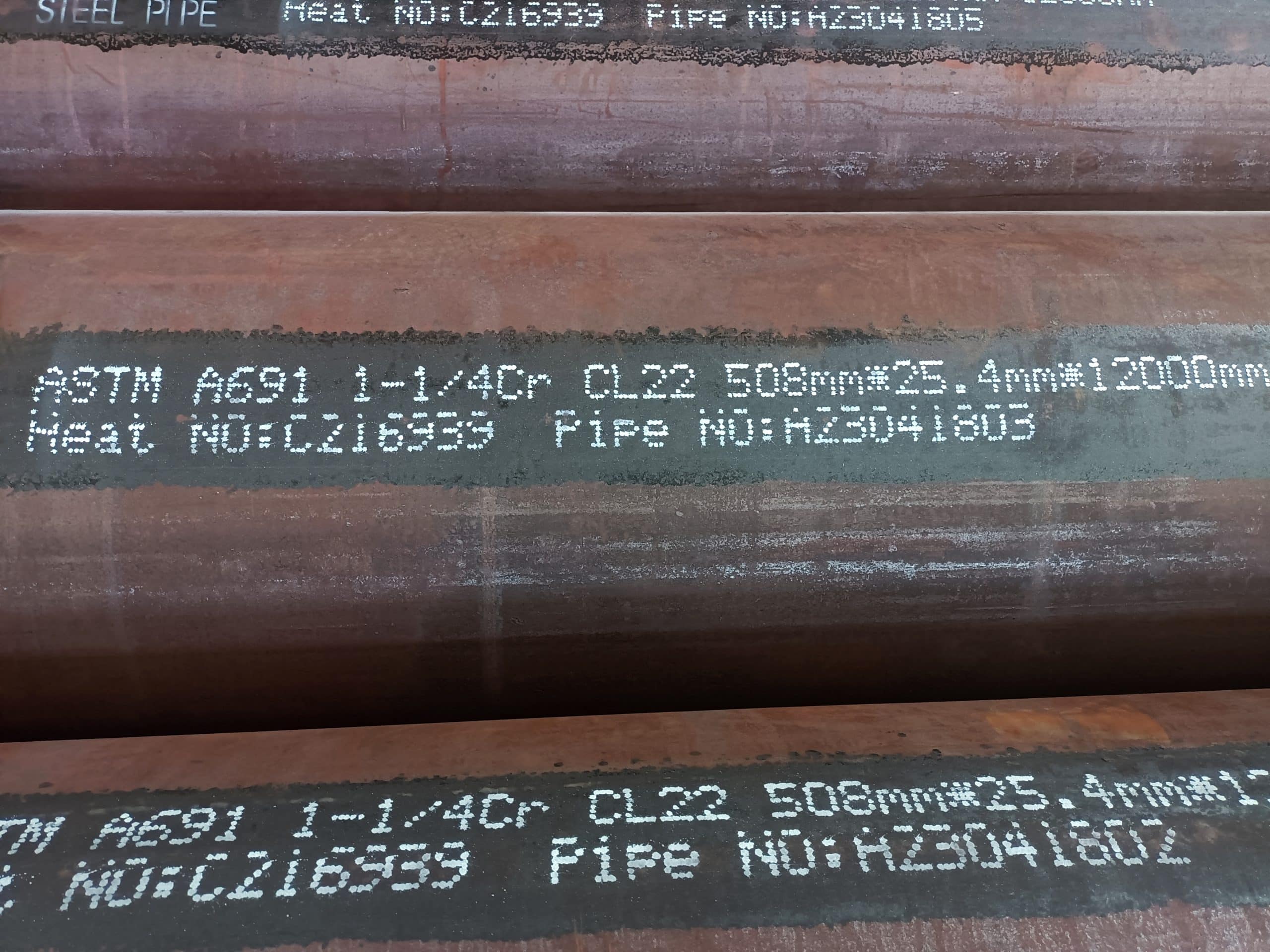
For export projects (e.g., ASTM A691 pipes & tubes in Spain), customers usually require 100% RT inspection.
- Heat Treatment Requirements
| Standard | Heat Treatment Method |
| ASTM A691 | Normalizing + Tempering (Mandatory) |
| ASTM A671 | Optional or required for partial grades |
Key Difference: ASTM A691 mandates heat treatment to ensure microstructural stability and high-temperature performance.
Procurement Risk Analysis
In actual procurement, customers often encounter the following issues:
❗ Risk of Material Misuse
Some suppliers substitute A671 for A691 to cut costs, which severely compromises safety.
❗ Insufficient Alloying Elements
Failure to meet ASTM A691 Grade 2.1 4Cr requirements leads to high-temperature failure.
❗ Non-Standard Welding and Heat Treatment
Affects the long service life of ASTM A691 pipe.
❗ Opaque Testing
Lack of complete laboratory data support.
LONGMA’s Quality Control Advantages
With over 20 years of experience as a steel pipe manufacturer, LONGMA has significant advantages in the field of high-end alloy steel pipes:
✔ In-House Laboratory System
- Optical Emission Spectrometer (OES)
- Universal Tensile Testing Machine
- Impact Testing Equipment
- Non-Destructive Testing Equipment (UT / RT)
All ASTM A691 pipes undergo strict testing with complete reports provided.
✔ Full-Process Quality Control
Comprehensive control from raw materials (A387 plates) to finished products, ensuring every ASTM A691 CL32 product complies with standards.
✔ International Project Experience
Successfully delivered multiple European projects, including ASTM A691 pipes & tubes in Spain, complying with both ASTM and EN standards.
✔ Technical Support Capability
Provides selection advice to customers, avoiding risks caused by mixing ASTM A691 and A671.
Why Choose ASTM A691?
If your project involves high temperatures, high pressures or critical equipment, choosing ASTM A691 Grade 2.1 4Cr Gr 32 is a safer solution:
- Superior high-temperature resistance
- Higher creep resistance
- Longer service life
- Lower maintenance costs
Conclusion: Choose the Right Standard to Reduce Project Risks
A comprehensive comparison of ASTM A691 and ASTM A671 reveals essential differences in materials, performance and applications. For critical industrial projects, selecting ASTM A691 is not only a technical requirement but also a safety guarantee.
Relying on an advanced in-house laboratory and strict quality system, LONGMA provides highly reliable ASTM A691 pipe solutions for global customers, supporting long-term stable project operation.
Contact us today to make your procurement safer and more efficient!