- 1. Why Is Steel Pipe Production Efficiency So Important?
- 2. Optimizing Raw Material Management to Improve Production Efficiency
- 3. Improving Forming Process Stability
- 4. Intelligent Welding Technology Improves Production Speed
- 5. Online Inspection Technology Reduces Rework Rates
- 6. Digital Production Management Improves Resource Utilization
- 7. Optimizing Heat Treatment and Straightening Processes
- 8. How LONGMA Internal Laboratory Ensures High Efficiency and Quality
- 9. Value of Process Optimization for Customers
- 10. Conclusion
In the context of continuous development in global energy infrastructure, oil and gas transportation, offshore engineering, and urban pipeline networks, the demand for high-quality steel pipes continues to grow. However, for steel pipe manufacturers, simply expanding production capacity is no longer sufficient to meet increasingly intense market competition. Improving production efficiency while ensuring product quality, reducing manufacturing costs, and shortening delivery cycles has become a key benchmark for evaluating the overall competitiveness of steel pipe manufacturers.
As a professional steel pipe manufacturer with over 20 years of industry experience, LONGMA has always been committed to improving production efficiency through process optimization and technological innovation. By adopting intelligent equipment, digital management systems, advanced inspection technologies, and a comprehensive quality control system, LONGMA not only achieves efficient production but also ensures that every API 5L steel pipe and LSAW steel pipe meets international standards. This article analyzes key process optimization strategies for improving steel pipe production efficiency from multiple perspectives.
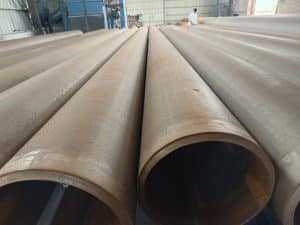
Why Is Steel Pipe Production Efficiency So Important?
For international buyers, a supplier’s production efficiency directly affects not only pricing but also project schedules and supply stability.
Low production efficiency may lead to:
- Extended delivery cycles
- Increased risk of project delays
- Rising production costs
- Reduced product consistency
In contrast, an efficient steel pipe production system can achieve:
- Faster delivery
- More stable quality
- Lower overall cost
- Stronger project assurance capability
Therefore, more customers now prioritize production processes and manufacturing capabilities when selecting steel pipe suppliers.
Optimizing Raw Material Management to Improve Production Efficiency
Steel pipe production begins with raw materials.
High-quality steel plates not only affect product performance but also directly influence production efficiency.
Raw Material Optimization Measures
LONGMA adopts:
- Strict supplier evaluation system
- 100% incoming inspection of steel plates
- Automated warehouse management system
Main Inspection Items
| Inspection Item | Purpose |
| Chemical composition analysis | Verify compliance with standards |
| Thickness inspection | Ensure dimensional consistency |
| Surface inspection | Detect cracks and defects |
| Mechanical property verification | Ensure forming performance |
High-quality raw materials reduce rework rates and improve overall production efficiency.
Improving Forming Process Stability
In LSAW steel pipe production, the forming process directly affects dimensional accuracy and welding quality.
Key Process Optimization
Automated forming control
Through PLC control systems, LONGMA achieves:
- Automatic adjustment of pressing force
- Automatic control of forming angle
- Real-time equipment monitoring
Comparison of Results
| Item | Traditional Process | Optimized Process |
| Forming accuracy | High fluctuation | More stable |
| Adjustment time | Longer | Significantly reduced |
| Rework rate | Higher | Effectively reduced |
| Production efficiency | Average | Significantly improved |
Stable forming processes are the foundation of improved steel pipe production efficiency.
Intelligent Welding Technology Improves Production Speed
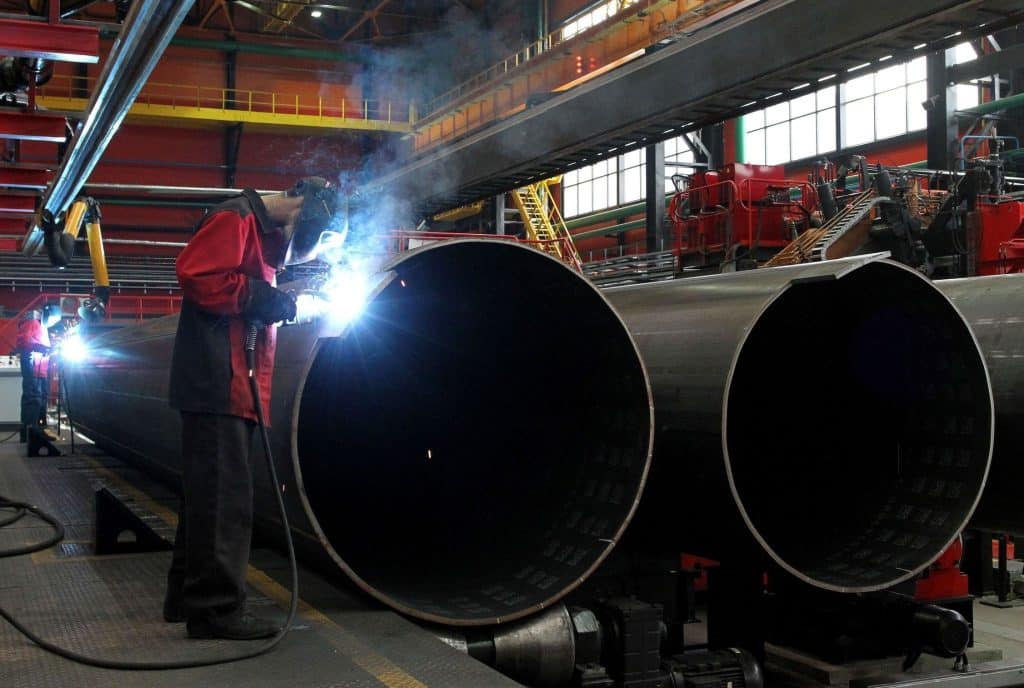
Welding is one of the most critical processes in steel pipe manufacturing.
LONGMA Intelligent Welding System
The system enables:
- Automatic weld seam tracking
- Automatic parameter adjustment
- Real-time heat input control
Technical Advantages
Traditional welding has:
- Parameter fluctuations
- High dependency on manual operation
- Limited welding speed
Intelligent welding systems can:
- Increase welding speed
- Reduce welding consumables
- Decrease welding defects
while ensuring API 5L steel pipe weld quality compliance.
Online Inspection Technology Reduces Rework Rates
Quality issues are a major factor affecting production efficiency.
LONGMA integrates online inspection throughout the entire production process.
- Laser Dimensional Inspection
Inspection purpose:
Real-time monitoring of:
- Outer diameter
- Roundness
- Ovality
- Wall thickness
Standards:
- API 5L Section 10
- ISO 3183 Clause 9
- Online Ultrasonic Testing (UT)
Inspection purpose:
Detection of:
- Laminations
- Cracks
- Lack of fusion
Process:
- Automatic pipe scanning
- Signal recognition
- Automatic alarm
- Data storage
Standards:
- API 5L Annex E
- ISO 10893-10
- Online Radiographic Testing (RT)
Inspection purpose:
Verification of weld internal quality.
Defects detected:
- Porosity
- Slag inclusions
- Incomplete penetration
Standards:
- ISO 10893-7
- API 5L PSL2
Through online inspection, defects can be identified and corrected during production, significantly reducing rework and downtime.
Digital Production Management Improves Resource Utilization
Modern steel pipe manufacturing has entered the era of intelligent manufacturing.
LONGMA has established a digital production management platform that enables:
Core Functions
- Real-time equipment monitoring
- Process parameter management
- Energy consumption analysis
- Production scheduling optimization
Practical Benefits
| Management Method | Traditional | Digital |
| Data collection | Manual | Automatic |
| Information feedback | Delayed | Real-time |
| Equipment utilization | Average | Higher |
| Decision efficiency | Slower | Faster |
Digital management significantly improves overall operational efficiency.
Optimizing Heat Treatment and Straightening Processes
Heat treatment and straightening affect both product performance and production rhythm.
Heat Treatment Optimization
LONGMA adopts:
- Automatic temperature control systems
- Intelligent heat preservation control
- Energy consumption optimization management
Ensuring:
- Uniform microstructure
- Stable mechanical properties
- Improved processing efficiency
CNC Straightening Technology
Through automatic adjustment of straightening parameters:
- Improved straightness
- Reduced manual intervention
- Shortened adjustment time
This is especially important for large-diameter steel pipe production.
How LONGMA Internal Laboratory Ensures High Efficiency and Quality
Many buyers worry whether improving efficiency will affect product quality.
LONGMA maintains a balanced focus on both efficiency and quality.
Laboratory Equipment
- Optical emission spectrometer
- Metallographic microscope
- Tensile testing machine
- Impact testing machine
- Ultrasonic testing equipment
- X-ray inspection system
Key Verification Items
| Test Item | Purpose | Standard |
| Chemical composition analysis | Material verification | API 5L / ISO 3183 |
| Tensile test | Strength verification | ASTM A370 |
| Impact test | Low-temperature toughness | API 5L PSL2 |
| Metallographic analysis | Microstructure evaluation | ASTM E112 |
| UT re-inspection | Internal quality | ISO 10893 |
| Dimensional inspection | Geometric accuracy | API 5L Section 10 |
All test results are digitally archived and fully traceable.
Value of Process Optimization for Customers
For international buyers, high production efficiency means:
Shorter Delivery Cycles:Stable production capacity reduces project waiting time.
Lower Procurement Risk:Comprehensive quality control reduces batch quality issues.
Higher Product Consistency:Automation reduces human error.
Stronger Supply Assurance Capability:Meets continuous supply requirements for large-scale projects.
These advantages are directly related to project success and economic performance.
Conclusion
Improving steel pipe production efficiency means not only faster production speed, but also more stable quality, lower manufacturing costs, and more reliable delivery capability. Every stage—from raw material management, forming process optimization, intelligent welding, online inspection, to digital production management—affects overall production efficiency.
For buyers, selecting a steel pipe manufacturer with advanced processes, a comprehensive quality control system, and strong production capabilities is essential to ensure smooth project execution. With over 20 years of industry experience, advanced manufacturing technologies, and strict quality management systems, LONGMA continues to provide reliable steel pipe products and services for global energy, infrastructure, and industrial customers.