- 1. What Are API 5L and ISO 3183?
- 2. Relationship Between ISO 3183 and API 5L
- 3. ISO 3183 vs. API 5L: Core Differences
- 4. PSL1 vs. PSL2: Core Difference in Procurement Risks
- 5. Differences in Chemical Composition Control
- 6. Differences in Testing Requirements: Why an In-House Laboratory Is Critical
- 7. How to Select the Right API 5L Steel Grade
- 8. Differences Between API 5L and ASTM A106 / A53
- 9. How LONGMA Helps Customers Reduce Procurement Risks
- 10. Conclusion
In the global oil and gas transmission sector, ISO 3183 and API 5L are the core standards for line pipe steel. Whether sourcing API 5L line pipe, designing long-distance oil and gas projects, or selecting high-grade products such as API 5L X52 pipe and API 5L X65 pipe, buyers need an in-depth understanding of the differences between the two standards.
For engineering companies, EPC contractors, and end energy enterprises, incorrect material selection not only increases procurement costs but may also lead to serious risks such as welding failure, low-temperature brittle fracture, and SSC/HIC corrosion. Therefore, understanding the correspondence between ISO 3183 and API 5L, as well as the requirements for different PSL levels, has become a key part of procurement for international projects.
With over 20 years of manufacturing experience, LONGMA will conduct an in-depth analysis of the core differences between ISO 3183 and API 5L from multiple dimensions, including standard systems, chemical composition, mechanical properties, testing requirements, application scenarios, and procurement risk control.
What Are API 5L and ISO 3183?
Overview of API 5L Standard
API 5L, full name API Specification 5L: Specification for Line Pipe, is formulated by the American Petroleum Institute (API) and is mainly used for oil, natural gas, and water transmission pipelines.
The widely used versions in the international market are:
- API 5L 45th Edition
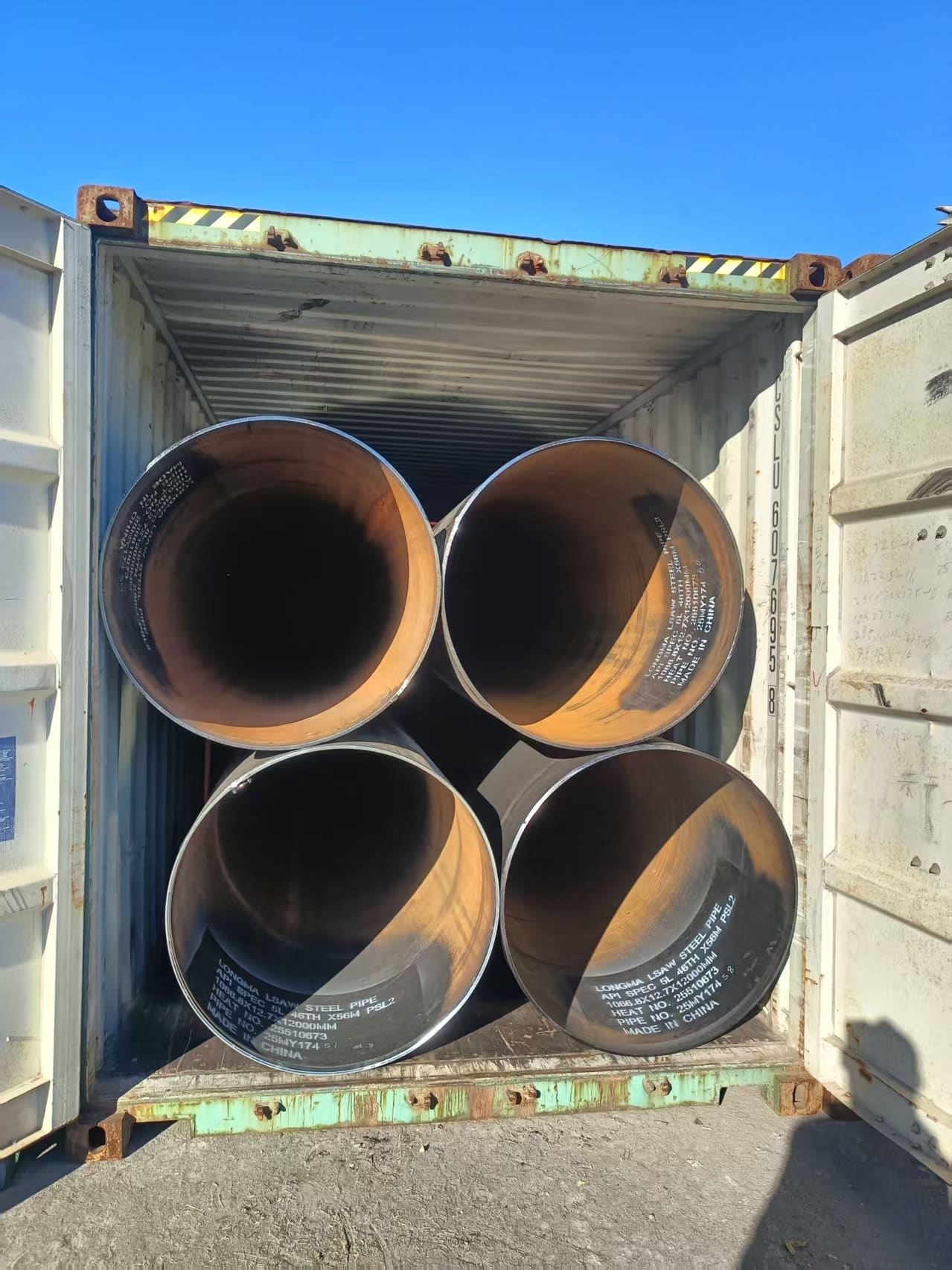
- API 5L 46th Edition
- The latest edition of API 5L
Among them, API 5L 46th Edition is highly harmonized with ISO 3183.
Common steel grades are as follows:
| API Steel Grade | Minimum Yield Strength |
| API 5L Gr B | 245 MPa |
| API 5L X42 | 290 MPa |
| API 5L X52 | 359 MPa |
| API 5L X60 | 414 MPa |
| API 5L X65 | 448 MPa |
| API 5L X70 | 483 MPa |
Examples:
- API 5L Gr B pipe
- API 5L X52 PSL2
- API 5L Gr X65 PSL2
- API 5L X70 PSL2
All are common materials in international oil and gas projects.
Relationship Between ISO 3183 and API 5L
Many customers ask:”Are ISO 3183 and API 5L exactly the same?”
The answer is: they are highly equivalent, but ISO 3183 is more oriented toward an international system, while API 5L focuses more on petroleum industry applications.
In fact:
- ISO 3183 is developed based on API Spec 5L
- They are highly consistent in dimensions, mechanical properties, and chemical composition
- API 5L emphasizes adaptability to the oil and natural gas industry
- ISO 3183 is more easily referenced by international EPC projects
Therefore, many international bidding documents simultaneously specify:
- API Specification 5L
- ISO 3183 / API 5L
- API Spec 5L Specification for Line Pipe
ISO 3183 vs. API 5L: Core Differences
| Item | ISO 3183 | API 5L |
| Standard Attribute | International standard | Petroleum industry standard |
| Issuing Body | ISO | American Petroleum Institute |
| Scope of Application | Global engineering projects | Oil and gas transmission sector |
| PSL Levels | PSL1 / PSL2 | PSL1 / PSL2 |
| Sour Service | More stringent requirements for HIC/SSC | Specified in Annex H |
| Certification System | ISO international system | API Monogram |
| Market Recognition | Common in EPC projects | Prevalent in North American oil and gas sector |
PSL1 vs. PSL2: Core Difference in Procurement Risks
Many procurement issues essentially focus on:
- API 5L PSL1 vs. PSL2
- Difference between API 5L PSL1 and PSL2
PSL1
Applicable to:
- Ordinary water transmission
- Medium and low-pressure oil and gas
- General structural purposes
PSL2
Applicable to:
- Offshore platforms
- High-pressure natural gas
- Sour service environments
- Long-distance oil and gas transmission pipelines
PSL2 adds requirements for:
- Impact testing
- DWTT (Drop Weight Tear Test)
- More stringent chemical composition control
- NDT (Non-Destructive Testing)
- CVN toughness requirements
Examples:
- API 5L Gr B PSL2
- API 5L X52 PSL2
- API 5L X65 PSL2
These are in high demand in international energy projects.
Differences in Chemical Composition Control
For high-grade materials, buyers are most concerned about:
- Excessively high carbon equivalent
- Poor weldability
- Insufficient low-temperature toughness
ISO 3183 generally imposes stricter control on CE (Carbon Equivalent).
Example:
| Steel Grade | Maximum Carbon Content |
| API 5L Gr B | 0.28% |
| API 5L X52 | 0.24% |
| API 5L X65 | 0.20% |
LONGMA adopts:
- Vacuum degassing
- TMCP (Thermo-Mechanical Control Process)
- On-line spectral analysis
To ensure that API 5L material specifications meet the requirements of international projects.
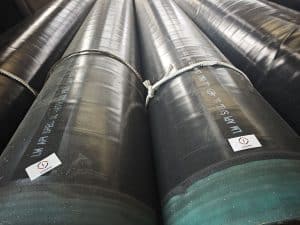
Differences in Testing Requirements: Why an In-House Laboratory Is Critical
What truly impacts project risks is not price, but testing capabilities.
- Hydrostatic Test
Standards referenced:
- API 5L Section 10
- ISO 3183 Clause 11
Purpose:
- Detect leaks
- Verify pressure-bearing capacity
LONGMA conducts on-line hydrostatic testing on every API 5L steel pipe.
- Ultrasonic Testing (UT)
Applicable to:
- API 5L seamless pipe
- API 5L ERW pipe
- API 5L LSAW pipe
Standards referenced:
- ASTM E213
- ASTM E273
Test items:
- Delamination
- Cracks
- Incomplete fusion
UT testing is almost mandatory for API 5L PSL2 pipe.
- Drop Weight Tear Test (DWTT)
Mainly for:
- API 5L X65
- API 5L X70
- API 5L X80
Purpose: Prevent brittle fracture propagation in long-distance natural gas pipelines.
- HIC / SSC Testing
Applicable to:
- Sour oil and gas environments
- NACE MR0175 projects
LONGMA’s in-house laboratory can perform:
- HIC Test
- SSC Test
- Charpy Impact Test
- Hardness Test
This builds greater customer trust than simply claiming “high quality”.
How to Select the Right API 5L Steel Grade
- API 5L Gr B
Applicable to:
- Ordinary water transmission
- Medium and low-pressure transmission
Common products:
- API 5L Gr B seamless pipe
- API 5L Gr.B PSL1
- API 5L Grade B pipe
Advantages:
- Low cost
- Easy to weld
- API 5L X52
Applicable to:
- Medium and high-pressure natural gas
- Long-distance transmission pipelines
Its yield strength reaches 359 MPa.
Compared with Gr B:
- Higher strength
- Thinner wall thickness
- Lower overall project cost
- API 5L X65
Applicable to:
- Subsea pipelines
- High-pressure natural gas
- Ultra-long-distance transmission
Its high strength significantly reduces:
- Pipeline weight
- Number of welds
- Installation costs
Differences Between API 5L and ASTM A106 / A53
Many buyers confuse:
- API 5L vs. ASTM A106
- API 5L vs. ASTM A53
Core differences:
| Standard | Main Application |
| API 5L | Line pipe transmission |
| ASTM A106 | High-temperature fluids |
| ASTM A53 | Structural and low-pressure use |
Therefore:
- Long-distance oil and gas projects must prioritize API 5L pipe
- High-temperature boiler systems are more suitable for A106
How LONGMA Helps Customers Reduce Procurement Risks
As a professional Chinese API 5L steel pipe manufacturer, LONGMA offers:
- Comprehensive Manufacturing Capabilities
- LSAW
- SSAW
- ERW
- Seamless
Covers:
- API 5L carbon steel pipe
- API 5L welded pipe
- API 5L seamless steel pipe
- Strict Quality Control
LONGMA’s in-house laboratory can perform:
- Chemical analysis
- Impact testing
- DWTT
- UT/RT
- Hydrostatic testing
- Dimensional inspection
To ensure compliance with international standards for:
- API 5L pipe tolerances
- API 5L wall thickness tolerance
- API 5L ovality tolerance
- International Project Experience
LONGMA has served:
- Oil and gas projects in the Middle East
- Natural gas projects in Southeast Asia
- Water transmission projects in Africa
- Energy EPC projects in Europe
Able to provide:
- EN10204 3.1/3.2 certificates
- NACE documentation
- Third-party inspection
- API Monogram
Conclusion
In the global oil and gas transmission industry, understanding the differences between ISO 3183 and API 5L is not only a technical issue but also a key part of procurement risk control.
Selecting a supplier with genuine manufacturing capabilities, a complete laboratory system, and international project experience is critical to ensuring safe project operation.
With over 20 years of steel pipe manufacturing experience, LONGMA is committed to providing global customers with high-quality API 5L steel pipe solutions, helping reduce procurement risks, improve engineering reliability, and optimize overall project costs.