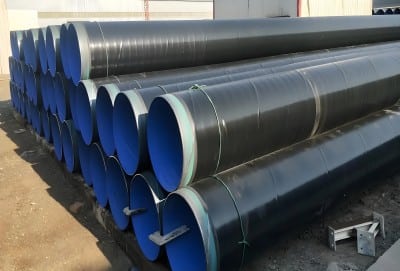
- 1. Why FBE Coating Testing Matters
- 2. Applicable Standards: Use the Right Standard for the Right Coating
- 3. Core Testing Methods for FBE-Coated Pipes
- 4. How Buyers Should Review an FBE Inspection Package
- 5. FBE vs. 3LPE: Do Not Mix the Test Standards
- 6. Practical Procurement Checklist
- 7. FAQ
- 8. Partner with LONGMA for FBE-Coated Steel Pipe
Fusion-bonded epoxy (FBE) coating is widely used to protect steel pipe from external corrosion in buried or submerged service. For procurement teams, however, specifying an FBE-coated pipe is only the first step. The coating must also be inspected and tested under a documented inspection and test plan (ITP) to verify thickness, continuity, adhesion, cure, and resistance to cathodic disbondment. A coating that looks uniform can still contain holidays, local under-cure, poor surface preparation, or adhesion defects that may shorten field performance.
This article explains the principal testing methods used for FBE-coated steel pipe and, more importantly, how buyers should connect each test to the correct coating standard and project specification. For single-layer external FBE on oil and gas transmission pipe, ISO 21809-2:2026 is the relevant ISO standard. For steel water pipe and fittings, AWWA C213-22 is a key reference. Polyolefin standards such as ISO 21809-1 and DIN 30670 apply to 3LPE/3LPP or polyethylene coating systems and should not be cited as if they were single-layer FBE standards.
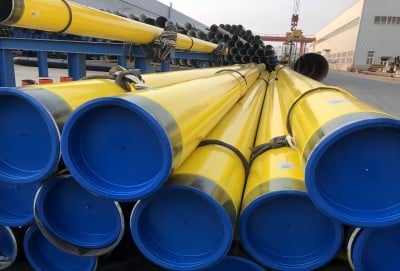
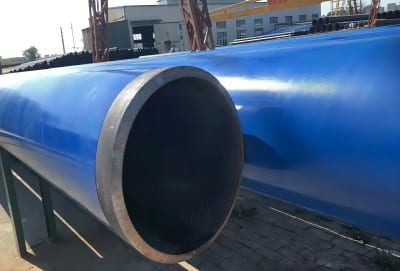
Why FBE Coating Testing Matters
FBE performance depends on the complete coating process: steel surface condition, blast-cleaning quality, preheating, powder application, cure, handling, and final inspection. Testing is therefore not a single end-of-line activity. It is a combination of process control and product verification performed at defined stages of production.
- Surface preparation checks confirm that the steel is clean and suitably profiled before coating.
- Dry film thickness (DFT) measurements verify that the applied coating is within the specified range.
- Holiday detection identifies pinholes, voids, and discontinuities that expose bare steel.
- Adhesion and flexibility tests assess whether the coating remains bonded during handling or deformation.
- Cathodic disbondment testing evaluates resistance to coating separation around an intentional defect under cathodic protection conditions.
- Thermal analysis such as DSC can be used, where required, to evaluate cure characteristics against the qualified coating system.
Applicable Standards: Use the Right Standard for the Right Coating
| Standard / specification | Primary application | How to use it in procurement |
| ISO 21809-2:2026 | Single-layer external FBE coating for steel pipe used in oil and gas pipeline transportation systems | Use for qualification, application, inspection, testing, handling, and storage requirements for the specified FBE system. |
| AWWA C213-22 | FBE coatings and linings for steel water pipe and fittings | Use for water-industry projects when the owner or specification calls for AWWA C213. |
| CSA Z245.20 | Plant-applied external coatings for steel pipe, including FBE systems within its scope | Use when required by Canadian or project specifications; confirm the edition stated in the purchase order. |
| ISO 21809-1 | Polyolefin coating systems such as 3LPE/3LPP | Do not use as the primary standard for standalone single-layer FBE. |
| DIN 30670 | Polyethylene coatings on steel pipes and fittings | Relevant to PE coating systems; not a substitute for an FBE coating specification. |
The purchase order should identify the coating system, applicable standard, coating material, qualified application procedure, required tests, sampling frequency, acceptance criteria, repair procedure, and documentation. When a project specification is more stringent than the base standard, the project requirement normally governs the order.
Core Testing Methods for FBE-Coated Pipes
Visual Inspection and Surface Preparation Verification
Before FBE powder is applied, the steel surface must be prepared in accordance with the qualified coating procedure. Inspectors typically check cleanliness, surface profile, contamination, and the condition of weld areas and pipe ends. Poor surface preparation is one of the most common causes of premature coating adhesion failure, so buyers should ask the supplier for process records rather than relying only on the final appearance of the pipe.
Dry Film Thickness (DFT) Measurement
DFT is measured with calibrated coating-thickness instruments at defined locations and frequencies. The required thickness is not a universal number for every FBE product; it depends on the coating system, service conditions, qualified procedure, and project specification. A useful inspection report should identify the pipe or batch, gauge calibration status, measurement locations, readings, and acceptance result.
Holiday Detection
Holiday detection is a non-destructive electrical test used to find discontinuities such as pinholes, voids, or exposed steel. The detector voltage must be selected in accordance with the applicable coating standard, coating thickness, equipment instructions, and project inspection procedure. A fixed volts-per-micron rule should not be applied to every FBE system without confirming the governing specification. For procurement purposes, the test record should show the instrument identification, test voltage, calibration or functional check, pipe identification, and repair/retest status.
Adhesion and Flexibility Tests
FBE adhesion can be assessed through the test method specified by the applicable standard or coating qualification procedure. Depending on the specification, this may include adhesion assessment after conditioning, bend/flexibility testing of coated specimens, or other defined methods. Buyers should avoid inserting a generic pull-off strength value into the purchase order unless that value is explicitly required by the governing specification or coating manufacturer qualification data.
Cathodic Disbondment Testing
Cathodic disbondment (CD) testing is especially important for buried pipelines that will operate with cathodic protection. A controlled defect is introduced into the coating and the specimen is exposed to defined electrochemical conditions. After the specified duration, the extent of disbondment around the defect is measured. Test temperature, duration, electrolyte, potential, holiday geometry, and acceptance limit must follow the governing standard or project specification; they should not be generalized from one test program to all FBE systems.
Cure Evaluation and DSC
Differential scanning calorimetry (DSC) can be used where required to compare the thermal behavior of the applied coating with the qualified FBE powder system. Parameters such as glass-transition behavior and residual reaction can help evaluate cure. Acceptance criteria are system-specific. A single universal delta-Tg value should not be used unless it is stated in the applicable specification, approved procedure, or coating supplier data.
Impact and Mechanical-Damage Resistance
Depending on the applicable specification, qualification and production-control testing may include impact or flexibility requirements intended to assess resistance to mechanical damage during handling, transport, lowering-in, or installation. The acceptance criteria should come from the specified FBE system rather than from a generic hardness threshold. Hardness alone does not prove complete cure.
How Buyers Should Review an FBE Inspection Package
A strong inspection package should allow a buyer to trace coating results back to the base pipe and coating batch. For critical projects, the following records are commonly requested as part of the final manufacturing record book:
- Base-pipe MTC/MTR and heat-number traceability, including EN 10204 3.1 documentation where contractually required.
- Coating material certificates and batch numbers.
- Surface preparation and process-control records.
- DFT inspection results.
- Holiday detection records and documented repair/retest results.
- Required adhesion, flexibility, cathodic disbondment, impact, or DSC reports according to the ITP.
- Calibration records for inspection equipment where required.
- Third-party inspection reports when the purchaser has specified independent witnessing or verification.
The exact sampling frequency for destructive tests should be taken from the applicable standard and approved ITP. It is better to state the required frequency in the purchase order than to rely on a generic “one test per 50 or 100 pipes” rule.
FBE vs. 3LPE: Do Not Mix the Test Standards
| Item | Single-layer FBE | 3LPE |
| Typical structure | Fusion-bonded epoxy coating applied directly to prepared steel | FBE primer + adhesive layer + polyethylene outer layer |
| Relevant ISO family | ISO 21809-2 for single-layer FBE | ISO 21809-1 for polyolefin systems |
| Key control focus | Surface preparation, thickness, holiday detection, adhesion/cure, cathodic disbondment | FBE primer quality plus interlayer adhesion, PE thickness, peel/impact and system-specific tests |
| Thickness approach | Specified by the qualified FBE system and project requirements | Overall coating thickness is typically much greater because of the multi-layer PE structure |
| Procurement risk | Using 3LPE criteria for standalone FBE can create incorrect acceptance requirements | Treating the FBE primer as if it were the complete coating system can miss PE-system requirements |
This distinction is important because millimeters-scale overall thickness values commonly associated with 3LPE should not be presented as normal single-layer FBE thickness. Procurement documents should clearly identify which coating system is being ordered.
Practical Procurement Checklist
- State the coating system and governing standard in the inquiry and purchase order.
- Request the coating procedure specification and evidence that the selected powder/application system has been qualified for the intended service.
- Agree the ITP before production, including hold points, witness points, sampling frequency, and acceptance criteria.
- Require full traceability between base pipe, coating batch, inspection records, and final shipment.
- Clarify repair limits and repair materials before coating production starts.
- If third-party inspection is required, define the scope in advance rather than adding it after production.
FAQ
How often should FBE-coated pipes be tested?
Non-destructive production checks such as visual inspection, DFT measurement, and holiday detection are performed at the frequency required by the applicable standard and ITP. Destructive or laboratory tests are normally sampled by batch, production run, or other defined frequency. The contract should specify the governing requirement.
Is ISO 21809-1 the correct standard for single-layer FBE?
No. ISO 21809-1 covers polyolefin coating systems. ISO 21809-2:2026 is the relevant ISO standard for plant-applied single-layer external FBE on steel pipe for oil and gas pipeline transportation systems.
What standard is commonly used for FBE on steel water pipe?
AWWA C213-22 is a key AWWA standard for fusion-bonded epoxy coatings and linings for steel water pipe and fittings. Project specifications may add further requirements.
Can DSC alone prove that an FBE coating is acceptable?
No. DSC is one tool for evaluating cure characteristics when required. Acceptance should be based on the complete qualified coating system and all specified inspections and tests, not on a single result.
Should buyers require third-party inspection on every order?
Not necessarily. The need depends on project risk, owner requirements, contract terms, and regulatory or client specifications. When required, the scope and witness points should be defined before production.
Partner with LONGMA for FBE-Coated Steel Pipe
LONGMA focuses on round ERW and LSAW steel pipe and supports anti-corrosion coating requirements for pipeline and infrastructure projects. The manufacturing site covers approximately 230,000 m², and annual production exceeds 500,000 tons. Depending on the order specification, inspection documentation can include base-pipe MTCs, NDT records, coating inspection reports, and coordination with third-party inspection agencies. Buyers should submit the required coating standard, service environment, pipe size, coating thickness requirement, and inspection scope with the inquiry so the technical team can confirm the applicable production and testing plan.
Contact: info@ilongma.com