- 1. Introduction
- 2. Why Hydrostatic Testing Matters
- 3. How Grade and Dimensions Affect Test Pressure
- 4. Hydrostatic Testing Process
- 5. Hydrostatic Testing and Non-Destructive Examination
- 6. Records and Quality Documentation
- 7. Common Issues to Avoid
- 8. Selecting an API 5L Pipe Supplier
- 9. FAQ
- 10. Conclusion
- 11. Contact LONGMA
Introduction
Hydrostatic testing is an important pressure-integrity test for API 5L line pipe. The pipe is filled with liquid and pressurized under controlled conditions to verify its ability to withstand the specified test pressure without leakage. Test requirements are governed by the applicable edition of API Specification 5L and the purchase specification.
API published the 47th edition of API Spec 5L in June 2026. However, a project may specify a different edition, so the governing edition must be confirmed before applying a clause, calculation or acceptance criterion. Hydrostatic testing is one part of pipe verification and does not replace required non-destructive examination or material testing.
Why Hydrostatic Testing Matters
Hydrostatic testing verifies pressure integrity under the specified test conditions. Test pressure is determined using the applicable standard requirements and factors, which may include specified minimum yield strength, outside diameter, wall thickness and limitations set by the standard. A simplified Barlow-type relationship is sometimes used to explain the relationship between these variables, but it should not replace the formula, factors and pressure limits required by the applicable API 5L edition.
Test pressure should not be inferred from operating pressure alone, nor should test records for different grades or dimensions be treated as interchangeable. The recorded test pressure must be consistent with the ordered pipe and the applicable calculation and acceptance requirements.
How Grade and Dimensions Affect Test Pressure
A pipe’s grade, outside diameter and wall thickness affect the calculation of hydrostatic test pressure. For otherwise comparable dimensions, a grade with a higher specified minimum yield strength may produce a different calculated test pressure, subject to the standard’s limits and applicable test factors.
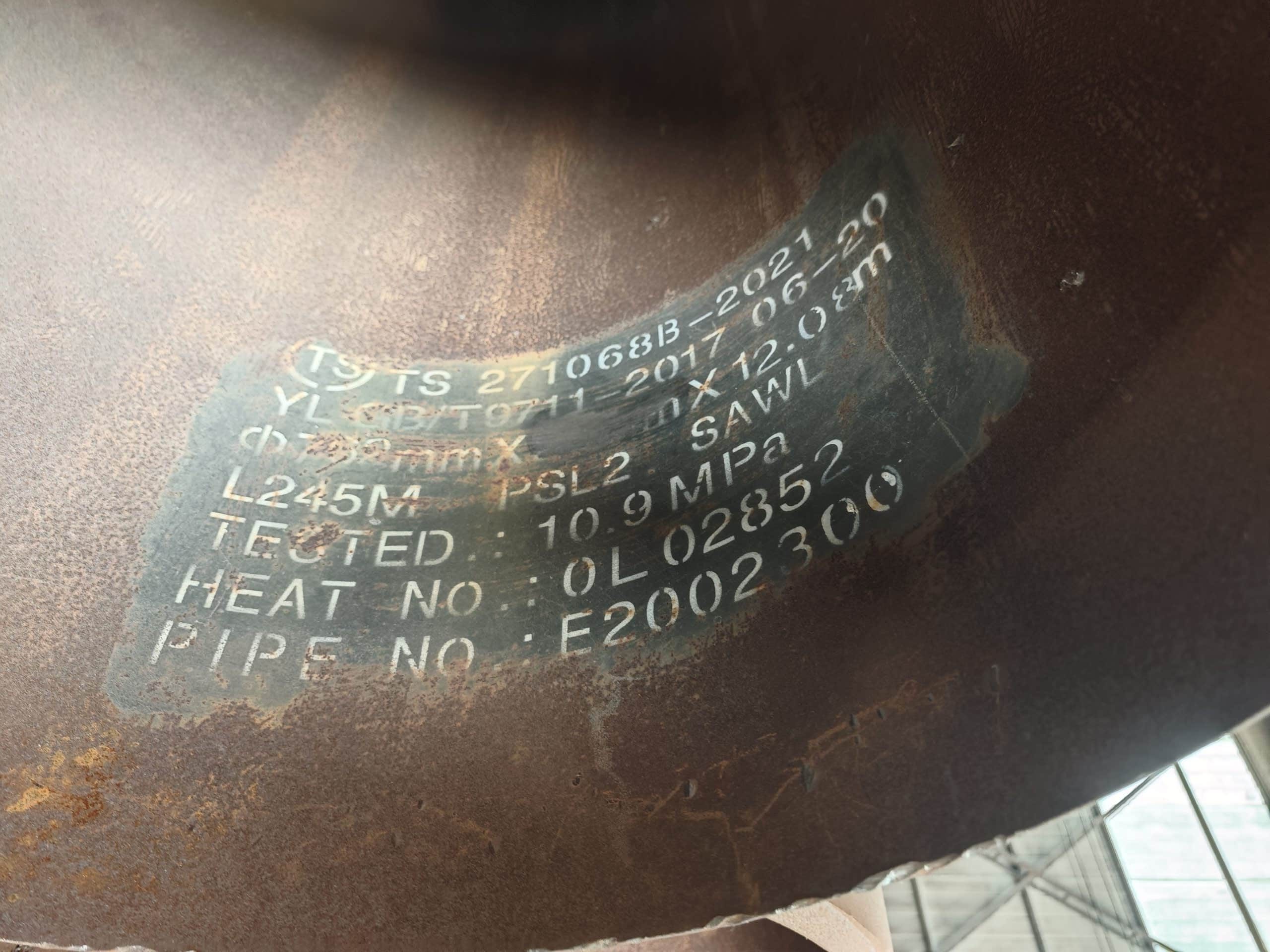
For this reason, purchasers should verify that the hydrostatic test record identifies the correct pipe and corresponds to the grade, dimensions and specification level stated in the order. A single pressure table should not be applied universally across all grades, dimensions, product types and editions of API 5L.
Hydrostatic Testing Process
A typical mill hydrostatic test includes the following stages, with the detailed procedure controlled by the applicable standard and the manufacturer’s approved quality plan.
Pre-test checks: Confirm pipe identification and carry out the required visual and dimensional checks. Any prerequisite inspection or non-destructive examination should be completed as required by the applicable product specification.
Test setup: Position the pipe in the hydrostatic tester, secure the ends and fill the pipe with the specified test liquid. Equipment and pressure-measuring instruments should be suitable for the required test range and maintained under the mill’s calibration system.
Pressurization and hold: Increase pressure according to the approved procedure until the required test pressure is reached. Maintain the pressure for the hold period required by the governing edition and product requirements. The required pressure and hold time should be taken from the standard and quality documentation, not assumed from a generic rule.
Release and evaluation: Depressurize the pipe safely and inspect it for leakage or other indications of failure. The acceptance decision should follow the applicable requirements. Record the test result and maintain traceability to the pipe identification and inspection documentation.
Hydrostatic Testing and Non-Destructive Examination
Hydrostatic testing and non-destructive examination serve different purposes. Hydrostatic testing evaluates pressure integrity under specified conditions; it does not provide the same information as ultrasonic testing, radiographic testing or other applicable NDT methods. Required NDT methods and their extent depend on the product type, manufacturing process, API 5L edition and purchase specification.
Requirements for weld-seam examination before or after hydrostatic testing should be checked directly in the governing edition and the applicable product requirements. It is not accurate to assume that one identical NDT sequence applies to every welded pipe or every PSL level.
Records and Quality Documentation
The test record should be traceable to the pipe and should document the result in accordance with the applicable quality system and purchase requirements. Purchasers may need to review hydrostatic test records alongside the mill test certificate, chemical and mechanical test results, dimensional inspection, NDT records and product markings.
Where third-party inspection or witness testing is required, the scope and notification arrangements should be agreed before production. Certificate type and documentation requirements should be stated in the purchase order rather than assumed to be identical for every project.
Common Issues to Avoid
Common specification and acceptance problems include using a test-pressure calculation from the wrong edition, applying a generic pressure table to a different pipe size or grade, confusing hydrostatic testing with NDT, and failing to maintain traceability between the pipe and its test record. Test-water handling, drying, corrosion prevention and discharge should be managed according to the mill’s procedures and applicable environmental requirements.
For thick-wall or large-diameter pipe, the equipment and procedure must be suitable for the required test conditions. Any additional hold time, test pressure or inspection requirement imposed by the purchaser should be documented in the project specification.
Selecting an API 5L Pipe Supplier
When assessing a supplier, review the relevant manufacturing capability, quality-management arrangements, calibration records for test equipment and traceability system. Confirm any required API Monogram licence or other certification directly against the project requirements and current certification records. The presence of a certificate alone does not establish that every supplied product complies with a particular order.
Before shipment, confirm that the order, product markings, mill test certificate, hydrostatic test records and required NDT documentation are consistent. If independent inspection is required, define the inspection scope and acceptance criteria in advance.
FAQ
What hold time does API 5L require for hydrostatic testing?
The required hold time depends on the applicable edition and product requirements, including relevant pipe characteristics. Check the governing edition and purchase specification rather than relying on a single value for all pipe.
Can hydrostatic testing replace NDT?
No. Hydrostatic testing and NDT have different purposes and are complementary where both are required by the applicable specification.
How is hydrostatic test pressure determined?
It is calculated and limited according to the governing API 5L requirements, taking into account the applicable material and dimensional parameters. The calculation and limits should be verified against the specified edition.
What information should be checked in a test record?
Check that the record is traceable to the supplied pipe and is consistent with the order, required test conditions and related inspection documentation.
What liquid is used for hydrostatic testing?
Water is commonly used, subject to the applicable procedure and project requirements. Liquid quality, handling, draining and drying should be managed to avoid contamination or corrosion concerns.
Conclusion
Hydrostatic testing is a key part of API 5L line-pipe verification, but its requirements must be applied using the correct standard edition and the actual ordered product details. Reliable acceptance depends on appropriate test pressure and hold-time controls, suitable equipment, traceable records and any required complementary inspection. Purchasers should define these requirements clearly and review the records against the purchase specification.
Contact LONGMA
For API 5L line pipe enquiries, contact LONGMA at info@ilongma.com with the grade, PSL level, dimensions, applicable standard edition and inspection requirements.