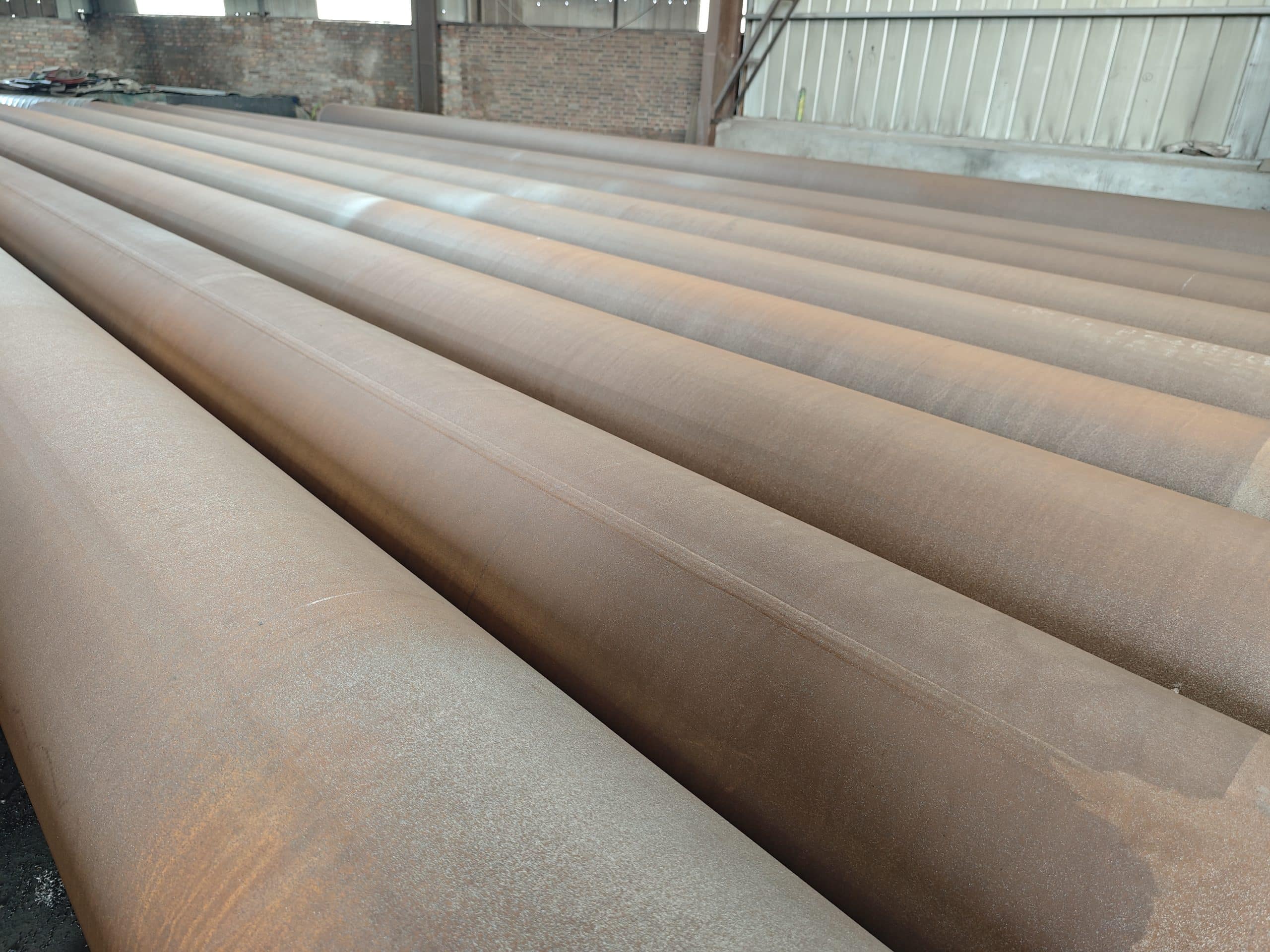
- 1. What Are ASTM A252 Pipe Piles?
- 2. Where Are ASTM A252 Pipe Piles Used?
- 3. Which ASTM A252 Grade Should You Buy?
- 4. How Should You Specify Pipe Pile Dimensions?
- 5. ERW, LSAW, or Seamless: Which One Is Better?
- 6. What Quality Documents Should You Request?
- 7. Which Tests Are Required for ASTM A252 Pipe Piles?
- 8. How Do You Select Pipe Piles for Different Ground Conditions?
- 9. Conclusion
- 10. FAQ
- 11. Request an ASTM A252 Pipe Pile Quotation
ASTM A252 pipe piles are frequently employed as load bearing foundation elements of bridges, ports, buildings, retaining structures and other infrastructure projects. But picking the right pipe pile is more than just seeking the ASTM A252 certification — you also need to check the grade, measurements, manufacturing process, testing papers, corrosion protection, delivery length, and project-specific needs. Standard compliance is only the beginning, procurement is not simply about technical acceptability.
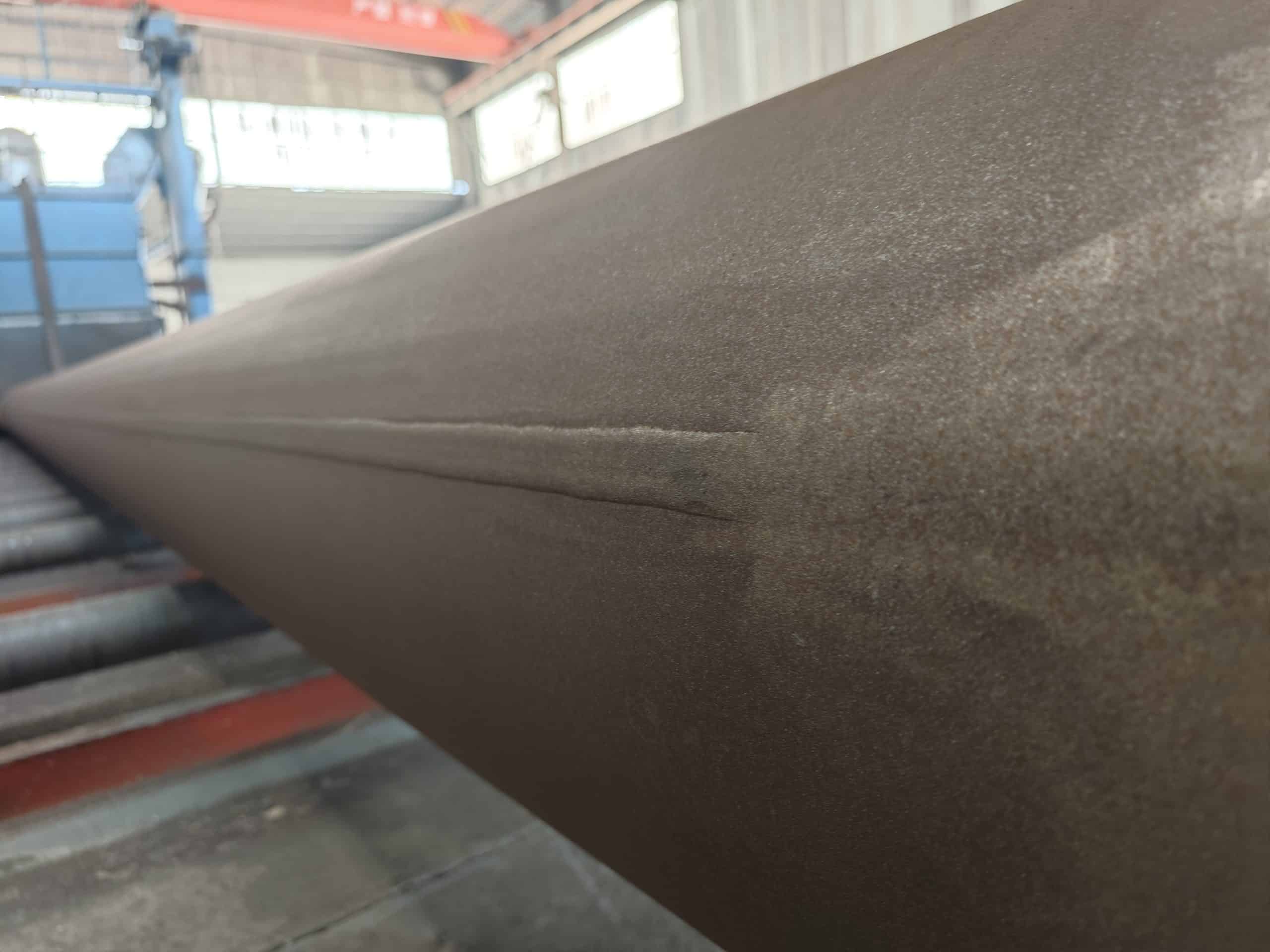
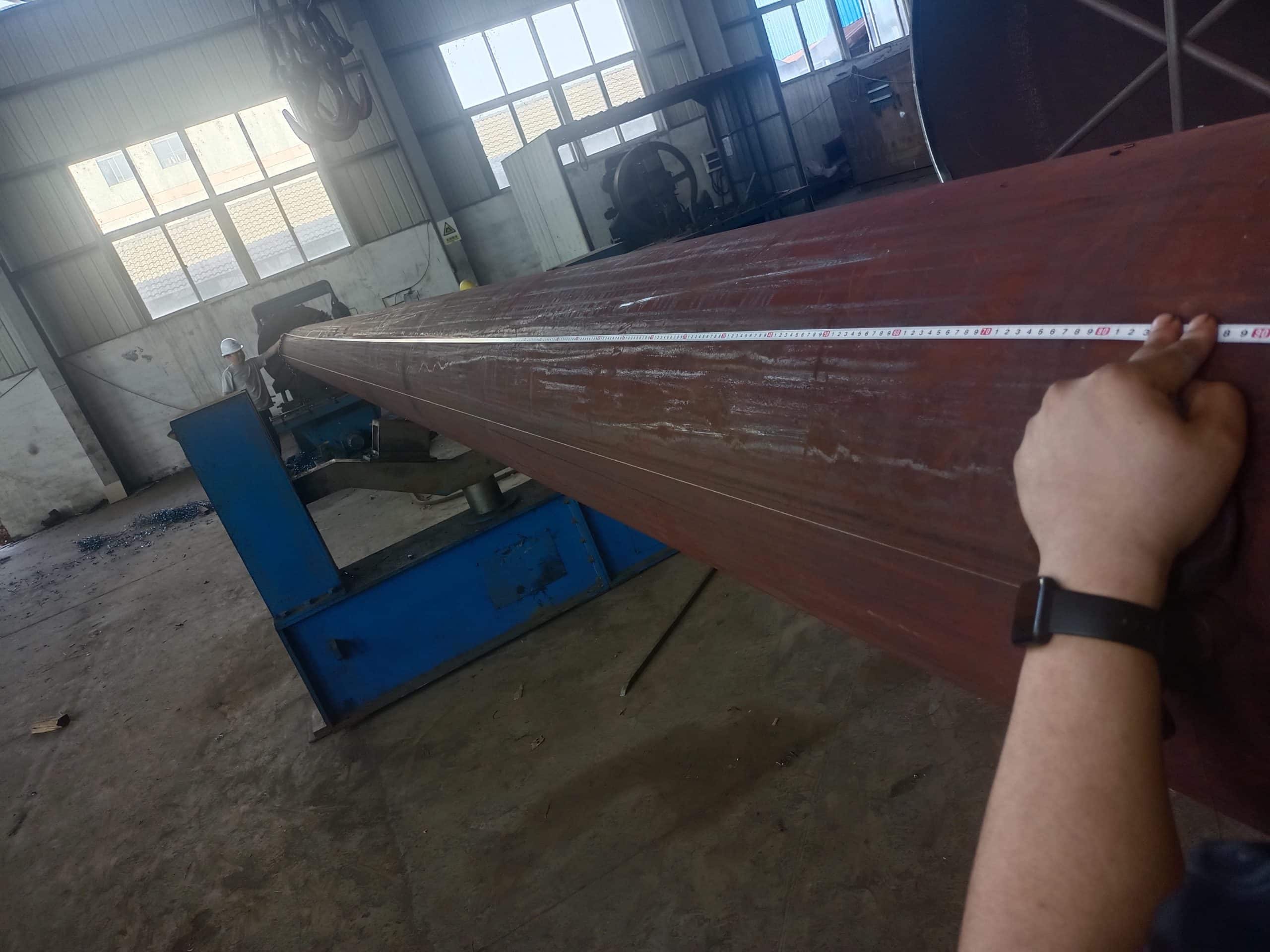
What Are ASTM A252 Pipe Piles?
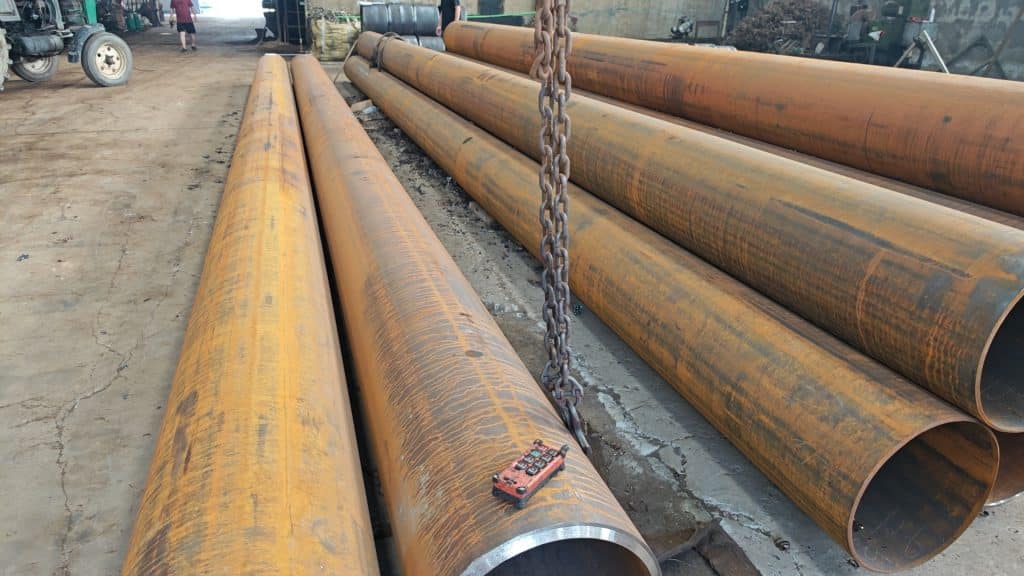
ASTM A252 is the Standard Specification for Welded and Seamless Steel Pipe Piles. A252 is a product specification developed for foundation members, not line-pipe or pressure-pipe requirements. The pipe may be fabricated as a welded or seamless product and may serve as a permanent load bearing element or as a shell which is subsequently filled with cast-in-place concrete. The product is normally cylindrical and used for driven piling systems and certain cast-in-place pile systems.
This term is important to understand for procurement, since it modifies what the standard does and does not guaranty. The minimum material and dimensional criteria for the pipe itself are covered by ASTM A252. It does not in itself dictate a whole foundation design, corrosion-protection system or set of site-specific test standards. That is a decision for the structural and geotechnical engineers on the project.
Where Are ASTM A252 Pipe Piles Used?
ASTM A252 pipe piles are often used for infrastructure applications and the environment in which they will be operating will directly impact which standard you should be specifying. The next sections take a deeper look at the most typical project kinds, and the material considerations that go with them.
Bridges and Highways
Heavy loads are often transferred through soft surface soils to deeper, more competent strata by means of pipe piles to support bridge piers, elevated-road foundations, and temporary or permanent construction platforms. In highway constructions, the pile must resist the vertical dead and live loads of the superstructure and lateral forces due to wind, braking and seismic occurrences . Bridge foundations frequently need more axial capacity than basic building supports, therefore procurement teams should validate the pile diameter and wall thickness with the geotechnical report. Driving conditions at bridge sites vary significantly from riverbed alluvium to deep gravel and the wall thickness required must be able to withstand the impact energy of the hammer used.
Ports and Marine Structures
Large diameter steel pipe piles are used for wharf pile foundations, breakwaters, trestles and offshore or nearshore constructions. The criteria for the maritime environment go farther than the steel grade itself. Buyers must consider exposure to salt water, tidal and splash-zone conditions, design corrosion allowance, protective coating systems and, in many instances, cathodic protection. The same ASTM A252 Grade 3 pipe that is adequate for a bridge pier may need a much stronger wall or a specific coating system to achieve a 50-year marine design life. Don’t assume the steel grade will solve corrosion concerns that should be handled by the design engineer via corrosion allowance, coating, and material selection.
Buildings and Industrial Facilities
They are often used as foundations for high-rise buildings, floors in warehouses and industrial plants, bases for heavy equipment, and as retaining or temporary support structures. Generally the pile is used for structures to accommodate vertical compression, uplift and lateral soil pressure. Industrial facilities may impose concentrated equipment loads, vibration or dynamic stress on the pile section and connecting details. Buyers may gain lower price and quicker lead times when large numbers of uniform-size piles are needed, assuming the design permits, by standardizing on a single grade, diameter and wall thickness for the project.
Energy and Civil Infrastructure
The application map also includes wind-turbine foundations, transmission and energy infrastructure, water-treatment plants and other public works. Energy projects often have a high axial load and a strong bending moment at the pile head which is favorable for bigger diameters and thicker walls. Water treatment and civil works may impose durability requirements in damp or chemically hostile soil. In any event, the customer should request the whole manufacturing and inspection record from the supplier, not only a grade confirmation. These applications stress long-term dependability rather than initial material price.
Remember that in all four situations, maritime, humid, saline or very corrosive, need extra treatment, coatings, cathodic protection, corrosion allowance and design-life. The pipe pile material must be confirmed by ASTM A252 and shall not substitute for the corrosion-protection system.
Which ASTM A252 Grade Should You Buy?
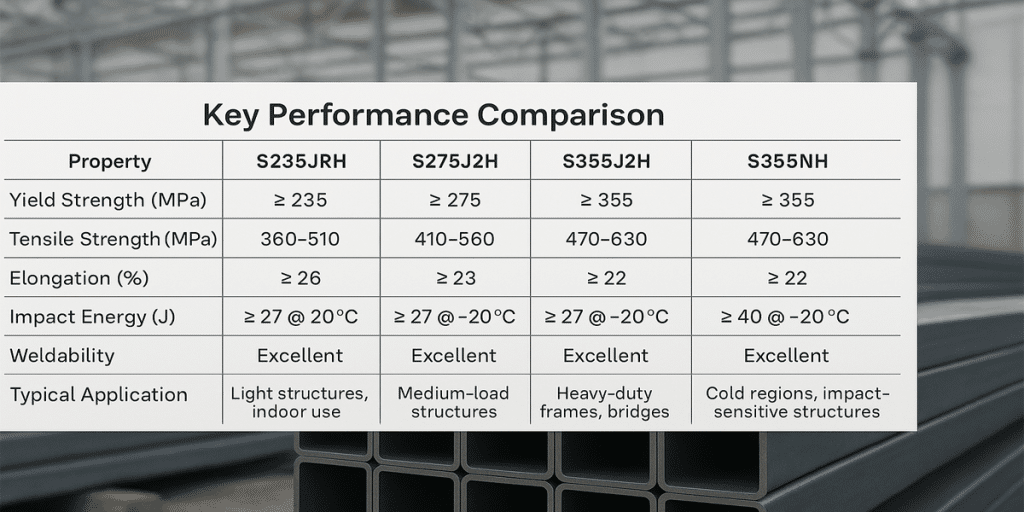
When you’re procuring, one of the first considerations you’ll make will be which of the three grades of ASTM A252 you need. The table below presents the minimal mechanical parameters of each grade and their practical location. These numbers are minimums as spelled out in the standard and are similar for the three classes for yield strength, tensile strength and the accompanying procurement concerns.
| ASTM A252 Grade | Minimum Yield Strength | Minimum Tensile Strength | Procurement Consideration |
| Grade 1 | 30,000 psi / 205 Mpa | 50,000 psi / 345 MPa | General foundation applications |
| Grade 2 | 35,000 psi / 240 Mpa | 60,000 psi / 415 MPa | Moderate load requirements |
| Grade 3 | 45,000 psi / 310 Mpa | 66,000 psi / 455 MPa | Higher-strength applications |
The 3 grade has the greatest minimum yield and tensile strengths of the three classes making it the most typical option for major infrastructure loads. But customers should not purchase just because Grade 3 is the most powerful. The steel grade should be selected based on design load, soil conditions, driving technique, piling stability, corrosion environment and the governing project specification. Choosing a higher grade than you need might raise the cost of material without increasing value. Choosing a grade too low can cause complications for driving and servicing.
Before you assign the grade, go through a brief series of questions with your technical staff. The project design document specifies which grade. Is the design load really a Grade 3 or may a bigger piece of Grade 2 meet the capacity? Could the driving machinery subject the pile toe and shaft to high impact energy, such that a more resistant steel would be desirable? Does the grade need to allow for a potential for bending in transit, lifting or installation? Finally, is going to a higher grade really providing economic advantages or construction benefits for this project, or is it an unwarranted premium? These questions discourage both over-engineering and under-specification.
How Should You Specify Pipe Pile Dimensions?
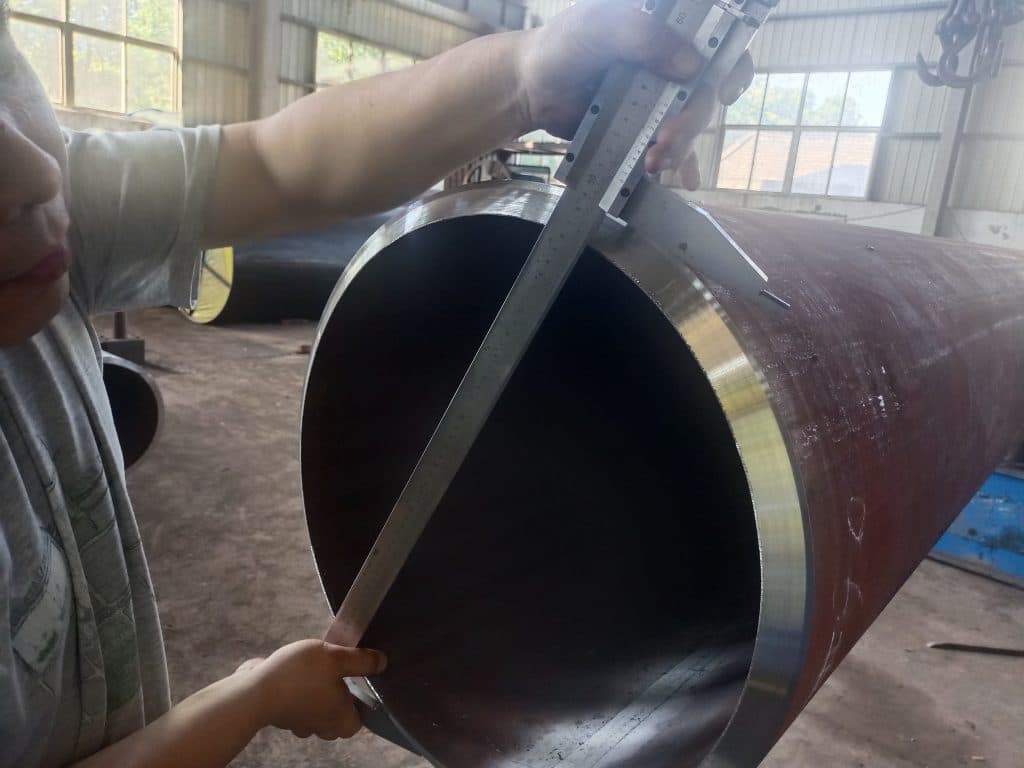
One of the most useful tasks in pipe pile procurement is to translate technical requirements into an explicit inquiry. The three most important parameters are outer diameter, wall thickness and length. Each one influences structural performance, behavior, transport and overall cost, thus each should be expressly defined, rather than left to the supplier’s judgment.
Outside Diameter
The outside diameter determines the cross sectional area of the pile, the end bearing area at the pile toe and the contact area with the surrounding soil along the shaft. A greater diameter will enhance both the skin friction surface and the end bearing capacity, which is typically required when the top soil layers are weak. Diameter also governs the compatibility of the pile with the pile-driving hammer and lead. It must thus be suitable with the equipment selected for the site. Finally, diameter effects transportation and handling. Large pipes may need specific trucking, crane capacity and vessel stowage, all of which increase expense and risk to logistics. Make sure the seller can make and ship the required diameter before you commit.
Wall Thickness
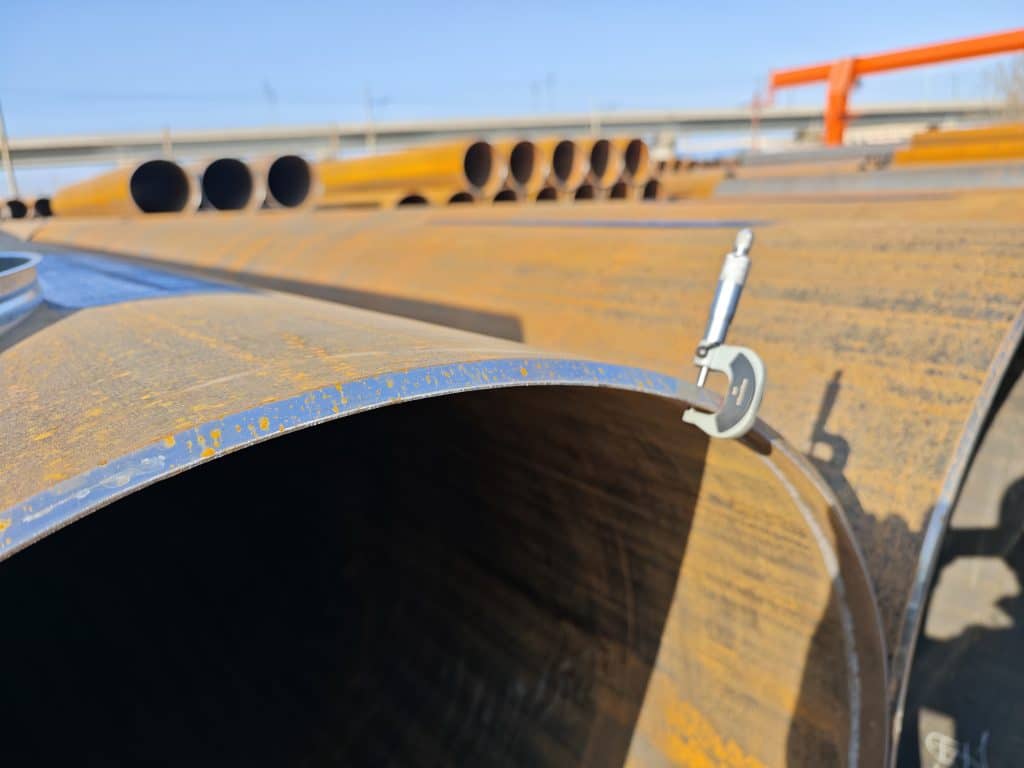
The wall thickness determines the axial and bending resistance, the resistance to local deformation while driving, the corrosion allowance and the weight of the material. A thicker wall will better withstand buckling at the pile head and toe under repeated hammer strokes, and also may offer a built-in corrosion tolerance that increases service life in hostile soils. Since steel is sold by weight, wall thickness has a big impact on cost; a little increase in wall thickness may greatly increase the tonnage and price of a large order. Wall thickness also influences the welding and field splicing of pile pieces, thus the chosen value must be compatible with the connection details in the design. Be sure to trade the structural advantage for the weight premium wisely.
Length
Length requirements should be designated as single random length, double random length or precise cut length, with the permissible length tolerance. Determine whether field splicing is authorized. This affects both the lengths the supplier must give and the equipment the contractor must have on site. Explain how the separate pipe lengths will be joined and transported to obtain the total pile length necessary without undue waste. Some vendors provide ASTM A252 pipe piles in a variety of diameters, wall thicknesses and lengths of around 3–18 m. In all cases the exact range of supply needs to be validated with manufacturer capacity, project designs and the purchase contract.
ERW, LSAW, or Seamless: Which One Is Better?
Buyers often compare production practices while assessing suppliers. Below is a table with the possible benefits of each approach, and questions you should ask to be sure the comparison is based on facts and not marketing hype.
| Manufacturing Method | Potential Advantages | Questions to Ask the Supplier |
| ERW (Electric Resistance Welded) | Efficient production for selected sizes and wall thicknesses | What is the weld inspection method and acceptance criterion? |
| LSAW (Longitudinal Submerged Arc Welded) | Suitable for large-diameter and heavy-wall pipe piles | What plate grade, forming process, and NDT coverage are used? |
| Seamless | No longitudinal weld seam | Is the available size, length, and quantity commercially practical? |
ASTM A252 allows both welded and seamless steel pipe piles. The presence or absence of a weld alone cannot thus be used to determine technical appropriateness. For welded pipe, the buyer should consider weld quality, non destructive testing coverage, dimensional stability, and end preparation. For big diameter foundation piles, LSAW is generally the preferred choice because to the combination of the big size and a well-controlled longitudinal weld. The final option must take into account the diameter, wall thickness, quantity, delivery schedule, building technique and budget.
What Quality Documents Should You Request?
Documentation is the connection between a steel grade on paper and steel that really fulfills the project requirement. A thorough collection of documents provides the customer and the engineer with the documentation required to accept the product and to track each pipe back to its manufacture and test records.
Essential Document Set
The Mill Test Certificate (MTC) is the heart of the documentation capturing the standard, grade, heat number and mechanical and chemical test findings for each lot. Request chemical composition analysis report, tensile test report with yield strength, tensile strength and elongation and dimensional inspection report for outer diameter, wall thickness and length around the MTC. Add heat-number and pipe-number traceability records, weld non-destructive testing reports where appropriate, third-party inspection reports as required by the project, and coating or anti-corrosion treatment reports if a coating is specified in the order. Lastly, collect the packing list, weight list and origin papers that assist customs clearance and delivery.
MTC Key Items to Verify
| MTC Item | What the Buyer Should Verify |
| Standard | ASTM A252 and the applicable revision |
| Grade | Grade 1, Grade 2, or Grade 3 |
| Heat number | Matches the raw material and production records |
| Yield strength | Meets the specified minimum |
| Tensile strength | Meets the specified minimum |
| Elongation | Meets the applicable requirement |
| Dimensions | Match the purchase order |
| Traceability | Each pipe can be linked to its test results |
Along with the papers themselves, a good buying guide will also urge the buyer to check supplier certification, prior project performance, pipe surface quality, delivery schedule and total pricing. When merely comparing the price per ton, variations in coating, testing, paperwork and risk might be hidden that greatly impact the whole cost of the project. Ask for the whole set of documents, check each line against the sequence, and use the MTC as the backbone of approval and not just a formality.
Which Tests Are Required for ASTM A252 Pipe Piles?
There are two levels of testing scope: what is required by ASTM A252, and what the project needs in addition. This differentiation helps to avoid over- or under-testing and to clarify the inspection strategy for both the supplier and the third-party inspector.
Common Inspection Items
Routine scope comprises chemical composition analysis, tensile testing, outer diameter and wall thickness measuring, length and weight checking, and surface quality inspection. For welded pipe piles: weld ultrasonic testing and, if required by the contract or project specification, X-ray radiography. Plate ultrasonic testing pertains to particular production processes that start with steel plate. Hydrostatic testing may be performed if required by the purchaser or project specification. Some supplier references point out that ASTM A252 pipe piles are not normally subject to a mandatory hydrostatic test, because the product is used for foundation bearing rather than fluid transport; whether a hydrostatic test is performed should be stated explicitly in the purchase technical specification and the inspection plan.
Inspection Hold Points
A hold point is a moment in production when work stops until approved by the inspector. Practical hold-point sequence for pipe piles typically include: raw material confirmation; plate inspection prior to forming; welding process review; non-destructive testing; dimensional approval; finished product release; and pre-shipment third-party inspection. It is better to agree these hold points in advance so the buyer has control over quality without holding up flow of production, and it specifies precisely when the supplier must ask for inspection.
How Do You Select Pipe Piles for Different Ground Conditions?
Product specification and site circumstances must match, since the same pipe pile performs quite differently in soft clay, thick gravel, rock, and seawater. The buyer must interpret ground conditions to concrete pile needs but also understand that ultimate pile capacity and foundation plan are the duty of expert geotechnical and structural engineers.
In soft soils, be concerned about pile length, shaft skin friction, and penetration depth to reach competent bearing layers. Pay attention to the design of the pile toe, wall thickness and the impact energy the pile must endure when driven if the soil or rock is hard. Where rock is encountered, consider pile shoes, end reinforcement, and the driving or drilling tools necessary to seat the pile. For a maritime environment, include corrosion allowance, protective coating and a design service life. Stress ductility, joint quality and resistance to cyclic loading in seismic areas. Design for lengths of single piles that can be handled, field spliced, and transported at restricted construction sites.
This list demonstrates why the pipe-pile specification cannot be written in a vacuum. The supplier may provide a quotation and deliver according to your specification, but it is up to competent engineers to check the appropriateness of the ground, single pile capacity and the final solution for the foundation, utilizing the geotechnical study and structural design. Set the supplier clear parameters. Let the engineer own the design.
Conclusion
Getting ASTM A252 pipe piles for infrastructure is more than simply the steel grade. Confirm pile size, manufacturing technique, end configuration, testing plan, MTC requirements, corrosion protection, delivery timeline and project specific design criteria before making an order. A full evaluation will safeguard the project timeline, regulate the overall cost, and make sure the pipe piles supplied will operate as intended.
FAQ
1. What is ASTM A252 used for?
ASTM A252 is for welded and seamless steel pipe piles for foundation and infrastructure works.
2. Which grade of ASTM A252 is the strongest?
Grade 3 has the greatest stated minimum yield strength and tensile strength of the three grades. Grade 3 has a minimum yield strength of 45,000 psi (310 MPa).
3. Are ASTM A252 pipe piles always welded?
Not always. The ASTM A252 products may be welded or seamless. The method of manufacture shall be specified by the purchaser in the inquiry and technical agreement.
4. Do I need hydrotesting?
It may not be a requirement of the pipe-pile specification itself, but the project owner or purchaser may include it as an extra requirement. The scope of testing should be clearly set out on the purchase order.
5. What to Include in an ASTM A252 Pipe Pile Inquiry?
Steel grade, outer diameter, wall thickness, length, quantity, production technique, pile-end arrangement, inspection requirements, coating, packaging, delivery term, documentation necessary.
6. Can we utilize ASTM A252 pipe piles for maritime projects?
They are candidates for maritime infrastructure but corrosion protection, design life, piling installation, weld quality and project-specific marine requirements need to be handled individually.
Request an ASTM A252 Pipe Pile Quotation
Send size necessary (Diameter, Wall thickness, Length and quantity required). Demand MTC, inspection reports, production timeline, shipment data and obtain technical help for bridge, port, construction and deep-foundation projects.
info@ilongma.com – Request a price