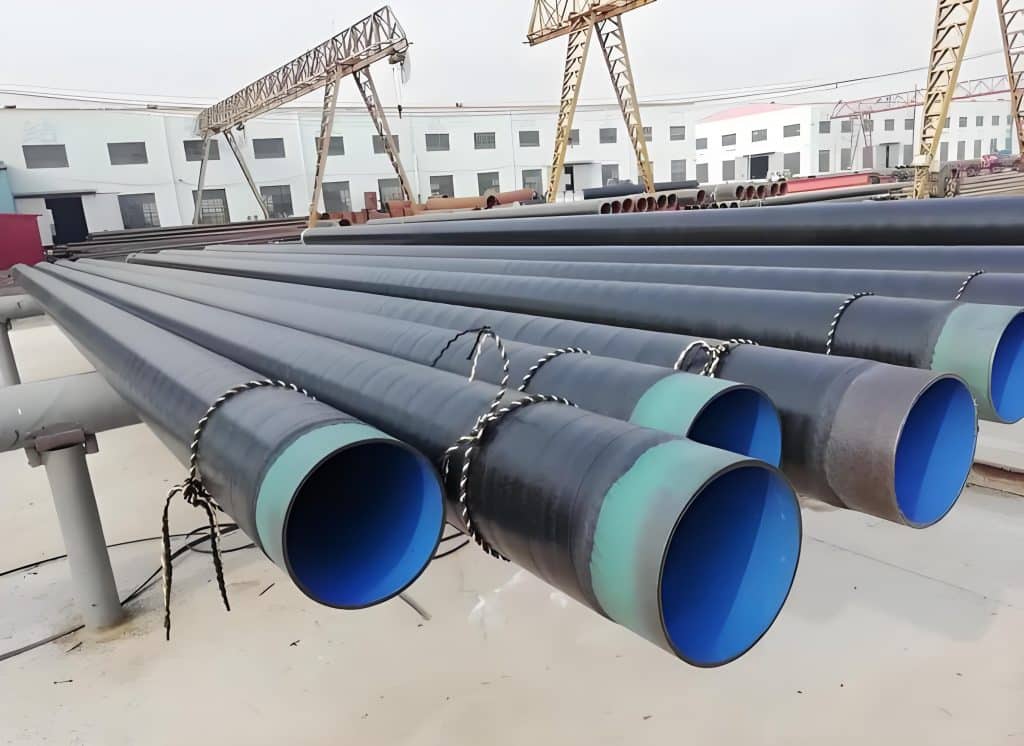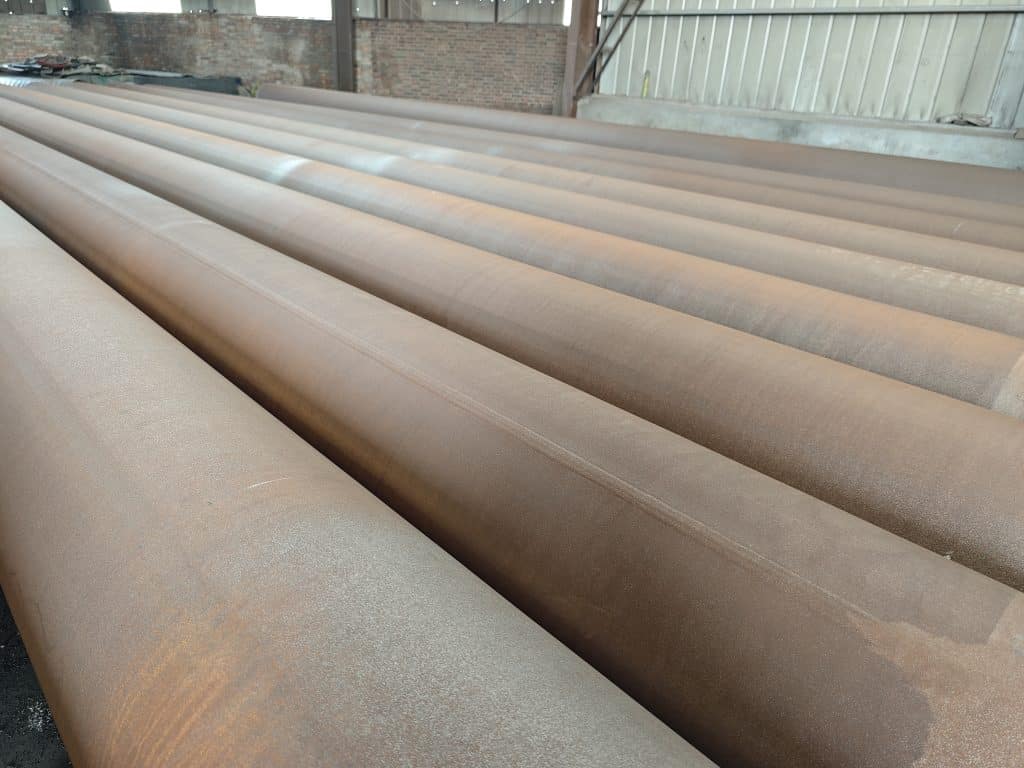
Cold-formed hollow sections are structural steel products shaped without a final hot-forming operation. Their dimensional consistency, range of section shapes and suitability for fabricated steel structures make them important in construction and industrial engineering. For LONGMA customers, the relevant products are round welded steel pipes and circular hollow sections (CHS). Although structural standards may also cover square and rectangular hollow sections, those profiles should not be presented as part of LONGMA’s round-pipe manufacturing range. This guide explains the main characteristics of cold-formed CHS, the applicable standards and the checks needed before procurement.
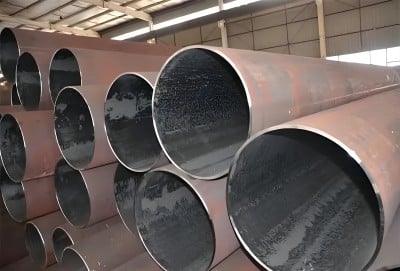
How Cold-Formed Hollow Sections Are Manufactured
Cold-formed welded circular hollow sections are commonly manufactured by forming steel strip or coil into a round profile and welding the longitudinal edges. Depending on the production route, operations can include strip preparation, forming, electric resistance welding, weld-bead treatment, sizing, straightening, cutting and inspection. The detailed sequence varies by equipment and product specification. Cold forming differs from hot-finished manufacturing, but hot-finished sections should not all be described simply as cold-formed products that have been heat treated. Forming and finishing routes can influence residual stresses, dimensional characteristics and mechanical behavior. Neither manufacturing route is universally better. Selection must follow the applicable product and structural design standards. In the case of LONGMA, ERW and LSAW describe round-pipe manufacturing processes; they should not be used to imply production of square or rectangular profiles.
For round welded sections, consistent strip preparation and forming help control the alignment of the longitudinal edges before welding. Sizing and straightening then help achieve the specified geometry, but they cannot compensate for every upstream defect. Quality control therefore extends from incoming material identification through welding, finishing and final inspection. The manufacturing route should be described accurately in project documentation rather than assuming that all cold-formed products use identical equipment.
Mechanical Properties and Grade Designations
Structural hollow sections are evaluated for properties such as yield strength, tensile strength, elongation and, where specified, impact toughness. AS/NZS 1163 is a product standard for cold-formed structural steel hollow sections in Australia and New Zealand. Its grade designations include C250, C350 and higher strength classes, with certain L0 variants. The grade number represents a nominal minimum yield-strength class, not a guarantee of a particular member’s load capacity. Structural resistance also depends on wall thickness, cross-sectional geometry, member length, buckling and connection details. The L0 suffix indicates impact performance requirements at 0°C under the applicable standard provisions. It is not correct to claim that every non-L0 section is inherently brittle or unsuitable for cold environments. The engineer must assess toughness needs using the project design conditions. Exact mechanical-property acceptance values and specimen requirements should be checked against the specified standard edition and documented in the mill test report.
Mechanical test results are meaningful only when matched to the ordered product designation and the test conditions. Buyers should distinguish the grade’s nominal strength class from the measured strength of a particular heat. Impact testing, when required, evaluates a different performance characteristic from static tensile testing. The L0 designation should be specified deliberately where the design calls for the relevant toughness qualification; it should not be inferred from the product’s intended geographic destination alone.
Dimensions, Tolerances and Structural Behavior
Circular hollow sections have a closed, rotationally symmetric shape that can be advantageous for members exposed to loads from multiple directions and for certain bracing and column applications. Their behavior under axial load, bending, torsion and buckling requires proper structural analysis. A larger diameter or thicker wall does not automatically make a section suitable for every design. Buyers should state outside diameter, nominal wall thickness, length, straightness and end preparation. Applicable tolerances should come from the specified product standard, not from a generalized percentage taken out of context. Manufacturer capability ranges must also be distinguished from the standard’s scope. For a theoretical circular-section mass, the nominal area is πt(D−t), with D and t in millimetres; multiplying by steel density gives an approximate mass per metre. Actual delivered mass depends on dimensional tolerances. Connection geometry and welding accessibility should be considered early because circular profiles can require different detailing from flat-sided sections.
Section selection also involves serviceability and connection design. A circular member may offer useful geometric symmetry, yet its actual resistance to buckling depends on slenderness, support conditions and imperfections. Connection detailing can influence fabrication effort and inspection access, particularly where braces meet larger tubular members. Engineers should therefore assess the complete structural system instead of choosing a section solely because its nominal yield strength or outside diameter is greater.
Cold-Formed Versus Hot-Finished Sections
Cold-formed sections can offer efficient production and consistent dimensions in commonly manufactured sizes. Hot-finished products may have different residual-stress and material characteristics because of their manufacturing history. However, statements that cold-formed sections always have tighter tolerances, better surfaces or lower costs are too broad. The results depend on the product standard, forming equipment, section dimensions and finishing processes. A comparison should therefore identify the actual standards and grades being considered, such as AS/NZS 1163 or EN 10219 for relevant cold-formed products and EN 10210 for hot-finished structural hollow sections. Similar nominal strength grades under different standards are not automatically interchangeable. Engineers must assess mechanical properties, impact requirements, dimensional tolerances and design-code compatibility before substitution.
When comparing manufacturing routes, distinguish material characteristics from product acceptance criteria. A hot-finished section and a cold-formed section may satisfy different standards even if their nominal dimensions appear similar. Residual stresses, corner geometry for noncircular profiles, available grades and heat-treatment history may affect design decisions. Substitution requires an engineering assessment of the applicable product and structural design standards, not merely a comparison of catalogue weights.
Welding, Corrosion Protection and Inspection
The longitudinal weld is an important quality-control area in welded hollow sections. It should not be described as automatically the most dangerous or weakest part of every pipe. Weld integrity depends on process control, material selection and inspection appropriate to the product specification. Inspection may include visual, dimensional, mechanical and nondestructive examinations according to the order and governing standard. For outdoor structural applications, corrosion protection may include painting or hot-dip galvanizing where suitable. If a project specifies galvanizing to AS/NZS 4680, the coating requirements must be addressed separately from the base-steel product standard. Coating design should consider atmospheric exposure, accessibility, fabrication and maintenance. Welded connections made after coating may require an approved repair procedure. For any safety-critical structure, compliance with a material standard does not replace structural design verification or the relevant building approval process.
Protective finishes must be selected for the intended exposure rather than assumed to be universal. Hot-dip galvanizing, paint and other coating systems have different preparation, inspection and maintenance requirements. If a structural assembly will be welded after coating, the project should specify how affected areas are prepared and repaired. The inspection package should distinguish manufacturing weld examination from field weld inspection, because these are separate activities with potentially different acceptance rules.
Selecting and Purchasing Circular Hollow Sections
A technical request for quotation should identify the applicable product-standard edition, grade, circular section dimensions, length, quantity, surface finish, end preparation and any impact requirements. Request heat or batch traceability and mechanical test records relevant to the purchase order. An EN 10204 type 3.1 inspection certificate can be specified when required, but it is a document type and should not be confused with ISO 9001 quality management certification. Likewise, a material certificate alone does not establish the adequacy of a structural connection or satisfy every regulatory approval requirement. Buyers should confirm the manufacturer’s production route, available dimensions, inspection scope and delivery conditions in writing. LONGMA has over 20 years of experience producing round ERW and LSAW steel pipes. Its facility covers 230,000 m² and its annual production exceeds 500,000 tonnes. Product availability under AS/NZS 1163, including any particular C350 or L0 grade, should be verified for the specific order rather than presumed from a general company profile.
Before shipment, the buyer should agree how nonconformities will be handled. This includes dimensional discrepancies, missing material identification, damaged finishes and incomplete test records. Receiving personnel can then compare markings, quantities and documentation against the purchase order. For international projects, it is also useful to identify the required inspection documents and applicable standards early, so that certification questions are resolved before fabrication or customs clearance becomes time-critical.
FAQ
What is a cold-formed hollow section? It is a structural hollow product formed through a cold-working manufacturing route; welded circular sections are commonly made from formed strip.
Does AS/NZS 1163 cover CHS? Yes. The standard covers circular as well as other hollow-section shapes.
Does LONGMA manufacture SHS or RHS? LONGMA’s stated manufacturing focus is round ERW and LSAW steel pipe, not square or rectangular hollow sections.
What does C350L0 mean? It is a C350 grade designation with an additional impact-toughness requirement at 0°C under the relevant standard.
Can ASTM A500 replace AS/NZS 1163? Not automatically. Any substitution requires assessment against the project specifications and approval by the responsible engineer.
What documents should buyers request? Ask for the agreed product standard, inspection records, material test certificate, traceability information and any additional project-specific evidence.