Why Offshore Projects Often Specify PSL2
Offshore pipelines may experience substantial external hydrostatic pressure, installation bending, low operating temperatures, cyclic loads and demanding inspection conditions. API 5L Product Specification Level 2 (PSL2) provides more tightly controlled material and manufacturing requirements than PSL1 in several important areas. This is why many offshore pipeline specifications call for PSL2.
However, offshore location alone does not create a universal rule that every pipe must be PSL2. The governing pipeline design standard, regulatory requirements, operator specification and service conditions determine the necessary material level and supplementary tests. DNV-ST-F101, for example, provides a framework for submarine pipeline systems and may require checks beyond a basic API 5L product designation.
PSL2 should therefore be understood as a common technical baseline for demanding line-pipe projects, not a substitute for a project-specific material specification. Procurement teams should confirm the applicable API 5L edition, steel grade, manufacturing process, toughness requirements and inspection provisions before placing an order.
PSL1 vs PSL2: Material and Inspection Requirements
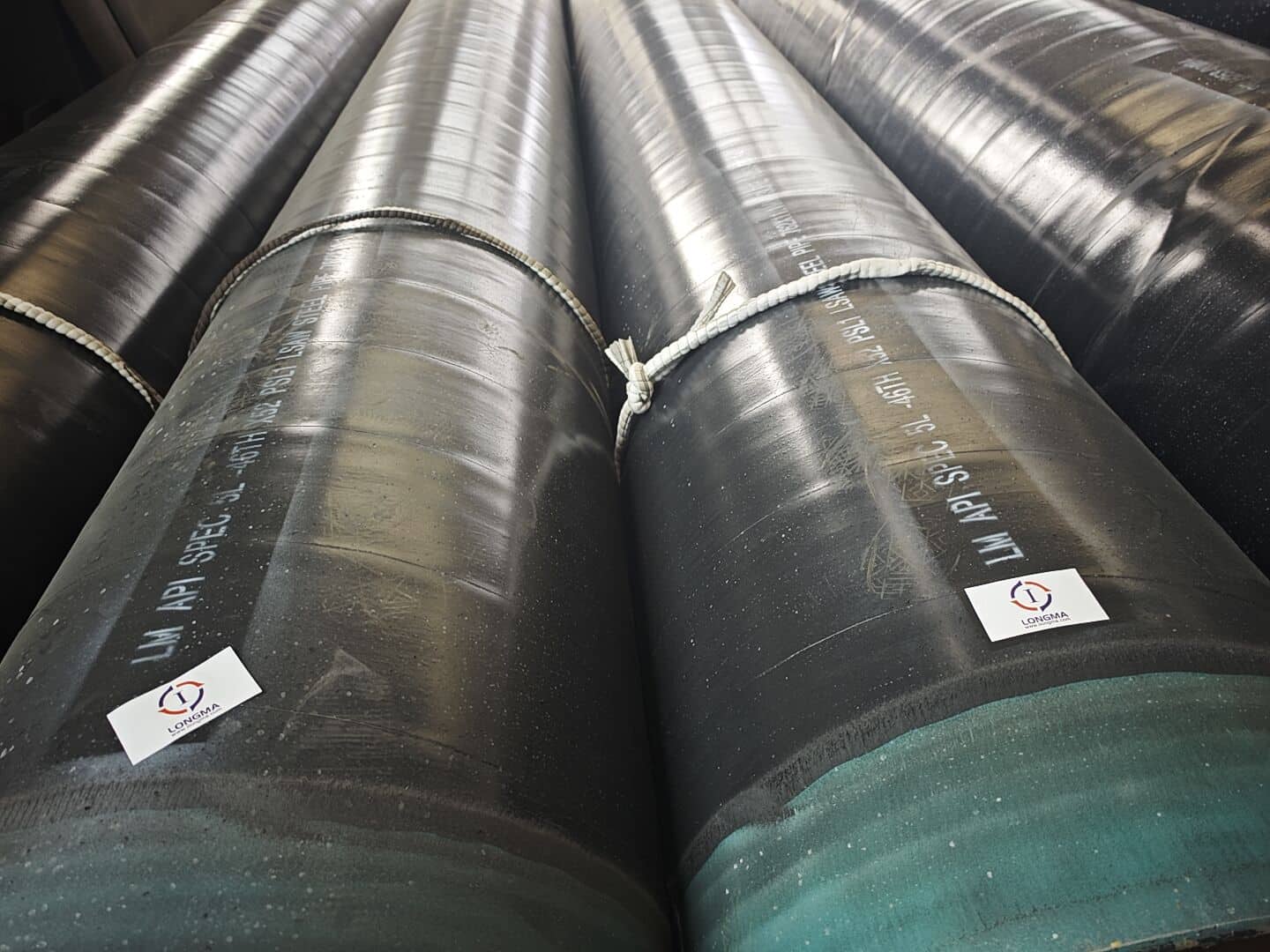
API 5L PSL2 generally applies tighter controls to chemical composition and mechanical properties, including specified maximum strength limits for relevant grades and defined toughness testing requirements. PSL1 and PSL2 are not simply two interchangeable certificate labels. Material selection must also consider carbon equivalent or cracking-susceptibility parameters, as applicable to the grade and manufacturing route.
Charpy V-notch test temperatures and acceptance values must be taken from the applicable product requirements and the project’s design basis. A test temperature of −20°C should not be presented as a universal offshore requirement. Similarly, a single carbon-equivalent limit should not be applied to every X65 PSL2 product without checking the governing calculation and standard provisions.
Nondestructive examination requirements depend on the pipe manufacturing process, grade, specification edition and supplementary requirements. PSL2 does not automatically mean that every pipe receives the same combination of 100% body UT and seam RT. The inspection and test plan should identify the examination coverage, method and acceptance criteria for the actual product.
| Consideration | PSL1 | PSL2 |
| Chemical composition | Specified limits by grade | Generally tighter controls for applicable grades |
| Mechanical properties | Specified minimum requirements | Additional maximum limits for relevant grades |
| Impact toughness | Not generally a basic PSL1 requirement | Specified toughness provisions apply |
| NDT | Depends on product and requirements | More stringent applicable provisions; method varies |
| Sour service | Requires separate qualification | Requires additional applicable requirements |
Offshore Design, Toughness and Corrosion Control
The external pressure of deep water introduces collapse and local buckling considerations that cannot be assessed using internal-pressure strength alone. Pipe diameter, wall thickness, ovality, material properties, installation loads and route conditions must be evaluated together. A higher steel grade can help with some internal-pressure design cases, but it does not automatically produce the best solution for external-pressure collapse or installation strain.
The steel grade selected for offshore service may range across multiple API 5L grades depending on the project. X52, X60, X65 and X70 are examples of grades that may be considered; no one grade is compulsory simply because a pipeline is subsea. Additional fracture-control measures may be needed depending on the design code, operating conditions and consequence assessment.
PSL2 is not a corrosion-resistant alloy designation. Carbon steel offshore pipelines normally require an engineered corrosion-control strategy, potentially including external coatings, cathodic protection, corrosion allowance, internal treatment or monitoring. The coating system and its qualification should be specified independently from the API 5L pipe grade.
Sour Service and Additional Project Requirements
Pipelines carrying H2S-containing fluids may require additional material qualification under ISO 15156/NACE MR0175 and the applicable API 5L supplementary provisions. Sour-service requirements are not automatically satisfied by purchasing ordinary PSL2 pipe. A relevant ‘S’ designation and Annex H requirements, where specified, must be interpreted against the exact product and edition.
Hardness limits, sulfide stress cracking (SSC) resistance and hydrogen-induced cracking (HIC) testing are subject to applicable material and service requirements. It is inaccurate to describe a single hardness value or a universal HIC/SSC test package as mandatory for every offshore PSL2 pipe. Project specifications should state the exposure conditions, test methods, acceptance criteria and required documentation.
Likewise, inspection by an independent agency or the provision of an EN 10204 3.2 inspection document may be required by an owner, but it should not be described as an automatic consequence of PSL2. The manufacturer and buyer should agree on the inspection hold points before production.
ERW and LSAW Selection for Offshore Pipelines
Both ERW and longitudinal submerged arc welded (LSAW) pipe can be considered for offshore projects where the selected product complies with the applicable standard and project requirements. ERW uses resistance heating to join the strip edges, whereas LSAW typically forms plate and uses submerged arc welding to produce a longitudinal seam. The processes have different production and dimensional capabilities, but neither should be excluded solely by a fixed pressure threshold.
The correct choice depends on diameter, wall thickness, steel grade, weld performance, dimensional tolerances, availability and installation method. For large-diameter, relatively thick-wall lines, LSAW is frequently a practical option. For sizes within qualified mill capabilities, ERW may also be suitable for demanding service.
During procurement, verify the manufacturer’s qualified size range, relevant API 5L license where required, inspection records, traceability, coating compatibility and project-specific tests. During handling and installation, protect pipe ends and coatings, apply approved welding procedures and inspect coating repairs in accordance with the project specification.
Frequently Asked Questions and LONGMA Support
Is PSL2 mandatory for every offshore pipeline? No universal requirement follows from location alone. PSL2 is widely specified because of its material and inspection controls, but the applicable design code and owner specification govern the project.
Does PSL2 automatically qualify a pipe for sour gas? No. Sour-service qualification must be separately specified and verified against the relevant requirements.
Are all PSL2 pipes tested at −20°C? No. Test temperature and acceptance criteria depend on the applicable standard and project requirements.
Does PSL2 guarantee 100% body and seam UT? No. Required NDT methods and coverage vary with the product and applicable provisions.
LONGMA manufactures round ERW and LSAW carbon steel pipe for energy and infrastructure projects. The company operates a 230,000 m² production facility with annual output exceeding 500,000 tonnes and supports traceability, inspection and project documentation. Send technical inquiries to info@ilongma.com or visit www.ilongma.com.