- 1. Why the Steel Pipe Industry Must Embrace Automation
- 2. Core Automation Technologies in Steel Pipe Production
- 3. The Importance of Automated Inspection Technology
- 4. Smart Manufacturing Is Transforming the Industry
- 5. Top Risk Control Concerns for International Buyers
- 6. LONGMA’s Vision for Future Smart Manufacturing
- 7. Conclusion
With the rapid development of global energy, offshore engineering, urban infrastructure and high-end manufacturing, the steel pipe industry is evolving from traditional manufacturing toward intelligent, digital and automated production. For international buyers, the level of automation has become a key indicator for evaluating a steel pipe manufacturer’s quality consistency, delivery capability and long-term cooperation value.
Especially as international standards such as API 5L-2018, ISO 3183, ASTM A671/A671M-19 and EN 10219-2:2019 become increasingly stringent, automation technology not only boosts production efficiency but directly determines product consistency and engineering safety.
With over 20 years of industry experience, LONGMA continues to upgrade automation and smart manufacturing. Through advanced production equipment, automated inspection systems and in-house laboratory capabilities, we deliver more stable, higher-quality steel pipe solutions to global customers.
Why the Steel Pipe Industry Must Embrace Automation
Traditional manufacturing relies heavily on manual labor and experience, leading to common issues:
- Unstable dimensional tolerances
- Fluctuating weld quality
- Inspection oversights
- Long lead times
- Poor batch consistency
In oil and gas, high-pressure transmission and offshore engineering, these problems can directly cause:
- Pipeline leakage
- Weld cracking
- Corrosion failure
- Project delays
Thus, under standards including API 5L, ASME BPVC Section IX and NACE MR0175/ISO 15156, automated production has become a critical threshold for international procurement.
Core Automation Technologies in Steel Pipe Production
1.Automated Forming Systems
In modern LSAW and ERW production lines, automated forming equipment precisely controls:
- Plate bending angle
- Forming speed
- Roundness deviation
- Weld gap
LONGMA’s digital control system effectively improves:
- Dimensional consistency
- Weld stability
- Forming accuracy for large-diameter pipes
Especially for ASTM A672-19 and ASTM A691/A691M-19 projects, high-precision automated forming significantly reduces welding defect risks.
2.Automatic Welding Technology
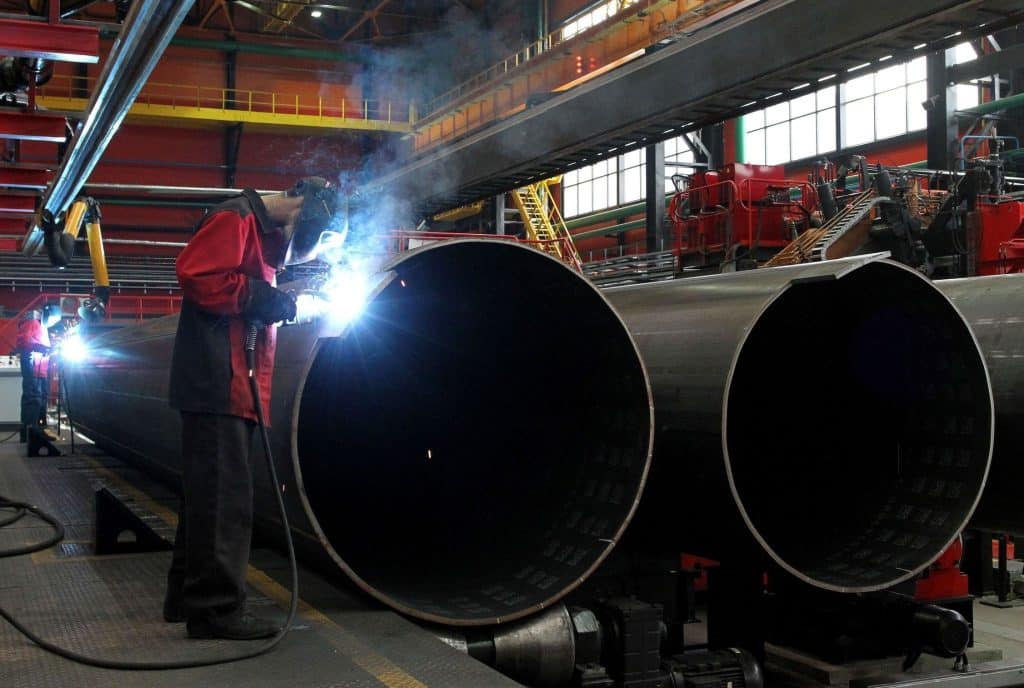
Automatic Submerged Arc Welding (SAW) is central to modern steel pipe manufacturing.
Compared with manual welding:
| Item | Automatic Welding | Manual Welding |
| Weld stability | High | Prone to fluctuation |
| Welding efficiency | High | Relatively low |
| Weld consistency | Excellent | Dependent on operator skill |
| Defect rate | Low | Higher |
| Suitability for mass production | Yes | Limited |
Complying with ASME BPVC Section IX welding procedure qualification, automatic welding ensures precise control of:
- Heat input
- Weld penetration
- Weld profile
This enhances the long-term operational reliability of API 5L-2018line pipes.
The Importance of Automated Inspection Technology
For international buyers, automated production alone is insufficient—a robust automated quality inspection system is essential.
LONGMA operates a comprehensive in-house laboratory with automated inspection equipment to ensure compliance with:
- ASTM A53/A53M-22
- ISO 3183
- EN 10219-2:2019
- AS/NZS 1163:2016
1.Automated Ultrasonic Testing (UT)
Purpose
Detect:
- Cracks
- Delaminations
- Incomplete penetration
- Inclusions
Process
- Automatic surface scanning
- Ultrasonic signal acquisition
- AI-powered defect recognition
- Automated report generation
Standards
Per API 5L PSL2 and ISO 3183:
- 100% UT inspection of welds
- Continuous automatic scanning of pipe bodies
Automated UT drastically reduces the risk of human error.
2.Automated Radiographic Testing (RT)
RT inspection is critical for ASTM A671-2001 and ASTM A672-19projects.
Purpose
Detect internal weld defects:
- Porosity
- Incomplete fusion
- Cracks
Advantages of Digital RT
| Item | Digital RT | Traditional Film RT |
| Imaging speed | Fast | Slow |
| Data storage | Cloud-based | Physical film |
| Defect recognition | AI-assisted | Manual interpretation |
| Inspection efficiency | High | Moderate |
LONGMA has adopted digital RT to improve inspection efficiency for export projects.
3.Automated Hydrostatic Testing System
Most transmission pipes require hydrostatic testing per ASTM A53/A53M-22 and API 5L.
Process
- Automatic end sealing
- Automated pressure buildup
- Automated pressure holding and timing
- Real-time data logging
- Automatic pass/fail determination
Automated hydrostatic testing eliminates manual recording errors and improves reliability.
Smart Manufacturing Is Transforming the Industry
The future of steel pipe manufacturing lies not only in automation but intelligence. Leading manufacturers are deploying:
1.AI-Powered Quality Analysis
Big data analytics identifies patterns in:
- Weld defects
- Raw material variations
- Equipment wear trends
Enabling proactive risk prediction.
2. MES (Manufacturing Execution System)
MES enables:
- Order tracking
- Production scheduling
- Raw material management
- Full quality traceability
A complete traceability system builds buyer confidence for large overseas projects.
3.Smart Warehousing & Automated Logistics
Automated warehousing improves:
- Shipping efficiency
- Inventory accuracy
- Delivery reliability
Critical for large-scale API 5L pipeline projects.
Top Risk Control Concerns for International Buyers
Price is rarely the primary concern for buyers. Key worries include:
- Unstable batch quality
- Weld quality issues
- Unverified inspection data
- Delayed deliveries
- Inadequate after-sales technical support
Thus, automation and in-house laboratory capabilities have become core evaluation criteria.
LONGMA mitigates project risks through:
- Automated production lines
- End-to-end quality traceability
- In-house laboratory testing
- Third-party inspection support (SGS/BV/TUV)
LONGMA’s Vision for Future Smart Manufacturing
With 20+ years of expertise, LONGMA continues to invest in:
- Digital factory construction
- Automatic welding upgrades
- AI defect recognition systems
- Smart inspection laboratories
- Automated warehousing
We strictly adhere to international standards:
- API 5L-2018
- ASTM A691/A691M-19
- EN 10219-2:2019
- ISO 3183
Conclusion
The steel pipe industry is transitioning from traditional manufacturing to smart manufacturing.Automation drives efficiency while defining product stability, safety and global competitiveness.
For global buyers, partnering with a manufacturer with proven automation capabilities, comprehensive inspection systems and strict adherence to international standards directly impacts project quality and long-term operational safety.
With decades of experience, a robust in-house laboratory and continuously upgraded automation, LONGMA delivers higher-quality, more reliable and smarter steel pipe solutions worldwide.