- 1. Why Welding Defects Represent a Major Procurement Risk
- 2. Common Welding Defects in Steel Pipe Production
- 3. How Welding Parameters Affect Weld Quality
- 4. Why Welding Procedure Qualification (WPS/PQR) Matters
- 5. How Non-Destructive Testing Detects Welding Defects
- 6. How Hydrostatic Testing Verifies Weld Integrity
- 7. How LONGMA’s In-House Laboratory Ensures Welding Quality
- 8. Why More Global Customers Choose LONGMA
- 9. Conclusion
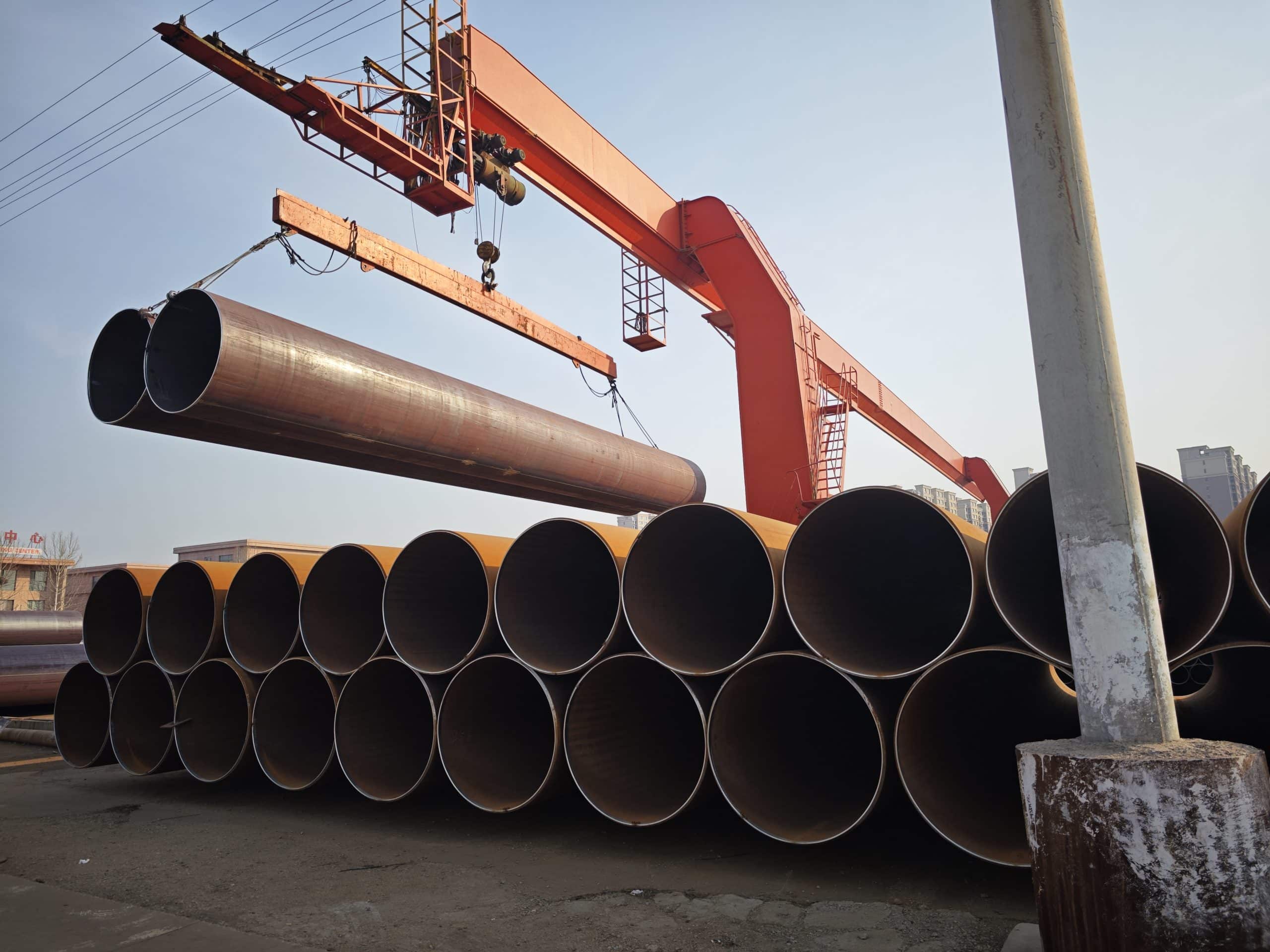
In industries such as oil and gas transmission, offshore engineering, chemical processing, and municipal pipeline construction, welding quality often determines the overall reliability of steel pipes. For international buyers sourcing API 5L steel pipe, LSAW steel pipe, and pipeline steel pipe, the primary concern is rarely the pipe price itself, but whether hidden welding defects may compromise long-term performance.
According to industry experience, a significant percentage of pipeline failures are closely related to welding quality issues. Even when the base steel material fully complies with standards, inadequate welding process control can lead to leakage, cracking, or even catastrophic failures.
As a result, welding defect prevention and control have become critical indicators of a manufacturer’s technical capabilities in modern steel pipe manufacturing.
With more than 20 years of industry experience, LONGMA combines advanced welding equipment, rigorous welding procedure qualification, and a comprehensive in-house laboratory system to achieve complete quality control from welding production to final inspection.
Why Welding Defects Represent a Major Procurement Risk
For long-distance oil and gas pipeline projects, the weld seam is often the most highly stressed area of the pipe structure.
If defects are present, they may result in:
- Pipeline leakage
- Weld cracking
- Reduced pressure-bearing capacity
- Shortened service life
- Project delays and costly claims
Particularly in high-pressure applications, even minor discontinuities can propagate over time and develop into serious failures.
This is why international standards such as API 5L, ISO 3183, and ASME Section IX impose strict requirements on welding quality.
Common Welding Defects in Steel Pipe Production
Different welding processes can produce various types of defects during welded steel pipe manufacturing.
| Defect Type | Primary Cause | Potential Risk |
| Porosity | Trapped gas during solidification | Reduced strength |
| Lack of Fusion | Insufficient heat input | Weld failure |
| Incomplete Penetration | Improper groove design or welding parameters | Reduced pressure resistance |
| Cracks | Stress concentration or rapid cooling | Serious safety hazard |
| Slag Inclusion | Inadequate cleaning between welding passes | Reduced fatigue life |
| Undercut | Improper welding parameters | Stress concentration |
For pipeline steel pipe applications, cracks and incomplete penetration are generally considered the most critical defects.
How Welding Parameters Affect Weld Quality
Many buyers focus on material specifications while overlooking the importance of welding process parameters.
In reality, welding parameters directly determine weld integrity.
1.Welding Heat Input Control
Insufficient heat input may cause:
- Lack of fusion
- Incomplete penetration
Excessive heat input may lead to:
- Grain coarsening
- Reduced toughness in the heat-affected zone (HAZ)
LONGMA utilizes automated welding control systems to continuously monitor:
- Welding current
- Welding voltage
- Welding speed
- Heat input
This ensures that welding operations remain within optimal process windows.
2.Weld Alignment Control
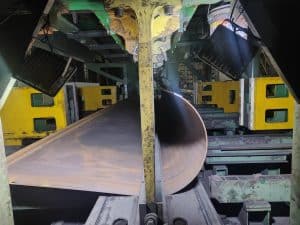
For LSAW steel pipe, alignment accuracy is particularly important.
Excessive misalignment may result in:
- Stress concentration
- Reduced weld strength
- Increased inspection difficulties
LONGMA employs automated alignment systems and laser positioning technology to improve weld seam accuracy and consistency.
Why Welding Procedure Qualification (WPS/PQR) Matters
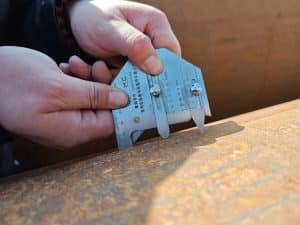
International projects frequently require suppliers to provide:
- Welding Procedure Specification (WPS)
- Procedure Qualification Record (PQR)
The purpose is to verify that the welding process can consistently produce acceptable weld quality.
According to ASME BPVC Section IX, welding procedure qualification typically includes:
- Tensile testing
- Bend testing
- Impact testing
- Macrostructure examination
LONGMA maintains a comprehensive welding procedure database for different steel grades and pipe specifications, ensuring that all critical process parameters are thoroughly validated.
How Non-Destructive Testing Detects Welding Defects
Even the most advanced welding processes must be verified through inspection.
For this reason, LONGMA has established a complete pipe inspection system.
1.Ultrasonic Testing (UT)
Inspection Purpose
UT is used to detect:
- Cracks
- Lack of fusion
- Incomplete penetration
- Laminations
Applicable Standards
Testing is conducted according to:
- API 5L PSL2
- ISO 10893-11
- ASTM E213
LONGMA’s automated UT systems provide 100% online weld inspection.
2.Radiographic Testing (RT)
For high-grade welded steel pipe, RT is one of the most effective methods for evaluating internal weld quality.
Advantages
RT can clearly identify:
- Porosity
- Slag inclusions
- Incomplete penetration
- Internal cracking
Testing is performed in accordance with:
- ISO 10893-7
- ASME Section V
Digital radiographic systems also create permanent image records for full traceability.
3.Magnetic Particle Testing (MT)
For ferromagnetic steel products, MT is primarily used to detect:
- Surface cracks
- Weld toe defects
- Heat-affected zone cracking
Testing is performed according to ASTM E709.
This method offers excellent sensitivity for identifying early-stage surface-breaking defects.
How Hydrostatic Testing Verifies Weld Integrity
Even after passing non-destructive testing, welds must undergo final pressure verification.
Testing Procedure
- Fill the pipe with water.
- Increase pressure to the specified test level.
- Maintain pressure for the required duration.
- Inspect for leakage or failure.
Hydrostatic testing is performed according to API 5L and ASTM A53 requirements.
This remains one of the most important methods for validating the service performance of pipeline steel pipe products.
How LONGMA’s In-House Laboratory Ensures Welding Quality
For international buyers, trust is built not through marketing claims but through verifiable testing capabilities and transparent quality data.
To support this commitment, LONGMA has established a comprehensive in-house laboratory equipped with:
- Ultrasonic Testing Systems (UT)
- Digital Radiographic Testing Systems (RT)
- Metallographic Analysis Equipment
- Optical Emission Spectrometers
- Tensile Testing Machines
- Charpy Impact Testing Machines
The laboratory performs:
- Mechanical property evaluation
- Microstructure analysis
- Weld defect verification
- Welding process optimization research
Every production batch is fully documented, providing complete traceability throughout the manufacturing process.
Why More Global Customers Choose LONGMA
In today’s competitive steel pipe manufacturing industry, customers need more than just a product—they need confidence in long-term quality and reliability.
LONGMA offers:
- More than 20 years of manufacturing experience
- Automated welding production lines
- Comprehensive WPS/PQR management systems
- Advanced non-destructive testing capabilities
- A fully equipped in-house laboratory
These strengths enable LONGMA to consistently supply high-quality API 5L steel pipe, LSAW steel pipe, and pipeline steel pipe products to customers around the world.
Conclusion
In modern steel pipe manufacturing, welding quality directly affects product safety, reliability, and service life. From welding parameter optimization and WPS/PQR qualification to UT, RT, MT, and hydrostatic testing, every stage plays a critical role in minimizing welding defects.
Through advanced manufacturing equipment, a rigorous quality management system, and strong in-house laboratory capabilities, LONGMA continues to provide internationally compliant steel pipe solutions that help customers reduce procurement risks and improve long-term project performance.
For buyers seeking stable supply chains and long-term partnerships, selecting a manufacturer with proven welding expertise and comprehensive inspection capabilities is one of the most effective ways to ensure project success.