- 1. Distinguish Between Material Grades and Product Standards
- 2. How to Select Common Natural Gas Pipeline Steel Grades
- 3. How Should API 5L and ISO 3183 Be Matched?
- 4. PSL1 or PSL2: Which One Is Better for High-Pressure Natural Gas Pipelines?
- 5. Can ASTM A671 and ASTM A672 Be Used for Natural Gas Pipelines?
- 6. How Does the Manufacturing Method Affect Pipeline Performance?
- 7. What Tests Are Required for Natural Gas Pipeline Steel Pipe?
- 8. How Does LONGMA’s In-House Laboratory Improve Buyer Confidence?
- 9. Procurement Checklist for High-Pressure Natural Gas Pipeline Steel Pipe
- 10. FAQ: Common Questions About Natural Gas Pipeline Material Selection
- 11. Conclusion
In long-distance natural gas transmission systems, urban high-pressure gas networks, compressor stations, and LNG-related facilities, steel pipe material selection directly affects design safety, welding performance, operating life, and total project cost. Buyers often encounter terms such as X52, X60, X65, PSL1, PSL2, API 5L, ISO 3183, ASTM A671, and ASTM A672. The main challenge is not a lack of available standards, but the risk of confusing steel grades, product specifications, and service conditions.
Reliable natural gas pipeline material selection should be based on design pressure, operating temperature, pipe diameter, wall thickness, transported medium, fracture toughness, weldability, and inspection level. Choosing a higher-strength or more expensive steel grade does not automatically guarantee a better pipeline solution.
With more than 20 years of manufacturing experience, LONGMA specializes in round ERW and LSAW steel pipes. Based on customer drawings, project specifications, and inspection requirements, LONGMA can help match the correct material grade, manufacturing process, nondestructive testing program, and quality documentation for natural gas pipeline projects.
Distinguish Between Material Grades and Product Standards
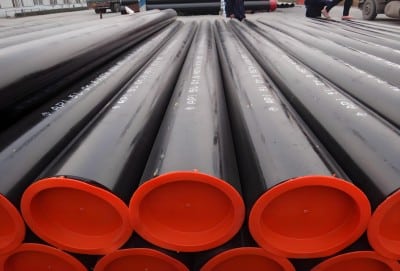
In natural gas pipeline projects, API 5L X52, X60, and X65 generally refer to line pipe steel grades. API 5L and ISO 3183 are finished steel pipe standards, while specifications such as ASTM A516 are commonly used for pressure vessel quality steel plates that may be used to manufacture welded pipes.
A complete purchase specification should clearly define:
- Finished pipe standard
- Steel grade and product specification level
- Manufacturing method
- Outside diameter, wall thickness, and length
- Design pressure and operating temperature
- Impact toughness and NDT requirements
- External coating system
- Required inspection and quality documents
ISO 3183 specifies requirements for seamless and welded steel pipes used in petroleum and natural gas pipeline transportation systems. It includes two product specification levels: PSL1 and PSL2. New projects should always state the exact edition of the applicable standard rather than using vague wording such as “latest edition.”
How to Select Common Natural Gas Pipeline Steel Grades
Grade B, X42, X52, X60, X65, and X70 are commonly specified for natural gas transmission pipelines. The number following the letter X broadly corresponds to the specified minimum yield strength in ksi.
| Common Grade | Strength Characteristics | Typical Application | Selection Considerations |
| Grade B / L245 | Moderate strength and good weldability | Urban gas systems and general pipelines | Suitable for relatively low-pressure or smaller-diameter systems |
| X42 / L290 | Higher strength than Grade B | Branch lines and gas transmission | Good balance between strength and cost |
| X52 / L360 | Widely used in international projects | Medium- and high-pressure natural gas pipelines | Mature welding procedures and broad availability |
| X60 / L415 | Higher strength | Large-diameter and higher-pressure systems | Requires stronger control of toughness and welding |
| X65 / L450 | May help optimize wall thickness | Long-distance and high-pressure pipelines | Higher demands on material consistency and field welding |
| X70 / L485 | High-strength line pipe steel | Major transmission trunk lines | Strict control of carbon equivalent and fracture resistance |
From a B2B procurement perspective, X65 or X70 is not necessarily more suitable than X52 for every project. Higher grades may allow designers to reduce wall thickness or pipe weight, but they can also increase manufacturing difficulty, welding procedure qualification requirements, and field girth-welding risks.
Therefore, the final grade of high-pressure natural gas pipeline steel pipe should be selected according to engineering calculations under the applicable pipeline design code, together with the capabilities of the steel mill and pipe manufacturer.
How Should API 5L and ISO 3183 Be Matched?
API 5L line pipe is one of the most widely used product specifications in the global oil and gas industry. It covers manufacturing methods, chemical composition, mechanical properties, dimensions, testing, marking, and documentation for seamless and welded line pipe.
ISO 3183 is the corresponding international standard for steel pipes used in petroleum and natural gas pipeline transportation systems. It also defines PSL1 and PSL2 requirements.
| Comparison Item | API 5L | ISO 3183 |
| Issuing Organization | American Petroleum Institute | International Organization for Standardization |
| Standard Type | Line pipe product specification | International line pipe standard |
| Product Levels | PSL1 and PSL2 | PSL1 and PSL2 |
| Product Scope | Seamless, HFW/ERW, SAW, and other line pipe | Seamless and welded steel pipe |
| Common Use | Oil and gas projects worldwide | International and cross-border pipeline projects |
| Procurement Focus | Edition, grade, PSL, and annex requirements | Edition and relationship with API requirements |
Some projects require compliance with both API 5L and ISO 3183. In such cases, the manufacturer should not simply list both standards on the Material Test Certificate. Chemical composition, tensile properties, impact requirements, dimensional tolerances, NDT scope, marking, and documentation must be reviewed to confirm that the pipe satisfies both specifications.
PSL1 or PSL2: Which One Is Better for High-Pressure Natural Gas Pipelines?
PSL1 provides basic line pipe requirements, while PSL2 generally includes stricter controls over chemical composition, mechanical properties, toughness, manufacturing consistency, testing, and traceability.
| Item | PSL1 | PSL2 |
| Chemical Composition | Basic limits | Stricter composition control |
| Carbon Equivalent | Standard requirements | Greater emphasis on weldability |
| Impact Toughness | Depends on grade or contract | Commonly required for critical projects |
| Nondestructive Testing | According to standard and order | Usually more comprehensive |
| Traceability | Basic batch traceability | More detailed production traceability |
| Typical Application | General transmission service | High-pressure, low-temperature, or critical gas pipelines |
For high-pressure systems, low-temperature regions, densely populated areas, or long-distance transmission lines, project owners often prefer PSL2. However, PSL2 should not be treated as a complete technical specification by itself. Purchase orders should also define impact test temperature, required absorbed energy, NDT scope, pipe-end tolerances, and supplementary requirements.
Can ASTM A671 and ASTM A672 Be Used for Natural Gas Pipelines?
ASTM A671 and ASTM A672 both cover electric-fusion-welded steel pipes manufactured from pressure vessel quality plate with filler metal. Their primary difference lies in the intended service temperature.
ASTM A671 is generally used for atmospheric and lower-temperature service, while ASTM A672 is intended for high-pressure service at moderate temperatures.
| Standard | Main Positioning | Typical Natural Gas Application |
| API 5L | Oil and gas line pipe specification | Long-distance natural gas transmission lines |
| ISO 3183 | International pipeline transportation standard | International gas and energy projects |
| ASTM A671 | EFW pipe for atmospheric and lower-temperature service | Low-temperature station piping and LNG-related facilities |
| ASTM A672 | EFW pipe for high-pressure service at moderate temperatures | Compressor stations, process gas systems, and plant piping |
ASTM A672 covers electric-fusion-welded pipe made from pressure vessel quality plate with filler metal. Heat treatment requirements depend on the selected grade, class, mechanical properties, and applicable design code.
An important procurement principle is that API 5L or ISO 3183 is generally preferred for long-distance natural gas transmission pipelines. ASTM A671 or ASTM A672 should only be used where permitted by the project specification and applicable piping design code. The phrase “high-pressure service” in a standard title does not automatically make that standard interchangeable with a line pipe specification.
How Does the Manufacturing Method Affect Pipeline Performance?
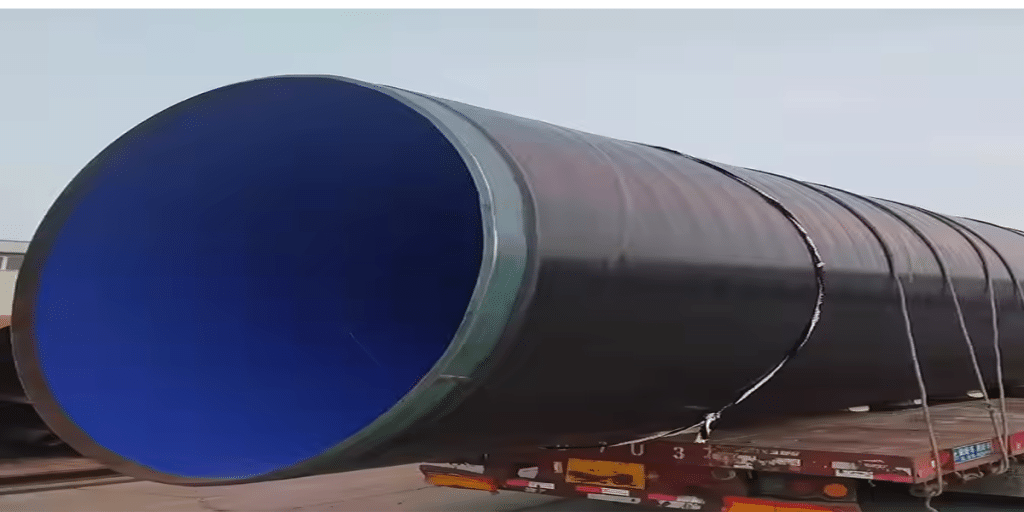
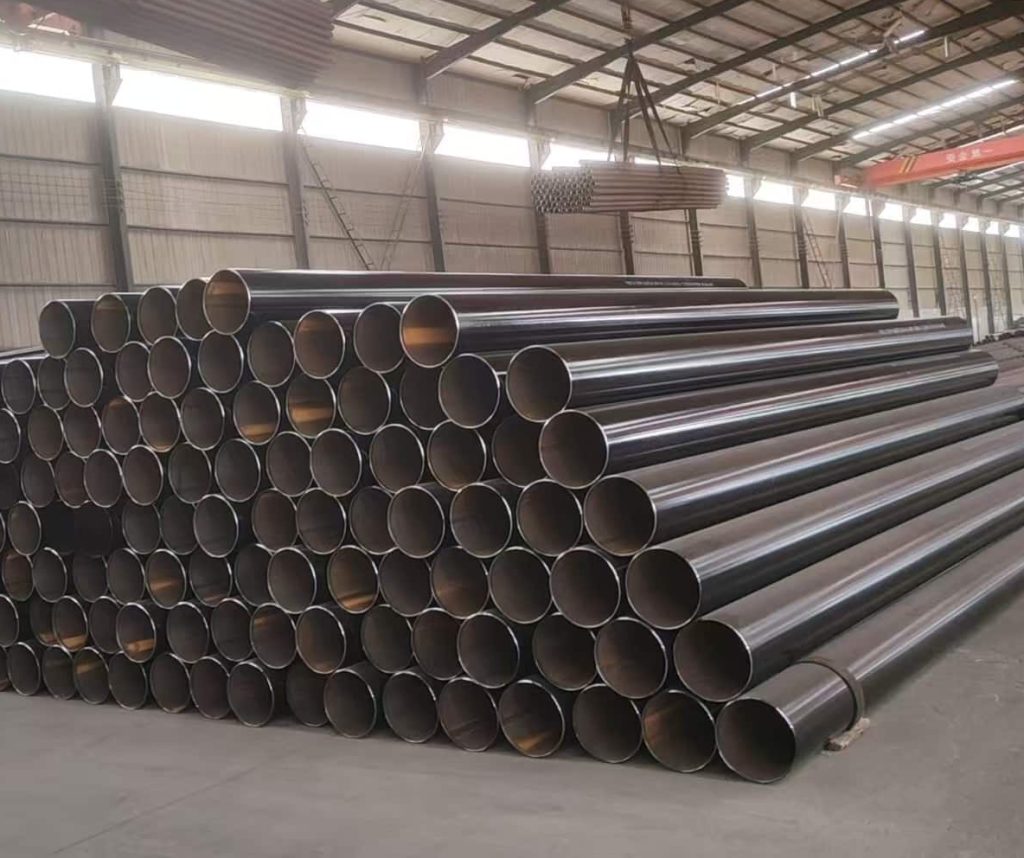
LONGMA focuses on round ERW and LSAW steel pipes. Each process is suited to different size ranges and project requirements.
| Manufacturing Method | Main Characteristics | Typical Application |
| ERW/HFW | High production efficiency and good dimensional consistency | Small- and medium-diameter natural gas pipelines |
| LSAW | Suitable for large diameter, heavy wall, and high-strength steel | High-pressure transmission lines and station piping |
| Seamless | No longitudinal weld seam, but size range may be more limited | Small-diameter high-pressure connections and special locations |
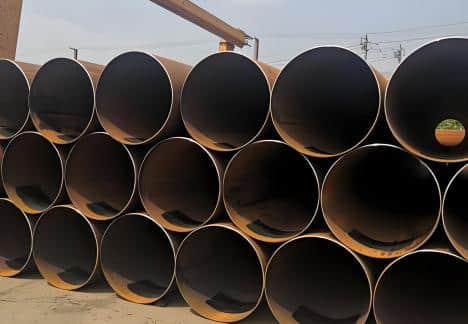
For large-diameter high-pressure natural gas pipeline steel pipe, LSAW production commonly uses wide steel plate formed through JCOE or similar processes, followed by internal and external submerged arc welding.
The presence of a longitudinal weld is not, by itself, a safety disadvantage. Pipeline reliability depends on base material quality, welding procedure qualification, weld geometry, NDT coverage, hydrostatic testing, and compliance with the project specification.
What Tests Are Required for Natural Gas Pipeline Steel Pipe?
Natural gas is flammable and can escape through very small defects. Quality control must therefore go far beyond visual inspection.
| Inspection Method | Main Purpose | Basic Procedure | Procurement Value |
| Chemical Analysis | Verify grade and weldability | Sample, spectrometer analysis, compare with heat number and MTC | Prevents material mix-ups |
| Tensile Test | Verify yield strength, tensile strength, and elongation | Prepare specimen, test, record, and evaluate | Confirms material strength |
| Charpy Impact Test | Assess low-temperature fracture toughness | Test specimens at specified temperature | Reduces brittle fracture risk |
| Drop-Weight Tear Test | Evaluate ductile fracture behavior in selected large-diameter line pipe | Prepare specimen, impact test, assess shear area | Supports fracture-control design |
| Ultrasonic Testing | Detect internal discontinuities in body and weld | Calibrate, scan, record, and evaluate | Detects cracks and lack of fusion |
| Radiographic Testing | Identify volumetric weld defects | Radiographic exposure, image review, and reporting | Detects porosity and slag inclusions |
| Hydrostatic Testing | Verify pressure integrity and leak tightness | Fill, vent, pressurize, hold, and inspect | Reduces leakage risk |
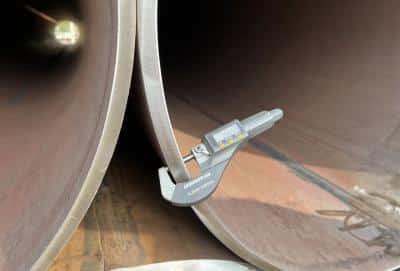
| Dimensional Inspection | Confirm OD, wall thickness, ovality, and straightness | Multi-point measurement and recording | Ensures installation compatibility |
Inspection standards and acceptance criteria should always follow the specified edition of API 5L, ISO 3183, and the project technical specification. A general NDT standard should not be applied mechanically to every order without considering the actual product standard and acceptance level.
How Does LONGMA’s In-House Laboratory Improve Buyer Confidence?
For international buyers, certificates may demonstrate system approval, but actual test records demonstrate the quality of a specific production batch.
LONGMA can establish a complete quality control chain from steel plate or coil to finished pipe, including:
- Raw material heat number and MTC verification
- Chemical composition and mechanical property testing
- Forming, welding, and expansion parameter records
- UT, RT, and other specified NDT
- Hydrostatic testing and dimensional inspection
- Pipe marking, batch identification, and document traceability
- Third-party inspection support from SGS, BV, TÜV, or DNV
Buyers should review laboratory equipment capability, calibration status, inspector qualifications, original test records, and whether each report can be traced back to the physical pipe. Equipment photographs alone are not sufficient evidence of reliable quality control.
Procurement Checklist for High-Pressure Natural Gas Pipeline Steel Pipe
| Procurement Item | Information to Specify |
| Service Conditions | Design pressure, design temperature, and gas composition |
| Product Standard | API 5L or ISO 3183, including edition |
| Steel Grade | Grade B, X42, X52, X60, X65, or other grade |
| Product Level | PSL1 or PSL2 |
| Manufacturing Method | ERW/HFW or LSAW |
| Dimensions | Outside diameter, wall thickness, length, and end tolerances |
| Toughness Requirements | Impact temperature, absorbed energy, and DWTT requirements |
| Inspection | UT, RT, hydrostatic testing, and supplementary tests |
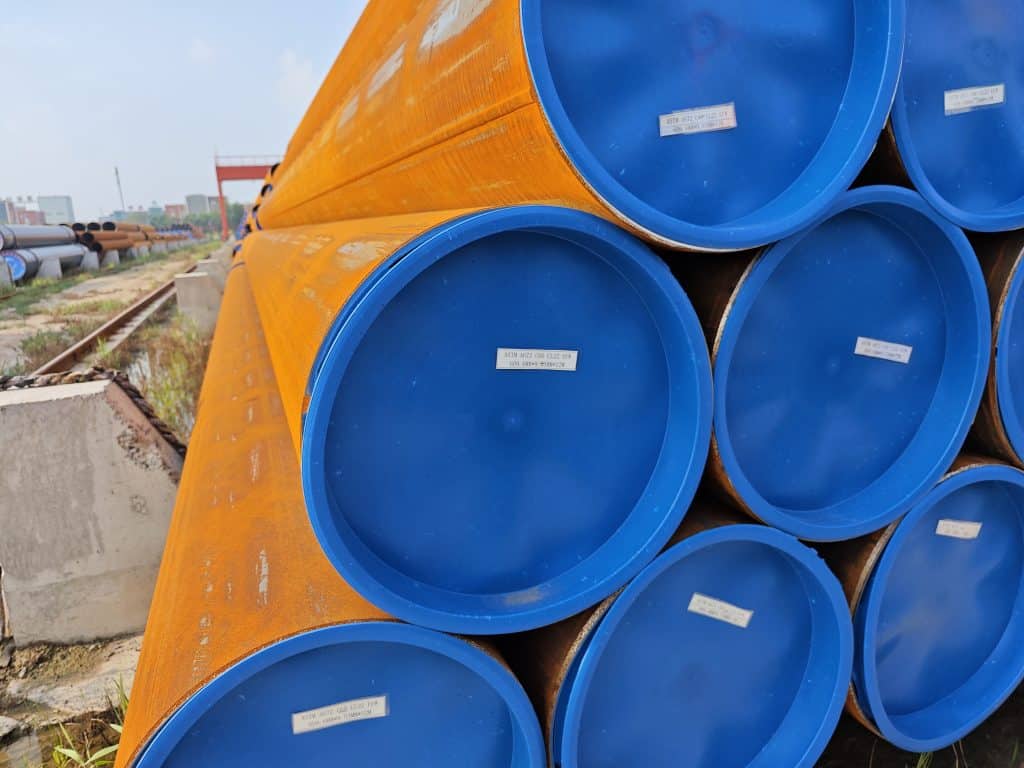
| Coating | FBE, 3LPE, 3PP, or project-specific coating |
| Documentation | MTC, NDT reports, hydrostatic records, and third-party certificates |
FAQ: Common Questions About Natural Gas Pipeline Material Selection
- Is X52 or X65 Better for Natural Gas Pipelines?
There is no universal answer. X65 offers higher strength and may help optimize wall thickness, but it also requires stricter control of weldability, toughness, and construction procedures. X52 may be more economical for medium-pressure systems or projects where supply availability and welding simplicity are priorities. X60 or X65 may be evaluated for long-distance, large-diameter, and higher-pressure pipelines.
- Can API 5L and ISO 3183 Be Used Interchangeably?
The two standards are closely harmonized, but they should not automatically be treated as identical. The exact editions, annexes, supplementary requirements, and project-specific conditions must be reviewed before dual certification is claimed.
- Is PSL2 Mandatory for Natural Gas Pipelines?
PSL2 is not mandatory for every natural gas pipeline. However, it is commonly specified for high-pressure, low-temperature, long-distance, or safety-critical transmission systems because of its stricter requirements for toughness, testing, and traceability. The final decision should be made by the project designer.
- Is LSAW Pipe Suitable for High-Pressure Natural Gas Transmission?
Yes. LSAW pipe is widely used for large-diameter, heavy-wall, and high-strength pipeline systems. Its suitability depends on compliance with the specified material requirements, welding procedures, NDT program, hydrostatic test, and dimensional tolerances.
- How Can Buyers Evaluate a Natural Gas Steel Pipe Supplier?
Buyers should review the manufacturer’s production range, standard certifications, raw material controls, WPS and PQR documentation, in-house laboratory capability, NDT personnel qualifications, test reports, traceability system, and third-party inspection experience. A low price cannot replace verifiable quality evidence.
Conclusion
Effective natural gas pipeline material selection is not simply a comparison between X52 and X65, nor is it only a choice between API 5L and ISO 3183. The correct solution must match steel grade, PSL level, manufacturing process, design conditions, fracture toughness, inspection scope, coating system, and documentation requirements.
For international gas transmission projects, reliable API 5L line pipe or ISO 3183 line pipe must be supported by controlled manufacturing, complete inspection, and verifiable traceability.
LONGMA specializes in round ERW and LSAW steel pipe manufacturing and can provide material review, production control, in-house testing, third-party inspection coordination, and export documentation support according to project specifications.
For a more accurate technical proposal and quotation, buyers can provide LONGMA with the required standard, grade, outside diameter, wall thickness, length, PSL level, coating requirement, and operating conditions. LONGMA’s technical team can then recommend a suitable material and quality control solution for the project.