- 1. Can ASTM and ISO Standards Be Directly Interchanged?
- 2. Main Differences Between ASTM and ISO Standards
- 3. How Does LONGMA Build a Dual-Standard Performance Matrix?
- 4. How Does LONGMA’s Internal Laboratory Demonstrate Standard Compliance?
- 5. Common Risks in International Steel Pipe Procurement
- 6. Why Choose LONGMA?
- 7. Conclusion
In international steel pipe procurement, customers often require products that comply with both ASTM standards and ISO project specifications. However, ASTM and ISO standards are not simply interchangeable through direct grade conversion.
The two systems differ in their application scope, material classification, manufacturing requirements, dimensional control, impact toughness requirements, and documentation procedures.
A truly reliable approach is not simply printing two standards on a steel pipe certificate. Instead, manufacturers need to establish a verifiable performance matrix during the contract review stage.
With more than 20 years of manufacturing experience, LONGMA specializes in producing round ERW steel pipes and LSAW steel pipes. Through raw material verification, manufacturing process control, internal laboratory testing, and complete traceability systems, LONGMA helps customers achieve compliance with both ASTM and ISO requirements while reducing technical discrepancies and acceptance risks in international projects.
Can ASTM and ISO Standards Be Directly Interchanged?
Generally, the answer is no.
ASTM standards are usually developed for specific products and service conditions.
For example:
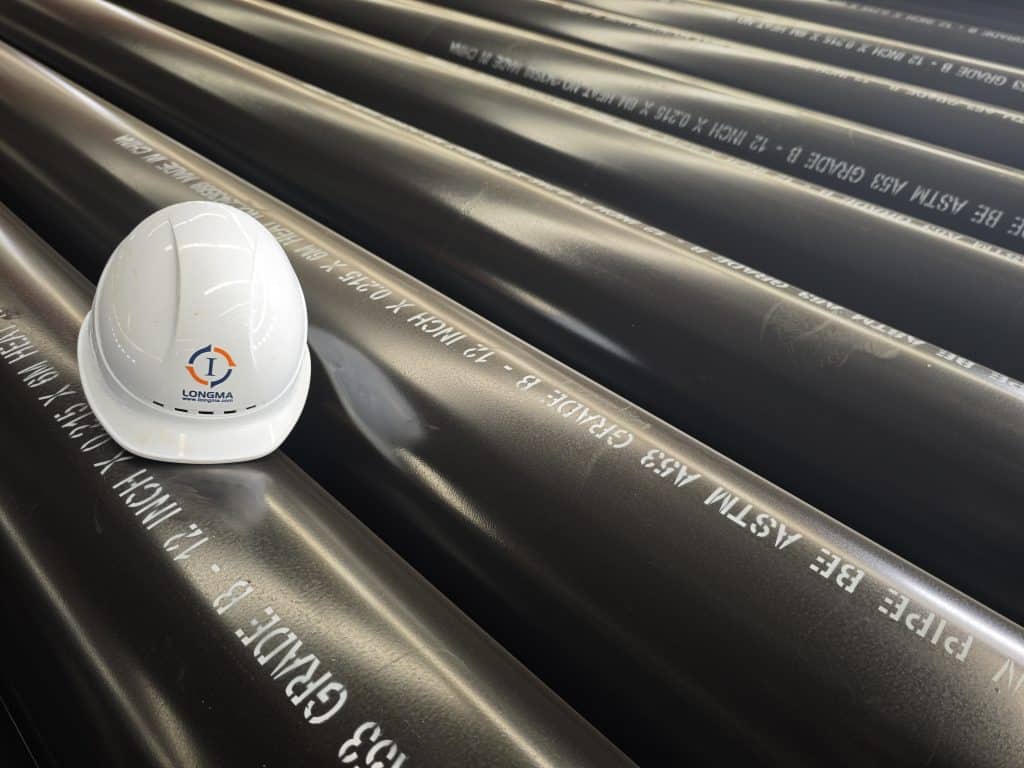
- ASTM A53/A53M-24covers welded and seamless black steel pipe and hot-dipped galvanized steel pipe from NPS 1/8 through NPS 26.
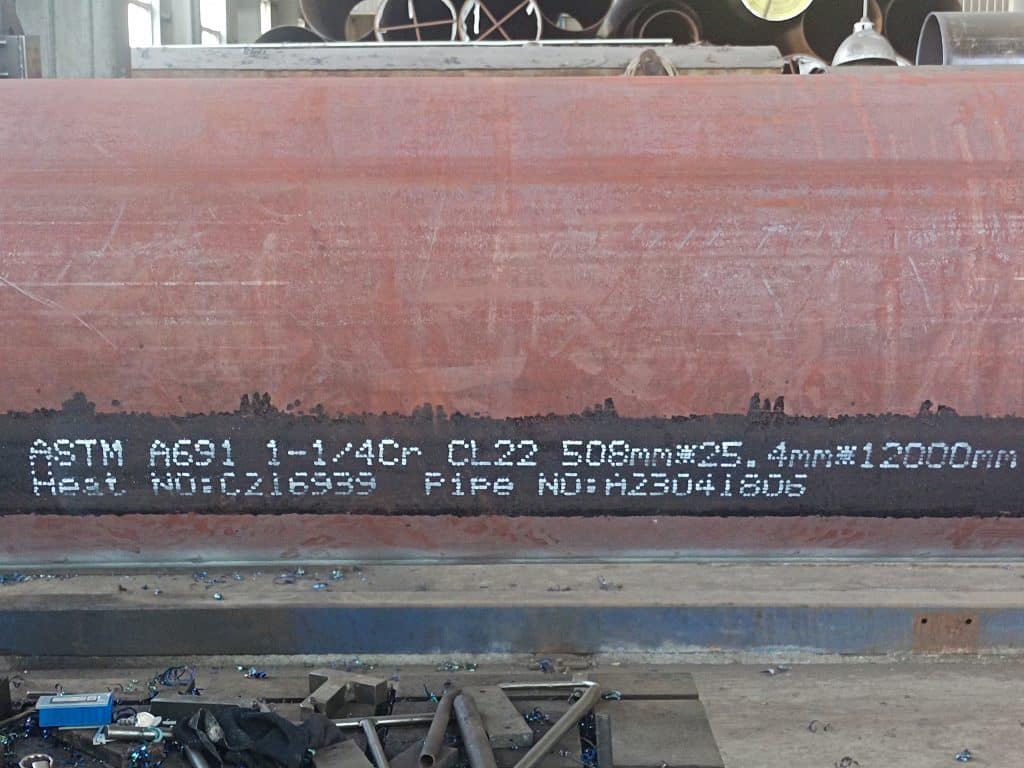
- ASTM A671applies to electric-fusion-welded steel pipe designed for atmospheric and lower-temperature service.
- ASTM A672covers electric-fusion-welded steel pipe for moderate-temperature and high-pressure applications.
Both ASTM A671 and ASTM A672 are based on pressure-vessel-quality steel plates. In these standards:
- Gradeidentifies the steel plate category;
- Classrelates to manufacturing conditions, heat treatment, and inspection requirements.
By contrast, ISO 3183:2019 specifically defines requirements for seamless and welded steel pipes used in petroleum and natural gas pipeline transportation systems. It establishes two Product Specification Levels:
- PSL1
- PSL2
ISO 3183:2019 supplements the requirements of API 5L 46th Edition and does not apply to cast pipe.
Therefore, when purchasing ASTM steel pipe, customers cannot automatically consider it equivalent to ISO 3183 steel pipe simply because the tensile strength values appear similar.
The key to achieving compliance between standards is comparing the final performance requirements rather than searching for superficially similar material grades.
Main Differences Between ASTM and ISO Standards
| Comparison Item | ASTM System | ISO 3183 System | LONGMA Control Focus |
| Standard Purpose | Classified according to specific products and service conditions | Designed for petroleum and natural gas pipeline transportation systems | Confirm actual application conditions first |
| Grade Identification | Combination of Grade, Type, and Class | Steel grade combined with PSL level | Establish a project technical matrix |
| Manufacturing Method | ERW, EFW, or seamless depending on specific standards | Qualified seamless and welded manufacturing processes | Verify manufacturing limitations |
| Toughness Requirements | Determined by standard, grade, and additional requirements | PSL2 generally places stronger emphasis on toughness and traceability | Confirm impact test temperature in advance |
| Documentation Requirements | MTC and purchaser-specified supplementary requirements | Emphasizes PSL level, inspection, and traceability | Link heat number, pipe number, and inspection reports |
This comparison shows that ASTM and ISO are not simply a matter of “which standard is stricter.”
For general pressure service and mechanical applications, ASTM A53 steel pipe may be an appropriate choice.
However, for long-distance oil and gas transmission pipelines, customers should generally follow ISO 3183, API 5L, or the project-specific pipeline specification.
How Does LONGMA Build a Dual-Standard Performance Matrix?
1. Define the Primary Standard First Instead of Requesting an Unclear “Dual Certification”
For every order, the primary standard should be clearly identified first, such as:
- ASTM A53
- ASTM A671
- ASTM A672
- ISO 3183
The requirements from the secondary standard should then be converted into additional technical specifications.
During contract review, LONGMA focuses on confirming:
- Standard number and edition;
- Steel grade, Grade, Class, or PSL level;
- ERW or LSAW manufacturing process;
- Outside diameter, wall thickness, length, and pipe-end configuration;
- Chemical composition and carbon equivalent;
- Tensile, impact, and hardness requirements;
- UT, RT, hydrostatic testing, and third-party inspection scope;
- EN 10204 3.1 certificates or project-specific documentation.
This approach prevents a common industry problem:
The quotation complies with one standard, but the final acceptance inspection is performed according to another standard.
2. Control Raw Materials According to the More Stringent Overlapping Requirements
When meeting both ASTM and ISO requirements, it is not enough to compare only the minimum yield strength.
The chemical composition, carbon equivalent, delivery condition, and impact toughness of steel plates or steel strips are equally important.
For example, two material grades may have similar strength levels, but differences in carbon, manganese, and microalloying element design can influence:
- Welding heat input;
- Preheating temperature;
- Heat-affected zone performance;
- Weldability;
- Long-term service reliability.
Therefore, LONGMA reviews steel plate or steel strip material certificates according to customer requirements and verifies heat-specific chemical composition through internal laboratory optical emission analysis.
Only when the actual inspection results satisfy both the primary standard and confirmed supplementary requirements will the raw materials enter the production process.
This approach helps prevent a common procurement problem:
The material meets the basic standard but fails to satisfy project-specific technical requirements.
3. Control ERW and LSAW Manufacturing Processes Separately
Different manufacturing methods require different quality control strategies.
ERW Steel Pipe Manufacturing Control
For ERW steel pipes, key control points include:
- Steel strip edge condition;
- Forming stability;
- High-frequency welding heat input;
- Squeeze pressure;
- Weld seam heat treatment;
- Online nondestructive testing.
Stable control of these parameters ensures consistent weld quality and dimensional accuracy.
LSAW Steel Pipe Manufacturing Control
For LSAW steel pipes, the main control points include:
- Steel plate forming;
- Edge preparation and bevel machining;
- Internal and external submerged arc welding parameters;
- Weld bead formation;
- Expansion process;
- Full-length weld inspection.
A professional welded steel pipe manufacturer does not apply one universal quality-control system to every product.
Instead, inspection plans and manufacturing procedures are developed according to:
- Applicable standards;
- Steel grade;
- Wall thickness;
- Pipe manufacturing method;
- Final service conditions.
How Does LONGMA’s Internal Laboratory Demonstrate Standard Compliance?
Simply stating that “quality is stable” is not enough to eliminate procurement risks.
Customers need measurable data that can be:
- Verified;
- Traced;
- Re-tested when necessary.
LONGMA’s internal laboratory provides objective evidence of product compliance through systematic inspection and testing.
1.Chemical Composition Analysis
Purpose
To verify whether carbon, manganese, phosphorus, sulfur, and alloying elements comply with purchase requirements.
Procedure
- Verify the heat number;
- Prepare test samples;
- Perform optical emission spectroscopy analysis;
- Review results;
- Record data into the traceability system.
Standard Focus
ASTM A53 publicly defines the product scope in Clause 1.1 and requires products to comply with applicable material and manufacturing conditions.
The public descriptions of ASTM A671 and ASTM A672 also emphasize the relationship between pressure-vessel-quality steel plates, Grade designation, and Class requirements.
For international projects, material verification should not rely only on supplier declarations. Heat-specific chemical analysis provides stronger evidence of compliance.
2.Tensile Testing
Purpose
To verify:
- Yield strength;
- Tensile strength;
Procedure
- Select samples according to the specified batch and sampling location;
- Machine test specimens;
- Perform tensile testing;
- Record fracture location and test results.
Procurement Value
Tensile testing prevents customers from judging finished steel pipe performance only based on raw material certificates.
A qualified steel pipe supplier should verify that the finished product—not only the original steel plate or coil—meets the required mechanical properties.
3.Charpy Impact Testing
Purpose
To evaluate the ability of:
- Base metal;
- Weld metal;
- Heat-affected zone;
to resist brittle fracture at the specified temperature.
Procedure
- Confirm specimen location and notch orientation;
- Condition specimens to the required temperature;
- Perform impact testing;
- Record individual and average absorbed energy values.
For ISO 3183 steel pipe projects, customers must clearly define whether PSL1 or PSL2 is required because ISO 3183:2019 establishes these two Product Specification Levels.
Compared with PSL1, PSL2 generally places greater emphasis on:
- Chemical composition control;
- Carbon equivalent;
- Impact toughness;
- Traceability;
- Nondestructive testing.
4.Nondestructive Testing and Hydrostatic Testing
Reliable steel pipe quality requires more than visual inspection.
LONGMA applies appropriate nondestructive testing methods according to project requirements.
| Inspection Method | Main Purpose | Procedure Steps | Defects or Conditions Identified |
| UT (Ultrasonic Testing) | Detect internal weld defects | Calibration, scanning, positioning, evaluation, and recording | Cracks, lack of fusion, inclusions |
| RT (Radiographic Testing) | Obtain internal weld images | Setup, exposure, imaging, and interpretation | Porosity, slag inclusion, incomplete penetration |
| MT (Magnetic Particle Testing) | Detect surface and near-surface defects | Magnetization, magnetic particle application, and indication evaluation | Weld toe cracks, surface cracks |
| Hydrostatic Testing | Verify pressure integrity of pipe body and weld seam | Water filling, air removal, pressurization, holding, and recording | Leakage and abnormal deformation |
Nondestructive testing cannot replace hydrostatic testing, and hydrostatic testing cannot replace UT or RT.
These inspection methods serve different purposes:
- UT and RT identify discontinuities within materials and welds;
- Hydrostatic testing verifies the pressure-bearing capability of the finished pipe.
Combining these methods provides stronger confidence in pipeline reliability.
Common Risks in International Steel Pipe Procurement
The biggest challenge for buyers is often not obviously defective products, but products that are only partially compliant.
Typical examples include:
- Steel pipe meets ASTM chemical composition requirements but fails the impact temperature requirements specified by an ISO project;
- Product reaches the target strength level but lacks the traceability documentation required for PSL2;
- Manufacturer provides MTC documents but cannot link inspection records to specific heat numbers and pipe numbers.
To reduce these risks, when purchasing ASTM steel pipe or ISO steel pipe, buyers should provide the following information during the inquiry stage:
- Applicable standard and edition;
- Steel grade, Class, or PSL level;
- Design pressure and service temperature;
- Impact testing requirements;
- NDT percentage and acceptance criteria;
- Third-party inspection points;
- Documentation and marking requirements.
Do not wait until production is completed before requesting dual-standard performance requirements or additional inspection items.
Why Choose LONGMA?
LONGMA has more than 20 years of experience in welded steel pipe manufacturing and specializes in producing round ERW steel pipes and LSAW steel pipes.
As an experienced welded steel pipe manufacturer, LONGMA develops production and inspection plans according to:
- ASTM standards;
- ISO 3183 requirements;
- Customer project specifications.
Instead of simply copying general manufacturing parameters, LONGMA evaluates each project based on the actual technical requirements, service conditions, and acceptance criteria.
LONGMA’s Key Advantages Include:
Complete Material Traceability
LONGMA maintains full traceability from:
- Raw material heat numbers;
- Production batches;
- Finished pipe identification numbers.
This ensures that every pipe can be linked back to its original material source and inspection records.
Comprehensive Laboratory Testing Capability
LONGMA’s internal laboratory supports:
- Chemical composition analysis;
- Tensile testing;
- Charpy impact testing;
- Hardness testing;
- Hydrostatic testing.
These tests provide objective evidence that products meet specified mechanical and performance requirements.
Complete Nondestructive Testing Support
According to project requirements, LONGMA can provide:
- UT (Ultrasonic Testing);
- RT (Radiographic Testing);
- MT (Magnetic Particle Testing);
- PT (Liquid Penetrant Testing).
These inspection methods help identify weld defects and ensure long-term pipeline reliability.
ERW and LSAW Welding Process Control
For ERW steel pipes, LONGMA controls:
- High-frequency welding parameters;
- Heat input;
- Squeeze pressure;
- Weld seam heat treatment;
- Online inspection.
For LSAW steel pipes, LONGMA controls:
- Plate forming;
- Welding parameters;
- Internal and external weld quality;
- Expansion process;
- Full-length weld inspection.
Project Documentation Support
LONGMA supports:
- EN 10204 3.1 certificates;
- Third-party inspection;
- Customer-specific quality documentation;
- Project traceability requirements.
Before production begins, LONGMA reviews standard differences and additional technical requirements to reduce risks caused by incomplete specifications or late-stage changes.
For projects requiring ISO 3183 steel pipe for oil and gas transportation, LONGMA focuses on:
- PSL level confirmation;
- Steel grade selection;
- Impact toughness requirements;
- NDT scope;
- Traceability requirements.
For projects requiring:
- ASTM A53 steel pipe;
- ASTM A671 steel pipe;
- ASTM A672 steel pipe;
LONGMA organizes manufacturing and inspection according to the specific application, Grade, and Class requirements.
Conclusion
LONGMA’s approach to meeting both ASTM and ISO standard requirements is not simply printing two standard numbers on a certificate.
Instead, LONGMA creates a complete compliance system by connecting:
- Material requirements;
- Mechanical properties;
- Toughness performance;
- Dimensional accuracy;
- Weld quality;
- Inspection procedures;
- Documentation control.
Through internal laboratory verification and systematic quality management, LONGMA provides measurable evidence of product compliance.
For customers requiring ASTM steel pipe for general pressure applications or ISO 3183 steel pipe for petroleum and natural gas transportation projects, complete technical requirements are far more valuable than unclear “dual-standard” requests.
A successful international steel pipe procurement process should define all critical requirements before production begins.
When submitting an inquiry, customers are encouraged to provide:
- Applicable standard and edition;
- Steel grade;
- Outside diameter;
- Wall thickness;
- Quantity;
- Service temperature;
- PSL level;
- Inspection scope;
- Destination port.
Based on this information, LONGMA can provide:
- Manufacturing feasibility analysis;
- Quality control plan;
- Production schedule;
- Technical proposal;
- Commercial quotation.
With professional manufacturing experience and a complete quality assurance system, LONGMA helps customers reduce acceptance risks and improve reliability throughout the entire project lifecycle.